Seeking out and planning an “establishing shot”
When I learned I’d be going to Córdoba, Spain, I started doing some research, looking for potential photo locations. I’m always on the hunt for those iconic “portrait” shots of places. By that, I mean a single image of a place that is recognizable and sums up the location in one frame. Back in the day we might have called this an “establishing shot” – one that gives you a lot of information about a location.
In terms of a stock photo library, it’s a shot you want in your files for those publishers looking for a single image that conveys what makes a place special. Think of all the “listicle” stories that you see now — Top Five Places to Retire, Ten Well-Preserved Medieval Cities, etc. These stories will generally only use one photo per list item so it needs to say a lot in one frame. Ideally it might give you a sense of the architecture (style, era, the color of the building materials), the surroundings (mountains in the distance, river running through) and maybe even a hint of the climate (palm trees, snow on the ground, and so on).
In looking at lots of images of Córdoba, the interior of the Mezquita — the enormous mosque-turned-cathedral with red and white striped arches —seemed like a popular and defining shot for the city. I definitely wanted to try my hand at a few of those images, but they were a little too focused on one aspect of the city for me. Only one building, although a very important building in relating the cultural history of the city.
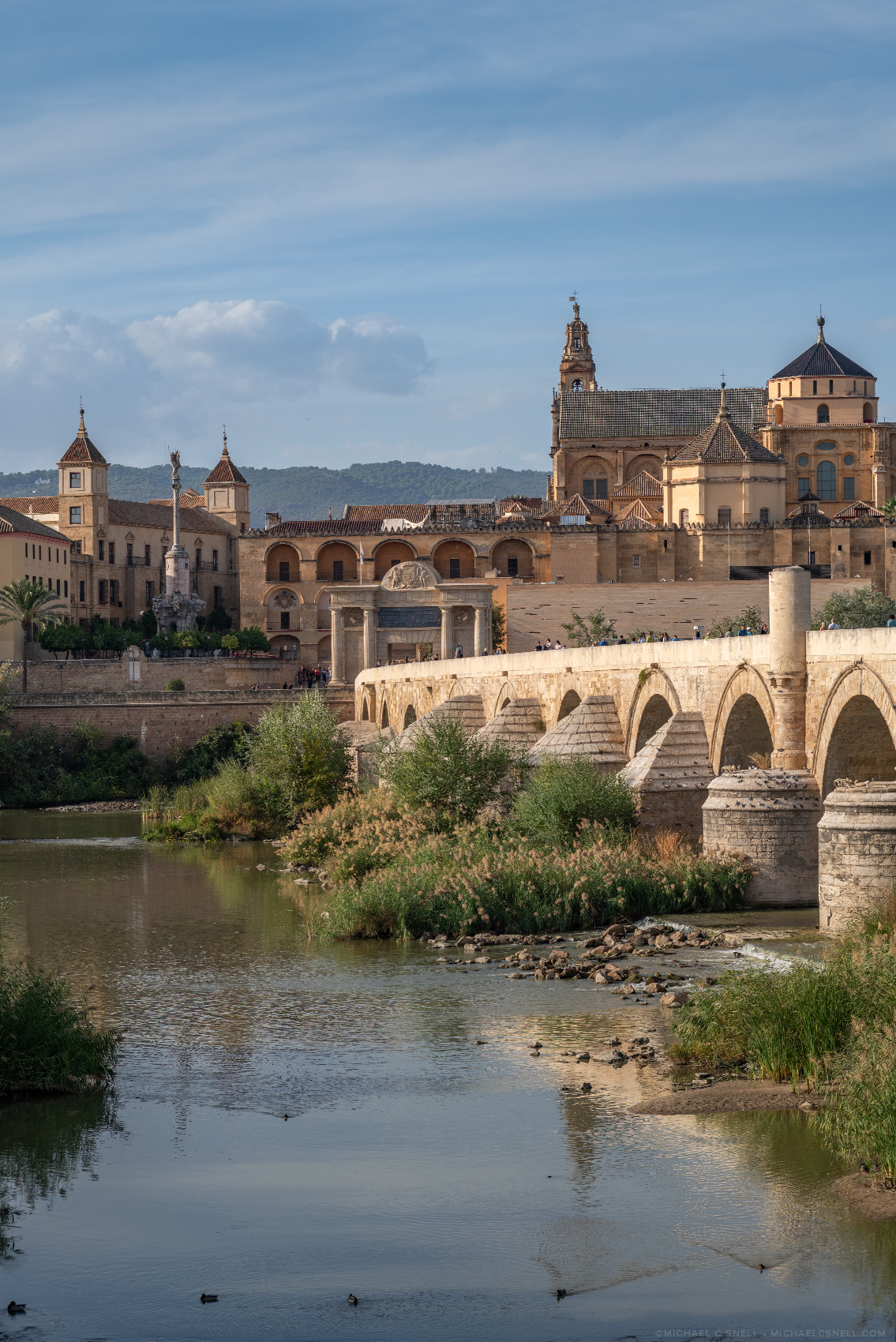
This image shows my first attempt at locating the area I intended to shoot. An afternoon scouting shot made with an 85mm lens.
I also wanted to find a view that provided some of those other clues about the place: architecture, setting, etc. I ran across several photos of the city taken from across the river with a Roman bridge in the foreground. That could work.
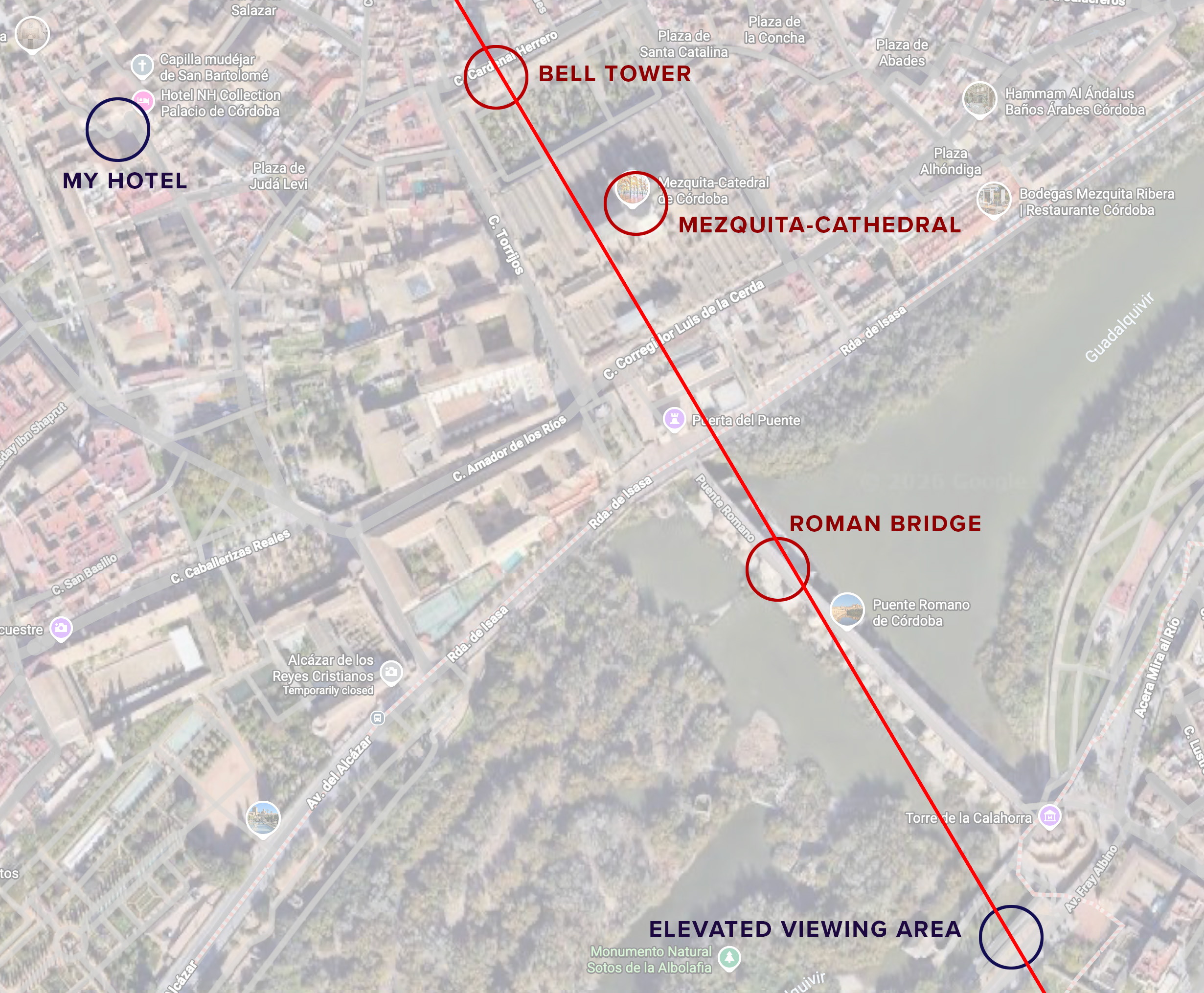
Using Google Maps, I located the landmarks I could see in these photos to try and triangulate where had been taken. This map shows the location of the various elements I was tracking: The Mezquita-Cathedral, the Mezquita Bell Tower (which, from the angle, looks like a tower connected to the cathedral itself but is actually across a walled garden from the cathedral section of the Mezquita) and the Roman bridge. Adding a line to see where these elements aligned from the opposite side of the river, it led me to the top level of a ramped walkway that leads down to the riverside, just west of the bridge tower.
I’ve also marked my hotel (see my last post) on this map, showing just how close all of these elements were. Thankfully it would be easy for me to run back over to the far side of the bridge to try the shot in different lighting situations. It was a half-mile walk to get from my room to the overlook.
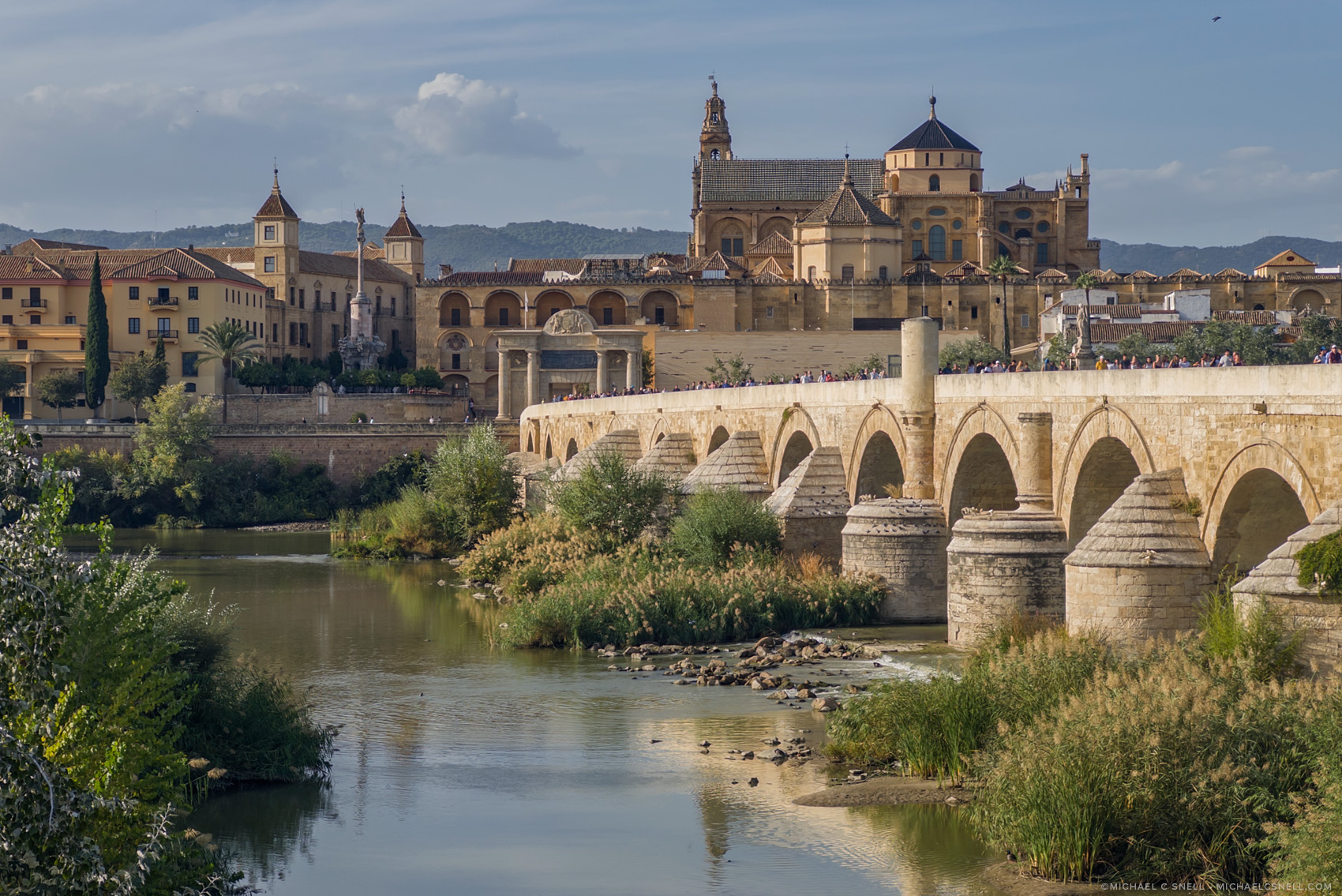
Another scouting shot taken with my phone. I’m actually quite happy with the light in these scouting shots. By the time I would come back for twilight the sun had become filtered by clouds so there wasn’t as much light hitting the bridge or shaping the cathedral.
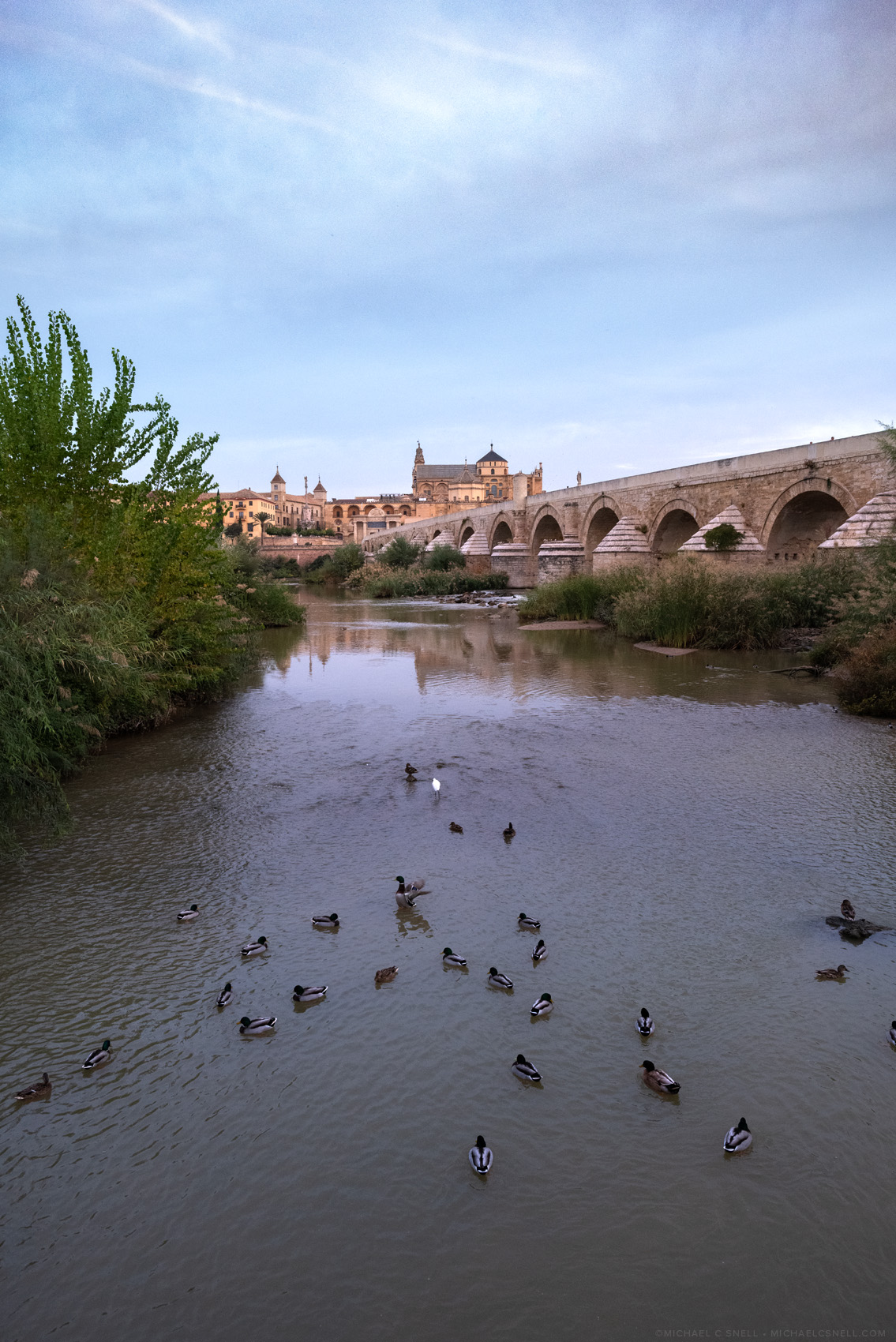
The first thing I did on the day I arrived was to throw an 85mm lens on my Nikon D850 and walk over to scout my presumed photo location. From the images I’d seen online, I’d guessed that a short telephoto (somewhere around 70-90mm) would be what I would need so I thought I’d travel light on this scouting run to see if the 85 was sufficient. If it proved a bit too long or not long enough, I’d return with my 70-200mm zoom back for twilight. As it turned out, the 85 was just about perfect, but I did shoot some wider shots on my phone as well, just to test some options. The vertical at the top of this post is from the 85mm lens and the horizontal above is from my phone.
I would have liked to move to the left a tad more so that the bell tower could separate from the cathedral a bit, but there were trees along the river bank to my left that would have blocked the view. You take what you can get and I had little to complain about.
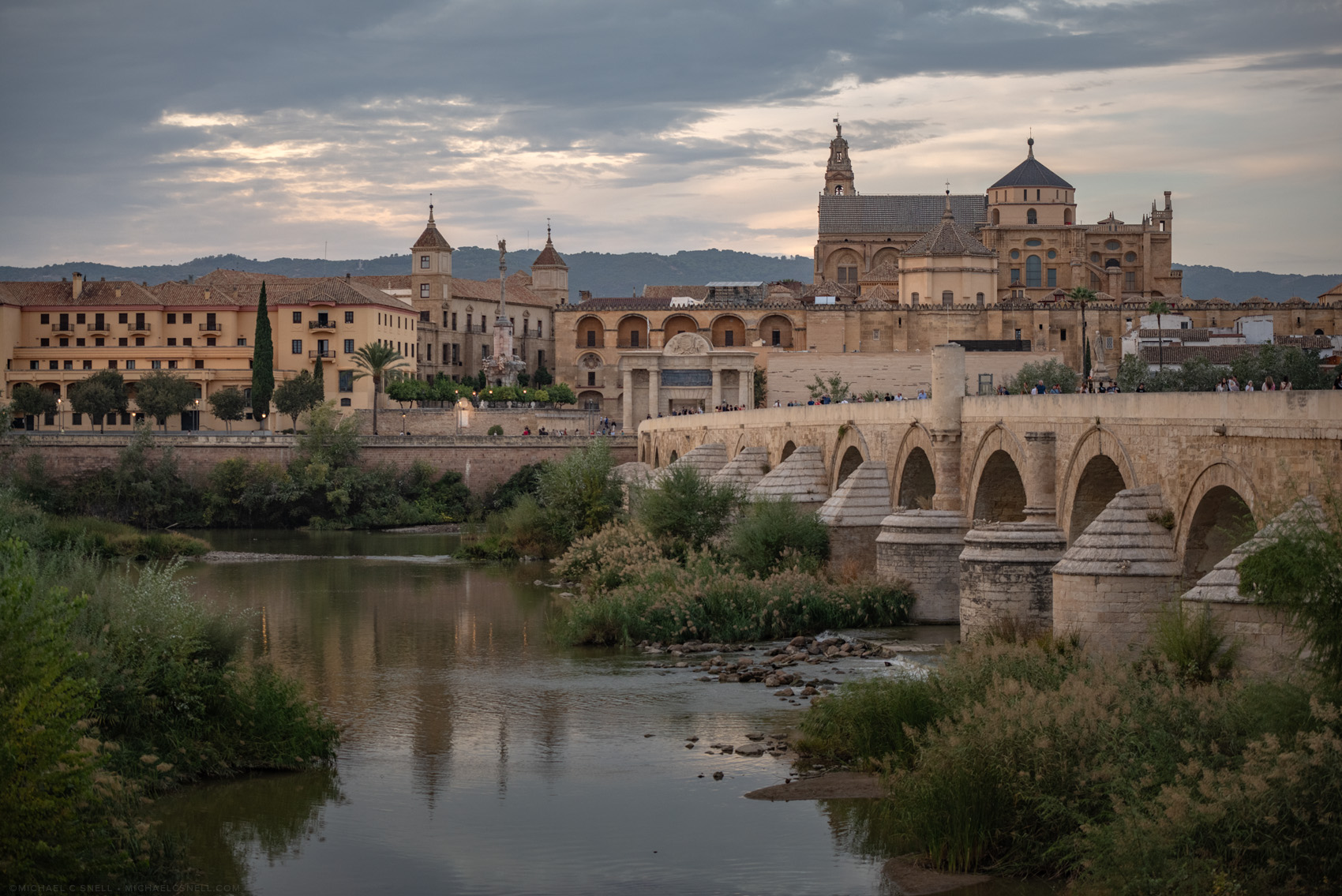
This is one of the first frames I made after returning for sunset/twilight.
From my scouting run I knew my spot and knew what gear I needed: I opted for the Nikon and the 70-200mm to give me a little flexibility. This first evening was going to be my best opportunity for catching sunset at the bridge given the scheduling of other events during my trip. I walked over a little before sunset and started shooting images as the light changed. The shot above is one of the earliest, while the light was still fairly warm.
What I’m typically waiting for in these twilight/skyline shots is that moment when the warm artificial lights have come on and balance with the remaining blue of the night sky. Too early, and the sky is too bright for the lights to be seen (or they haven’t even been switched on yet). Too late and there is too much contrast and the artificial light overpowers the darkening sky, rendering it completely black. Getting the same kind of artificial/natural light balance before sunrise is often impossible because city lights aren’t left on all night in many locations.
This is pretty much the moment I look for:
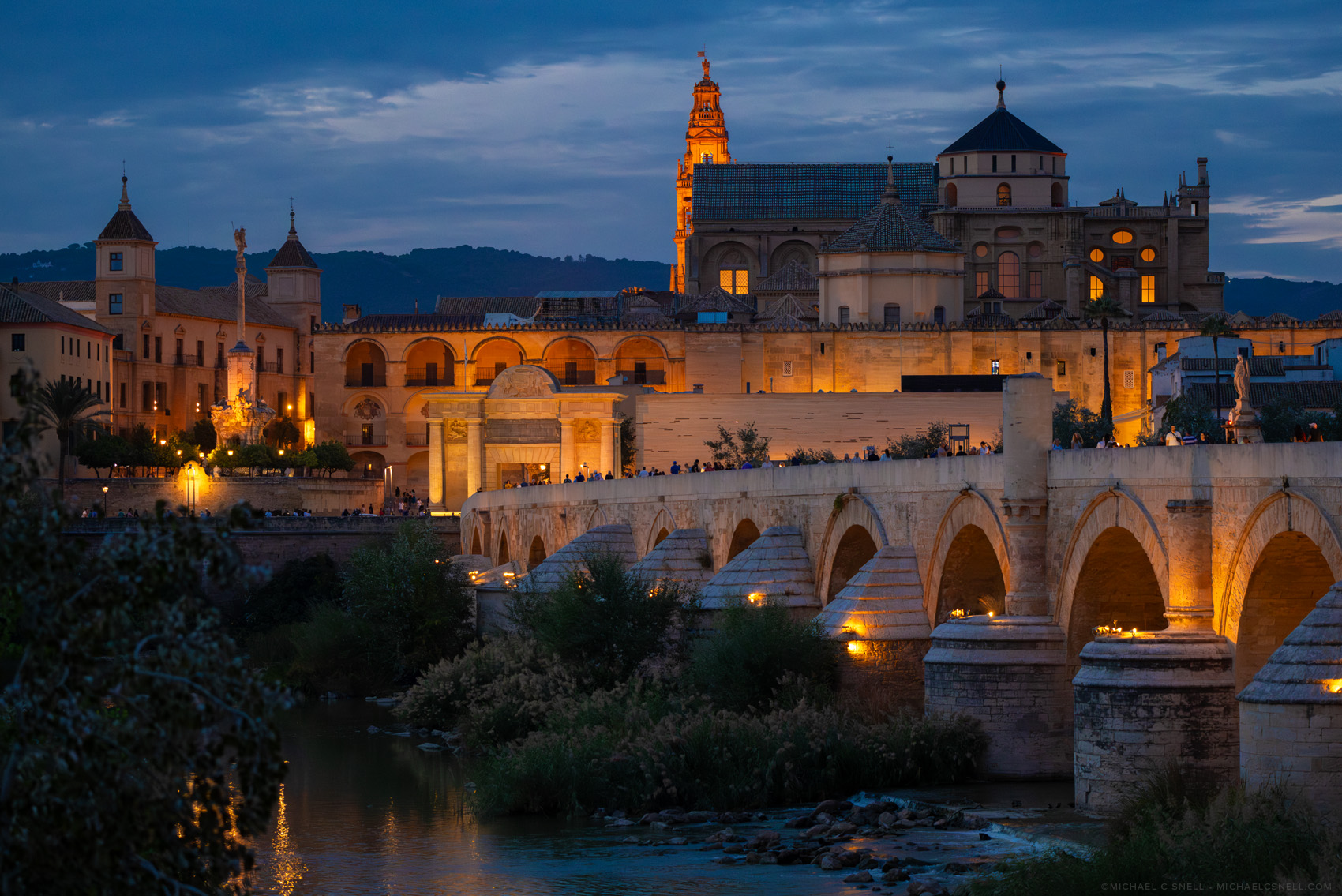
Between exposures, I would notice that some additional lights were coming on, others were going out. The strength of the lights on the bridge in particular seemed to become more or less powerful. I’m not sure if that was due to a flickering that was out of sync with my shutter, or if this type of light just took awhile to “warm up.” No matter. I’d long ago learned to shoot several exposures just to ensure I don’t have an odd frame (I’m remembering my recent night market shoot in China where the lights flickered dramatically from frame to frame). The lights from inside the cathedral were particularly tricky. They seemed to go off and on frequently. Some Spanish cathedrals actually have timers where you can insert a coin to get the lights to come on for a few minutes. Perhaps this one had this feature.
I won’t bore you with every variation I shot — I took 136 frames between 7:20 and 8:00 pm — but here’s one of the later versions when a fortuitous flock of birds managed to add a little extra to my sky:
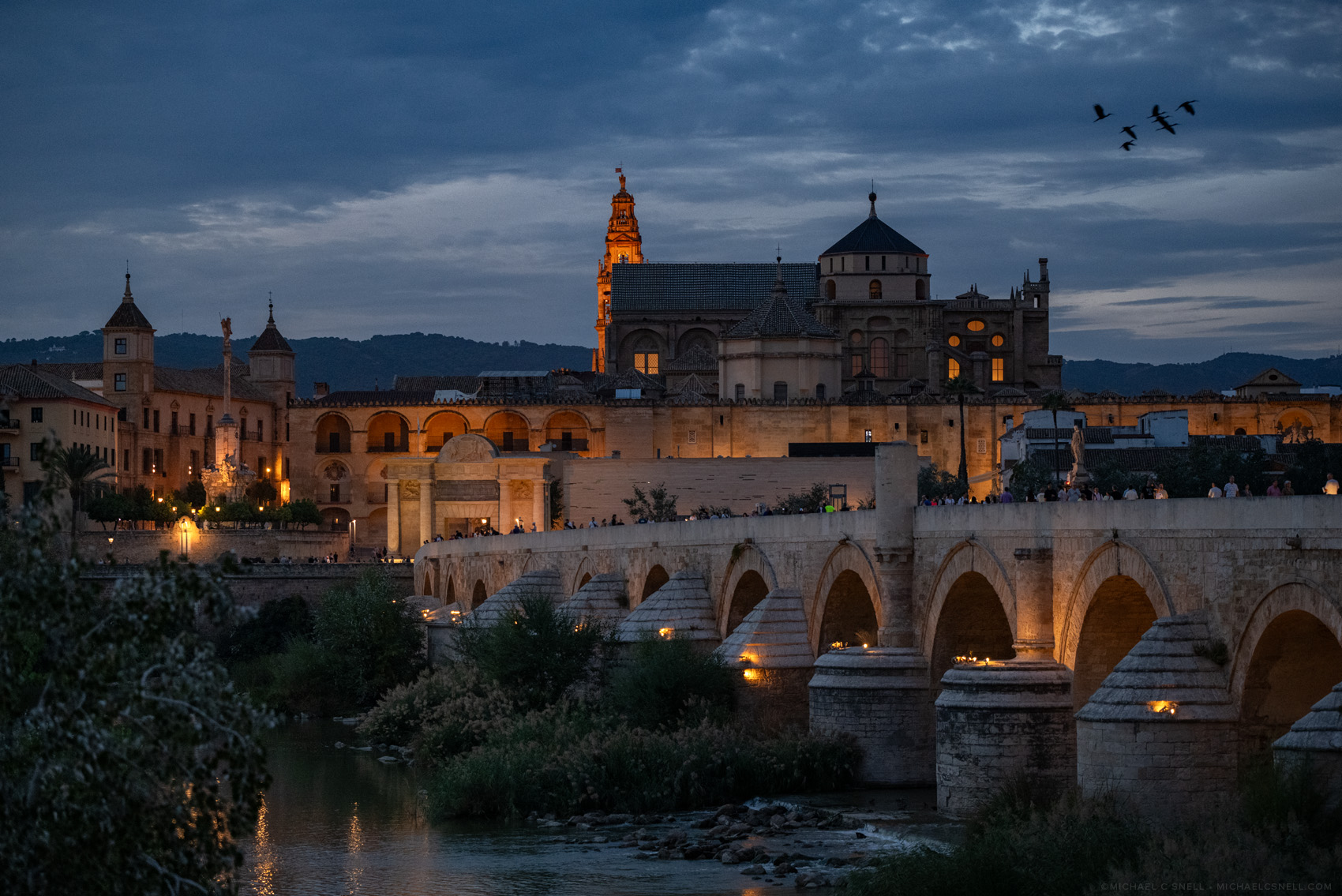
I had managed to get several shots I was happy with on this first evening’s attempt. This freed me up to shoot other locations on the following evenings even though I’m sure I could have returned here again and again for an endless array of possibilities.
I did come back the following morning, however. I thought it was worth seeing what morning light looked like, even though it proved to be a bit overcast. For some additional options, this time I took my wide 17-35mm lens for the Nikon and my Fujifilm X-Pro3 with a 50mm f2 lens (roughly a 75mm equivalent in full-frame 35mm standards).
This vertical is from the Nikon:
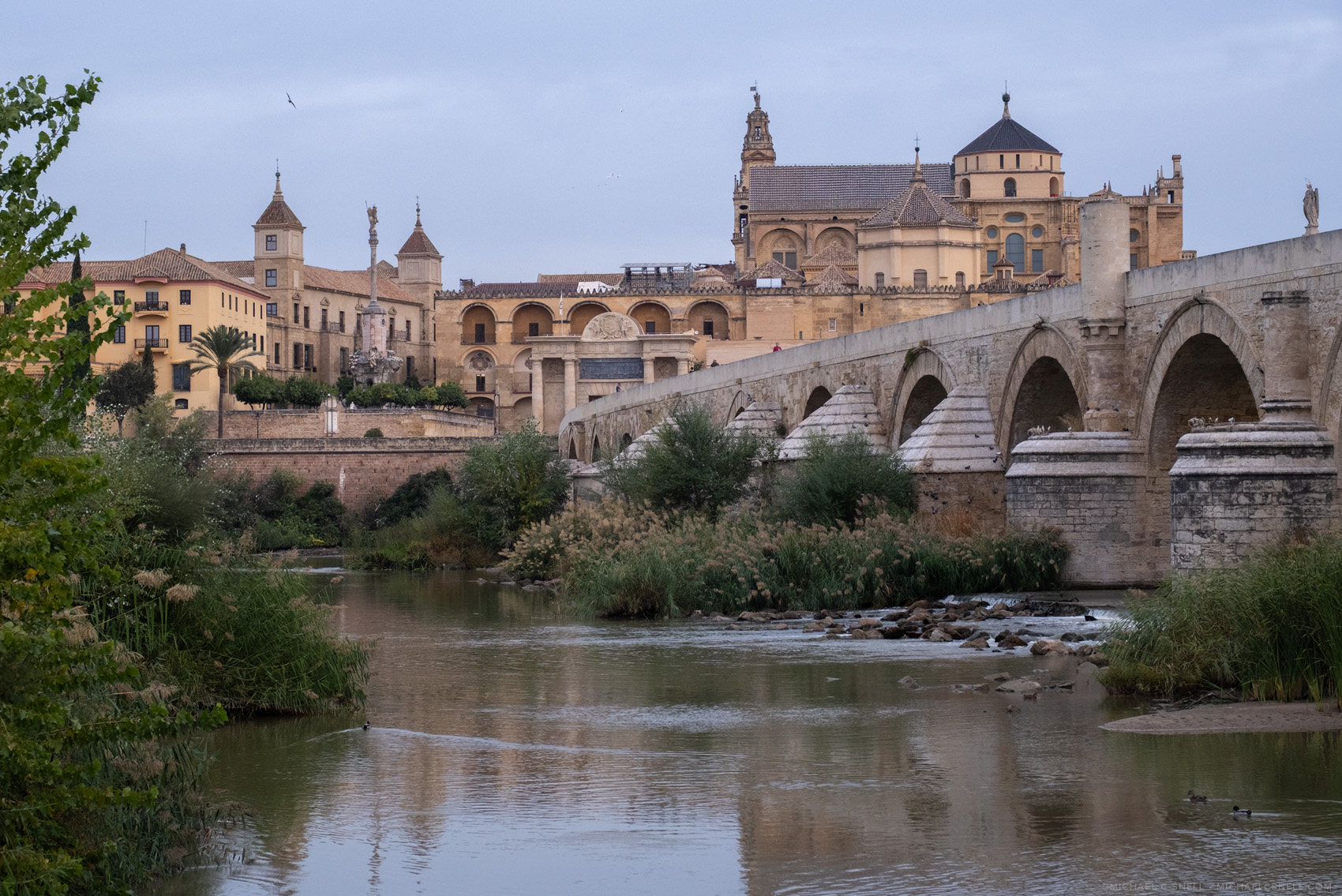
This final image is from the X-Pro3. For these morning shots, I walked further down the ramp to get lower and closer to the water. Since I had a less interesting sky to work with, I thought it helped to include a little more of the river.
I felt that each the of the outings to photograph from the bridge were fairly successful. Even the scouting shots have some merit.. Are there other versions — shot by other photographers — that I feel are better? Absolutely. But weather, time of year, and so on all play a part in what is possible on any given night. I’m sure the next time I find myself in Córdoba I’ll spend another evening (or two) by the river, trying my hand at another variation of this scene.
In the next post I’ll talk about the rest of my initial scouting walk I took on that first afternoon with just my 85mm lens. It was a really fun exercise in how to make the most of a single focal length. Something I’m trying to get better at.


One Comment