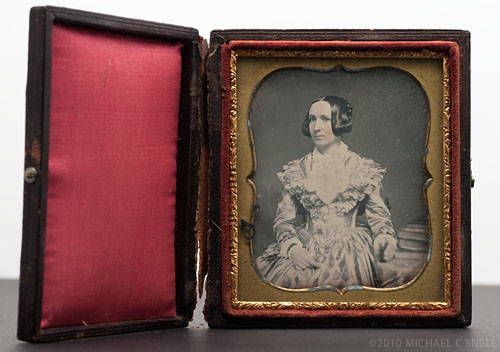
I had thought about a catchy title for this post like “shooting dead relatives” but decided that it might get me some strange Google hits.
Winter grinds on in these parts and I haven’t had any travel for the last few months. Instead I’ve been getting caught up on indoor work that includes updating my files with stock agencies, organizing the chaos that developed over the course of the last year in my office and doing lots of tabletop studio shoots. I don’t do a lot of studio work but I do have a few clients that need the occasional product shot. This past couple of weeks I’ve been shooting a lot of architectural glass and mirror samples. While I had the small studio area set up for this, I decided to copy some old family photos.
Some of these photos appear to be daguerrotypes. These images are tricky to photograph because they have a mirror-like surface and at most viewing angles they actually appear as a negative — almost like an etched piece of silver.
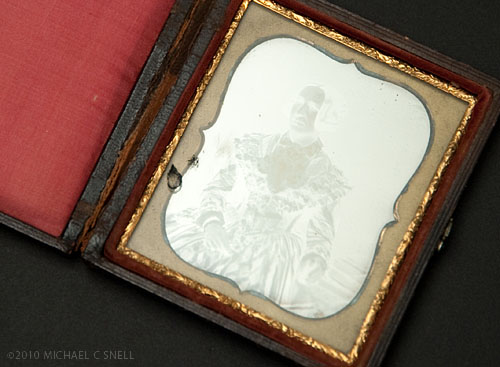
To see the image properly, you have to look straight-on so that something dark is reflected on the surface. Reflections of any other kind would be a big problem when re-photographing these portraits so I built a box out of foam core. The bottom was a piece of black foam core so that it doesn’t reflect onto the lower portion of the daguerrotype. The sides and back were white to bounce as much light around as possible and I draped a piece of thin foam packing material over the top to soften and distribute the light that came into the box. That light came from two hot lights that I had shooting up at the ceiling and bouncing down into the box.
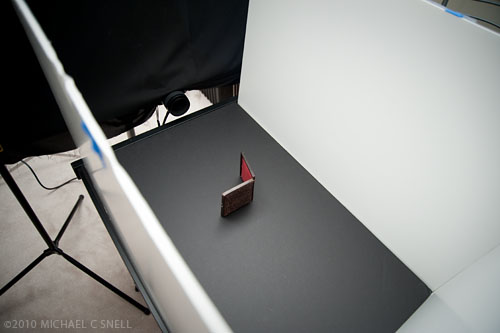
To eliminate reflection from the surface of the image, I draped a piece of matte black cloth from a background stand across the front of the box. Think of the box as a puppet theater and the black cloth is the front curtain. I could stick the lens of my camera through the curtain and let the cloth drape over the lens to block any reflection from the markings on the camera itself. I used my Nikon D300 and a Nikkor 60mm macro lens to be able to get the close focus that I needed.
The system worked pretty well but there is some pitting in the surface of the glass covering the portraits that was accentuated in the copies. For the tighter shots that I made, where the frames are cropped out, I’ll need to do some significant spotting in Photoshop. I like the wider shots warts-and-all, though. The wear on the cases and the pitting of the glass show the age of these images which were likely made between 1840 and 1860.