[sponsored post]
The next posts will explore the Otago Peninsula on New Zealand’s South Island. Dunedin is located where the peninsula joins the mainland and at the far tip of the peninsula is the Royal Albatross Centre, where I was to play wildlife photographer for the afternoon and try and get at least one decent shot of a Royal Albatross. I say “play” at being a wildlife photographer because I have the utmost respect for photographers who specialize in this field and I know that my infrequent dabbles of an hour or two don’t even come close to the kind of commitment, stamina and determination that it actually takes to get a really beautiful wildlife shot.
The Royal Albatross is listed as an endangered species and Taiaroa Head, where the Royal Albatross Centre is located, is the only mainland breeding colony near human occupation. These are large birds with wingspans reaching 10 feet. They live mainly at sea, coming to land pretty much just to lay eggs and raise their young. If I remember correctly, I believe our guide said that they don’t visit land at all for the first five years of life.
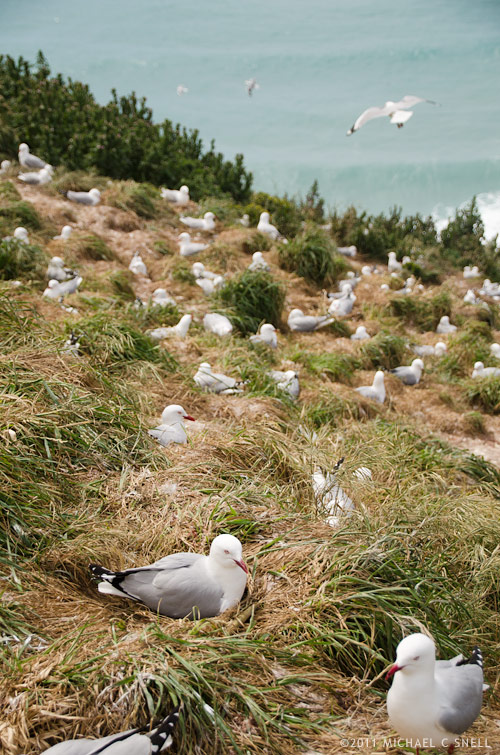
The image above is not of an albatross colony, but of a group of Red Billed Gulls. These birds covered the hillside as we approached the Royal Albatross Centre and gave hope that our search for an albatross might be an easy one. Not that easy, we would come to learn. The Centre is a fantastic place for learning about the albatross and other regional wildlife, but as is usually the case with wildlife, some days are always better than others for viewing wild birds in their natural habitat. A good hike up a steep slope to a viewing area that had been made from a WWII bunker led to this view of our first albatross through some very scratched plexiglass:
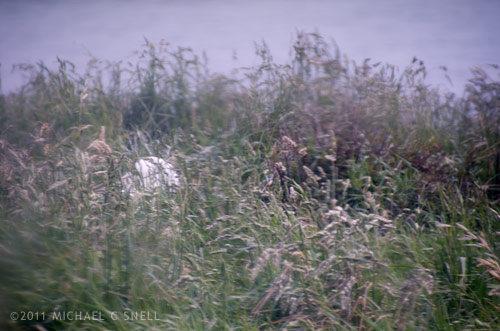
Yeah.
That white shape on the left is a nesting albatross. The birds were just returning for the beginning of their nesting season but they were still few and far between. This was the only one we could spot and it was pretty clear that this was not going to be the way I was going to get my albatross shot today. Luckily there was a part two to this excursion and we next made our way to the Monarch and out into the Pacific.
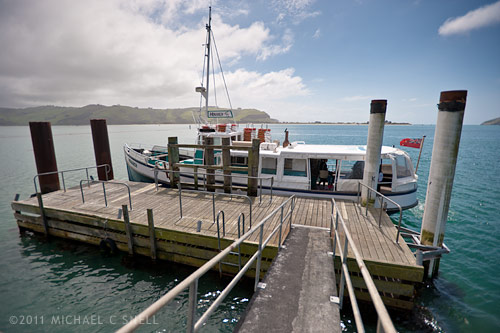
I’ve been on a few boats like this for various whale-watching trips, etc., and I’ve learned a couple of things about shooting from them. One, take the longest glass you have because you’ll never be as close as you want (although the optimist in me tells me to keep a second body around my neck with a wide angle just in case we have a freak encounter and a whale pops up right next to the boat). Birds only enhance the requirement for long glass as I learned one long winter’s night in a blind on the Platte River in central Nebraska — but that’s another story. Lesson two, be prepared for a bumpy ride.
And today’s ride was a bit bumpy. Or maybe “rocky” and “roll-y” is a more apt description. Once out on the big water, our little boat was riding 9 foot swells like a Coney Island roller coaster. I tried to capture these swells in a photo, with limited success:
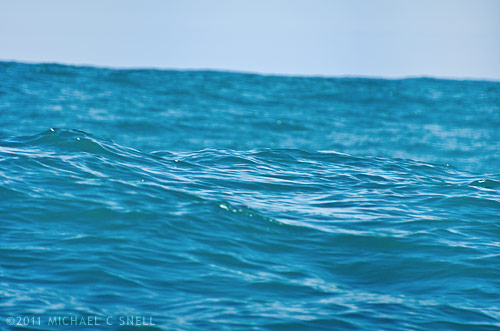
You can kind of see the sharp foreground swell with another, more distant, swell out-of-focus in the distance but you really can’t decipher it without some sense of scale. Oh well, trying to photograph that occupied my time until the albatross was spotted.
There had been a couple of sightings earlier that were more distant and it seemed that the birds were always moving away from us but, this time, I heard the captain say that there was an albatross on my side of the boat and he was coming toward us.
I had positioned myself in a narrow walkway on the side of the boat where I could push my lower back against a wall and have a foot out forward against the rail to give me some stability with my hands free. “Some” stability. Remember that we’re diving over swell after swell and anything put on a flat surface wouldn’t stay put for a second. I had also tried to reduce my top-heaviness by not bringing the full backpack. I’m primarily relying on my Nikon D7000 and the Tamron 18-270mm zoom. At the 270 end, it’s the largest glass I carry — the next closest being my Nikkor 80-200. With the smaller sensor of the D7000, the Tamron is the approximate equivalent of a 400mm lens. A true bird photographer would probably consider this to be just barely enough but it was all I had and I was making the most of it. I also appreciated the Tamron’s compactness and low weight. Hand-holding a fast, 400mm prime lens with all the weight that a fast lens brings would have been a challenge. The Tamron isn’t as fast as my 2.8 Nikkor, but I made up for this by increasing my ISO to 800 to get some of the shutter speed back that I was losing to a slower lens. At ISO 800, I was able to get a shutter speed of 1/2500th of a second at f/6.3. And that did the trick. It gave me a fast enough shutter to overcome the rocking of the boat and — maybe I forgot to mention this — the potential 75mph speed that the bird can achieve.
The Albatross appeared over a swell and, as predicted, headed toward us and slowly arced his path across the back of the boat. As it approached, I fired off several shots — trying to regain auto-focus a couple of times throughout the burst, just to make sure I’d get something sharp. This was another lesson I’d learned on a whale-watching excursion when a fluke appeared, beautifully backlit, and my autofocus slipped off and grabbed the background as the boat rocked and I ended up with a bunch of useless images of a fuzzy whale tail with a tack-sharp cliff in the background. Lesson learned.
This time I tried to concentrate on following the bird’s path and fire-fire-fire, re-check focus, fire-fire-fire, re-check focus, fire-fire-fire… and then… that was it. We had a couple more albatross sightings but none quite that close. Thanks to the Tamron 18-270, this albatross had been close enough that I got a few shots like these — the first only lightly cropped to straighten the horizon and the second cropped a bit more:
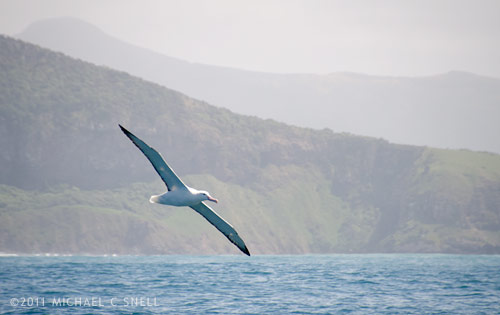
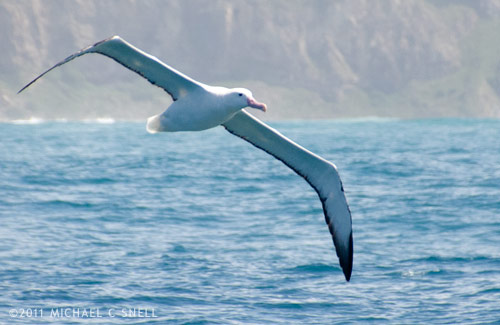
I’m not typically selling to a wildlife market. For my purposes, I just really want to have images in the file that help tell the story of a place. These albatross shots show the bird and a bit of the environment. That works. If someone needs a shot of a nest, eggs hatching, etc., I’m glad to leave that sale to the wildlife guys that have the patience to get those shots. It takes a lot of work on their part and I know I’m not going to compete with their images with what I get on a 2-hour boat trip. Still, I’m happy to have gotten the shots that I did and it was a great day to be out on the water enjoying this beautiful place. The Otago Peninsula is absolutely magnificent and I could have easily spent weeks there. Unfortunately, I only had a couple of days this time. I’ll show you more of those two days in the coming posts — as well as another spot where the Tamron saved me on a wildlife surprise.