Category Archives: sponsored

Yellow-Eyed Penguin encounter

[sponsored post]

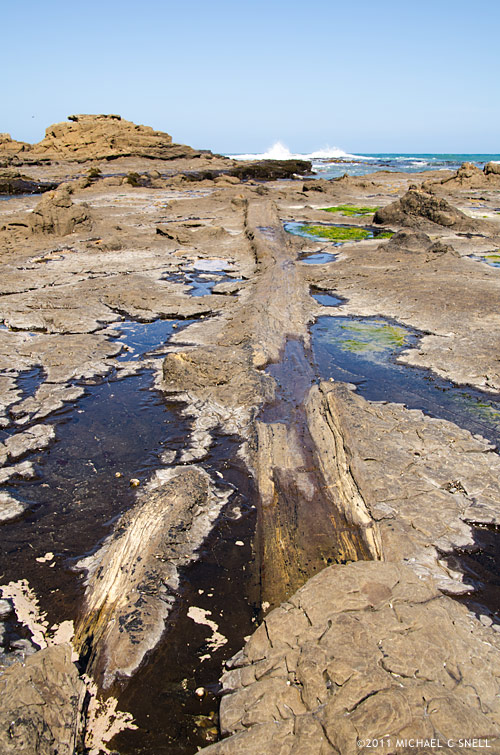
It all started when we visited the fossilized forest at Curio Bay on New Zealand’s southeastern coast. In the photo above, you can see one of the ancient, petrified trees that are visible in the rock at low tide. We were told that the endangered Yellow-Eyed Penguins are frequently spotted in the area but that they are usually only making their way between the ocean and their nesting areas at sunrise and sunset. As we were there near mid-day, it was doubtful we would see any. If we did, however, signs instructed visitors to keep at least two car-lengths away to make sure the penguins could go about their business undisturbed.

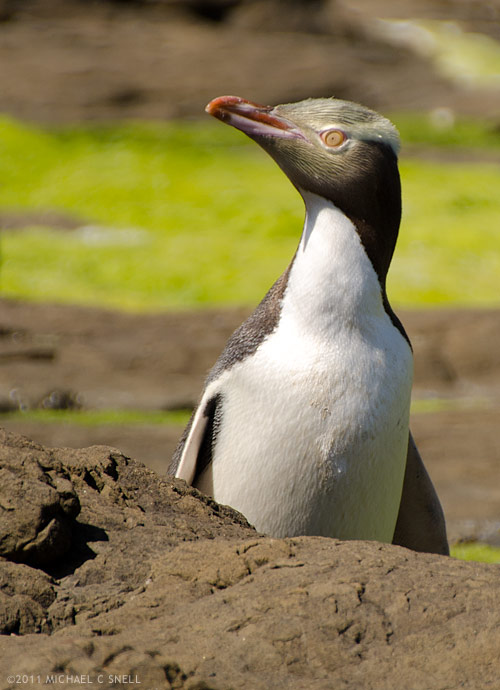
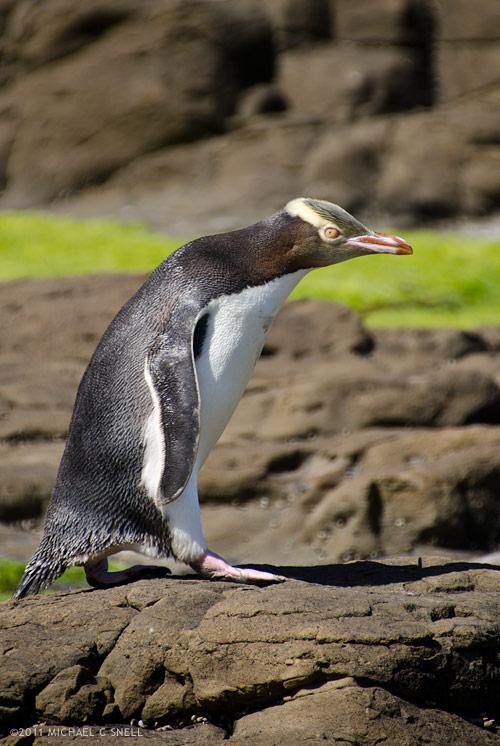
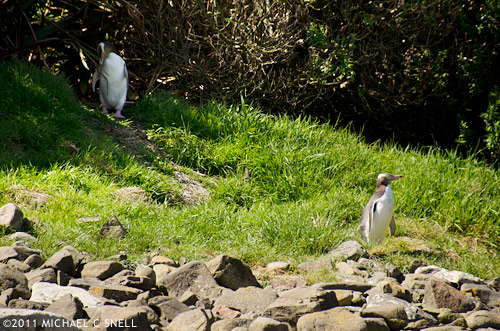
Wanting to get clear of the bulk of the tourists at the site, I picked up my pace and headed for the far end of the rocky beach where I found some great examples of the petrified logs and stumps and began photographing them. A few moments later, a sound caught my attention and I looked up to see two Yellow-Eyed Penguins emerging from the underbrush at the top of the beach.

One was more bashful and stayed in the shade but, as I continued to photograph them, the other made his way cautiously onto the beach. I picked a location where it looked like he would cross my path, but where he wouldn’t come so close that I would disturb him. Once again — as had happened on several occasions on this trip — I was happy to have brought along my Tamron 18-270mm zoom lens. I hadn’t been expecting to be photographing wildlife at this location and had nearly come to the beach with only a 17-35. Luckily I’d decided otherwise and now the 270mm end of the Tamron was just what I needed.

I wasn’t too aware of what was going on behind me until the penguin had gone and I turned around to leave. It was then that I noticed that a large group of people had assembled behind me and had been photographing the penguins as well. One was a fellow photographer from my group who had, unfortunately, come to the beach with only a 60mm prime lens. He’d made do and gotten some nice shots but he certainly didn’t have as many options available to him as I had.

Here are a couple of shots — first, just as the penguin re-emerged after walking behind a large rock:

That shot’s cropped a bit, but it’s sharp enough to handle it. I mainly cropped it to get rid of some distracting gull poo in the foreground. Proof that you can’t control everything in the scene. The next shot is closer to full frame but is also cropped a small amount just to get rid of some visual noise around the edge of the frame and also to show the penguin a bit better at the small size required by this blog template:

I don’t generally like to crop photos after they are shot. Coming from a background of shooting transparency, I learned to crop in-camera. It was a necessity. I’m only recently embracing the ability to crop and re-frame images in Lightroom or Photoshop. Files captured by modern DSLRs are now large enough that there is some lee-way. You can crop an image down a bit and still have a reasonably large file that will be viable as a stock image. I continue prefer to “get it right” in-camera whenever possible, but it has become a welcome byproduct of digital photography that I can now tweak an image’s crop later to make it stronger. Especially in situations like this where time was limited and I wasn’t able to reposition myself or to get closer just to eliminate some distracting element in the foreground or background.

Operation Albatross

[sponsored post]

The next posts will explore the Otago Peninsula on New Zealand’s South Island. Dunedin is located where the peninsula joins the mainland and at the far tip of the peninsula is the Royal Albatross Centre, where I was to play wildlife photographer for the afternoon and try and get at least one decent shot of a Royal Albatross. I say “play” at being a wildlife photographer because I have the utmost respect for photographers who specialize in this field and I know that my infrequent dabbles of an hour or two don’t even come close to the kind of commitment, stamina and determination that it actually takes to get a really beautiful wildlife shot.

The Royal Albatross is listed as an endangered species and Taiaroa Head, where the Royal Albatross Centre is located, is the only mainland breeding colony near human occupation. These are large birds with wingspans reaching 10 feet. They live mainly at sea, coming to land pretty much just to lay eggs and raise their young. If I remember correctly, I believe our guide said that they don’t visit land at all for the first five years of life.

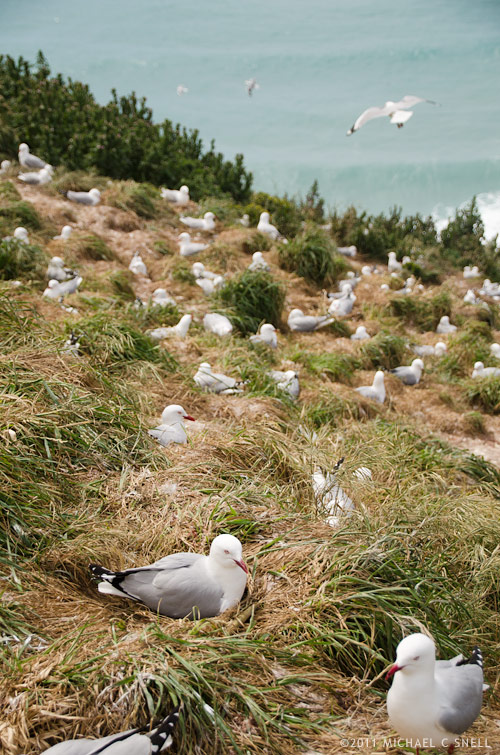
The image above is not of an albatross colony, but of a group of Red Billed Gulls. These birds covered the hillside as we approached the Royal Albatross Centre and gave hope that our search for an albatross might be an easy one. Not that easy, we would come to learn. The Centre is a fantastic place for learning about the albatross and other regional wildlife, but as is usually the case with wildlife, some days are always better than others for viewing wild birds in their natural habitat. A good hike up a steep slope to a viewing area that had been made from a WWII bunker led to this view of our first albatross through some very scratched plexiglass:
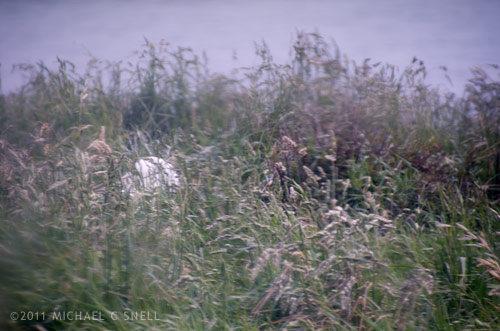
Yeah.

That white shape on the left is a nesting albatross. The birds were just returning for the beginning of their nesting season but they were still few and far between. This was the only one we could spot and it was pretty clear that this was not going to be the way I was going to get my albatross shot today. Luckily there was a part two to this excursion and we next made our way to the Monarch and out into the Pacific.
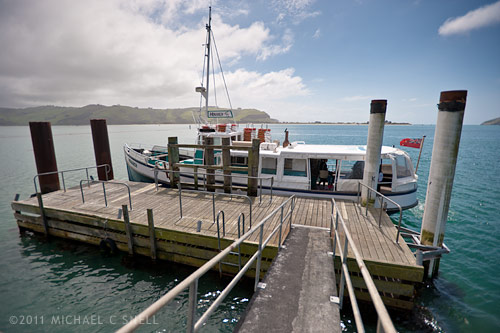
I’ve been on a few boats like this for various whale-watching trips, etc., and I’ve learned a couple of things about shooting from them. One, take the longest glass you have because you’ll never be as close as you want (although the optimist in me tells me to keep a second body around my neck with a wide angle just in case we have a freak encounter and a whale pops up right next to the boat). Birds only enhance the requirement for long glass as I learned one long winter’s night in a blind on the Platte River in central Nebraska — but that’s another story. Lesson two, be prepared for a bumpy ride.

And today’s ride was a bit bumpy. Or maybe “rocky” and “roll-y” is a more apt description. Once out on the big water, our little boat was riding 9 foot swells like a Coney Island roller coaster. I tried to capture these swells in a photo, with limited success:
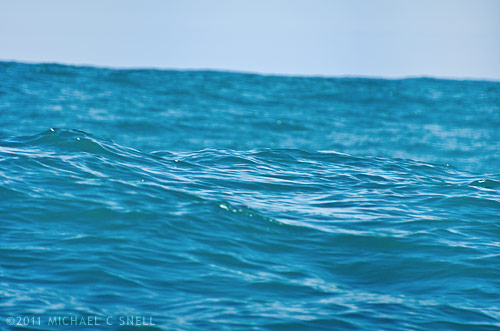
You can kind of see the sharp foreground swell with another, more distant, swell out-of-focus in the distance but you really can’t decipher it without some sense of scale. Oh well, trying to photograph that occupied my time until the albatross was spotted.

There had been a couple of sightings earlier that were more distant and it seemed that the birds were always moving away from us but, this time, I heard the captain say that there was an albatross on my side of the boat and he was coming toward us.

I had positioned myself in a narrow walkway on the side of the boat where I could push my lower back against a wall and have a foot out forward against the rail to give me some stability with my hands free. “Some” stability. Remember that we’re diving over swell after swell and anything put on a flat surface wouldn’t stay put for a second. I had also tried to reduce my top-heaviness by not bringing the full backpack. I’m primarily relying on my Nikon D7000 and the Tamron 18-270mm zoom. At the 270 end, it’s the largest glass I carry — the next closest being my Nikkor 80-200. With the smaller sensor of the D7000, the Tamron is the approximate equivalent of a 400mm lens. A true bird photographer would probably consider this to be just barely enough but it was all I had and I was making the most of it. I also appreciated the Tamron’s compactness and low weight. Hand-holding a fast, 400mm prime lens with all the weight that a fast lens brings would have been a challenge. The Tamron isn’t as fast as my 2.8 Nikkor, but I made up for this by increasing my ISO to 800 to get some of the shutter speed back that I was losing to a slower lens. At ISO 800, I was able to get a shutter speed of 1/2500th of a second at f/6.3. And that did the trick. It gave me a fast enough shutter to overcome the rocking of the boat and — maybe I forgot to mention this — the potential 75mph speed that the bird can achieve.

The Albatross appeared over a swell and, as predicted, headed toward us and slowly arced his path across the back of the boat. As it approached, I fired off several shots — trying to regain auto-focus a couple of times throughout the burst, just to make sure I’d get something sharp. This was another lesson I’d learned on a whale-watching excursion when a fluke appeared, beautifully backlit, and my autofocus slipped off and grabbed the background as the boat rocked and I ended up with a bunch of useless images of a fuzzy whale tail with a tack-sharp cliff in the background. Lesson learned.

This time I tried to concentrate on following the bird’s path and fire-fire-fire, re-check focus, fire-fire-fire, re-check focus, fire-fire-fire… and then… that was it. We had a couple more albatross sightings but none quite that close. Thanks to the Tamron 18-270, this albatross had been close enough that I got a few shots like these — the first only lightly cropped to straighten the horizon and the second cropped a bit more:
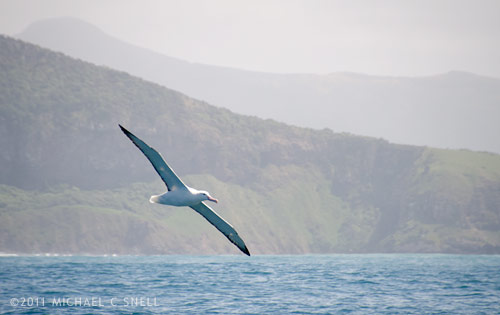
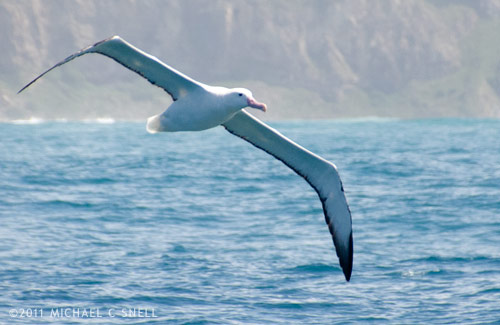
I’m not typically selling to a wildlife market. For my purposes, I just really want to have images in the file that help tell the story of a place. These albatross shots show the bird and a bit of the environment. That works. If someone needs a shot of a nest, eggs hatching, etc., I’m glad to leave that sale to the wildlife guys that have the patience to get those shots. It takes a lot of work on their part and I know I’m not going to compete with their images with what I get on a 2-hour boat trip. Still, I’m happy to have gotten the shots that I did and it was a great day to be out on the water enjoying this beautiful place. The Otago Peninsula is absolutely magnificent and I could have easily spent weeks there. Unfortunately, I only had a couple of days this time. I’ll show you more of those two days in the coming posts — as well as another spot where the Tamron saved me on a wildlife surprise.
Shooting details with the Tamron 18-270

[sponsored post]

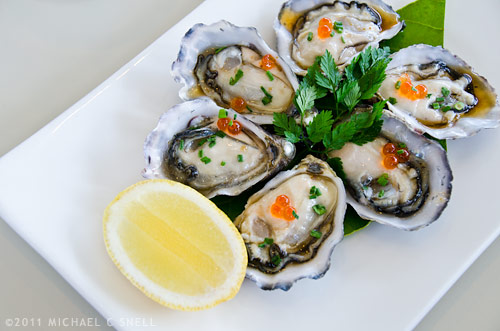
I’ve neglected to mention that all of the photos from my last three blog posts — Glimpses of Auckland, Auckland Graffiti and Back from New Zealand — were taken with my new Tamron 18-270mm lens. As I had suspected, the wide range of focal lengths offered by that one small lens made it the perfect companion on those quick walks that I would take in the morning before breakfast or between sessions of my SATW Board meeting. I also took it to meals just in case something particularly photogenic was served, like these oysters on Waiheke Island:

When I travel for reasons other than purely photography, it’s always a trade off of when to take the gear and when to just focus on the meeting or whatever else might be the actual purpose of the trip. The thing is — you never know when an opening ceremony at a convention might include dancers in traditional dress or be held at a venue that has an amazing view of sunset over the bay. It’s not always practical to take a backpack full of gear and keep it shoved under the table while having dinner at a nice restaurant. For a while I made do with a pocket point-and-shoot for times like this but I was never entirely satisfied with my results. For this trip, I went with the Nikon D7000 and the Tamron 18-270mm lens. I even had video capabilities when needed.

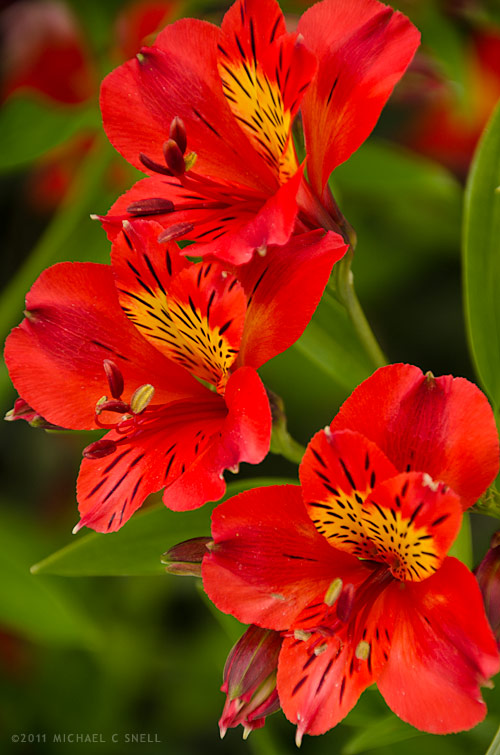
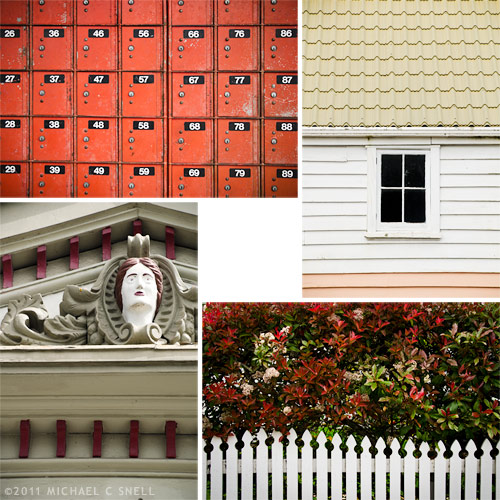
The flowers at the top of this post and the detail shots below came from a couple of hours that I had to walk around the small village of Greytown, New Zealand. The weather was overcast and wide shots weren’t exactly tourism brochure worthy with those white skies, so I focused on details that kept the sky cropped out and took advantage of the nice, flat light. The Tamron came through for me again with its ability to focus close enough that there really wasn’t ever a shot I couldn’t get (I think Tamron specs out the minimum focus distance at just over 19 inches). The bokeh is nice as smooth as well.

Sure, there were other times on the trip when I had more time and freedom to photograph and I’d make use of nearly every lens and filter that I’d packed, but for those days that I had to tend to other business and still feel prepared for the occasional shot that presented itself, the D7000 and 18-270 combo never let me down.

Tamron 18-270mm lens

[sponsored post]

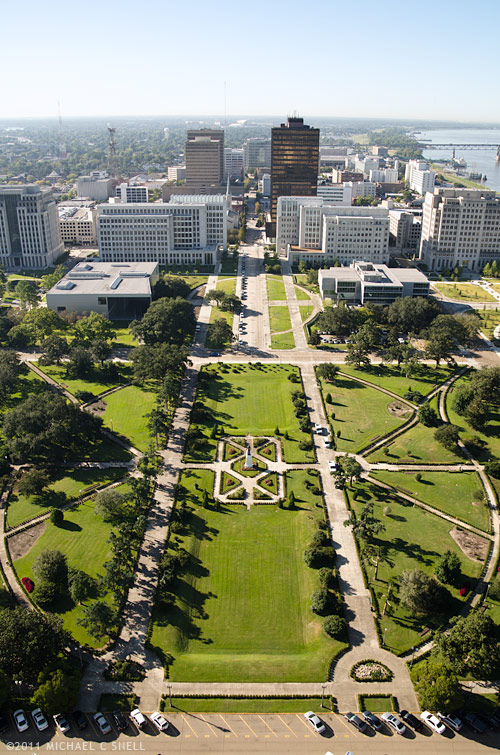
I recently had an opportunity to try out the Tamron 18-270mm zoom lens on a shoot in Louisiana (The full name of this lens is the Tamron 18-270mm f/3.5-6.3 Di II VC PZD). The shot above is of downtown Baton Rouge, taken from the 27th floor observation deck of the State Capitol Building. That’s the wide end of the lens — 18mm. Now check this out:

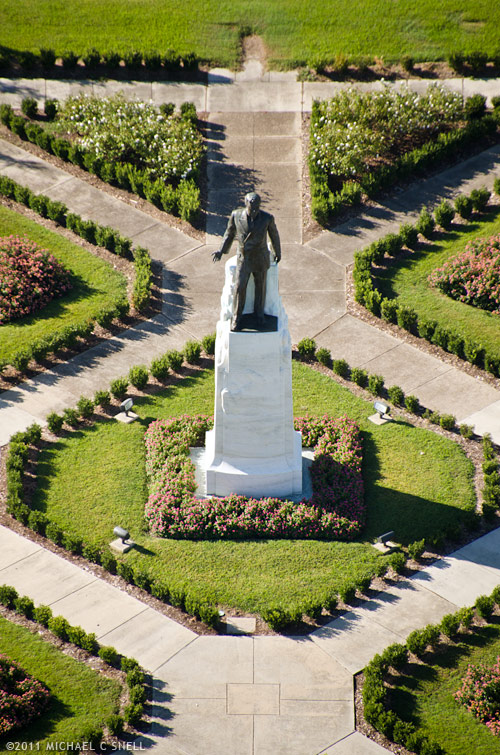
That’s the Huey Long statue on the Capitol grounds shot from the same spot with the lens zoomed all the way to 270mm. These were taken my Nikon D7000 so, given the cropped sensor, the zoom range would be the equivalent of 27mm to a little over 400mm on a full-frame DSLR (Tamron Di II lenses are not built for full-frame sensors, however. Their Di lenses are the full-frame models). That’s pretty significant coverage. And it’s small — less than a pound and it takes 62mm filters.

To a travel photographer, the idea of having one lens that does everything while being lightweight and compact… well… that’s pretty appealing. Of course, you can’t have it all. No one lens can do everything. But this one does a lot.

There are shooting situations that require that you “go light” and not take all your gear. An example might be a day out in a kayak. You don’t have space to take a lot with you and it might be inconvenient — if not dangerous — to try and change lenses while out on the water. That’s where I see a lens like this really shining. It would get you through almost any situation you might encounter from wide shots of your companion kayakers that show the surrounding scenery, to tight telephoto shots of wildlife that might appear with little warning.

To achieve a zoom range like this and to keep the lens light, you need to give up some speed and the Tamron 18-270 is an f/3.5-6.3. Almost everything I carry is f/2.8 or faster so this might seem slow — especially if you’re hand-holding it and shooting telephoto — but the 18-270 does have very capable stabilization and — let’s face it — with today’s DSLRs it’s no longer such a big deal to crank up the ISO a little.

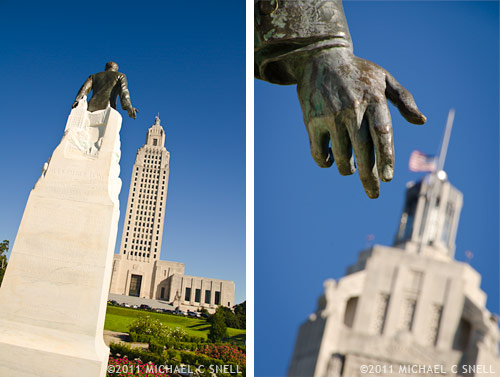
As another example of the Tamron’s range and the creative potential that it brings: here are two shots from the reverse view of those at the top of this post. These are taken from behind the Huey Long statue, looking back up at the Louisiana State Capitol Building (Long was instrumental in its construction, by the way, and was assassinated inside it). I took a few steps in between these two images but they are shot from more or less the same position. The shot on the left at 18mm (27mm equivalent) and the one on the right at 270mm (400+).

I shot a lot with this lens while on my Louisiana road trip and will share more images later. The Tamron 18-270 impressed me enough that it’s earned a place in my bag when I go to New Zealand next month. Then we’ll really see what she can do.