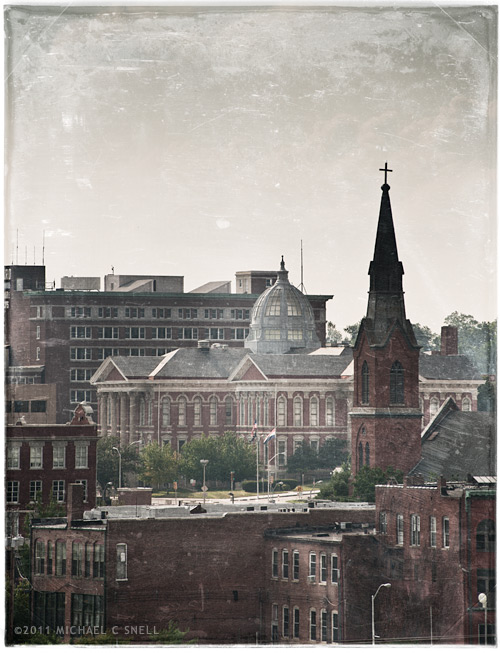
Here’s a shot from yesterday’s quick trip to St Joe. Something about the original image felt like it was from a different time so I applied some old glass-plate textures to take it further in that direction.
Here’s a shot from yesterday’s quick trip to St Joe. Something about the original image felt like it was from a different time so I applied some old glass-plate textures to take it further in that direction.
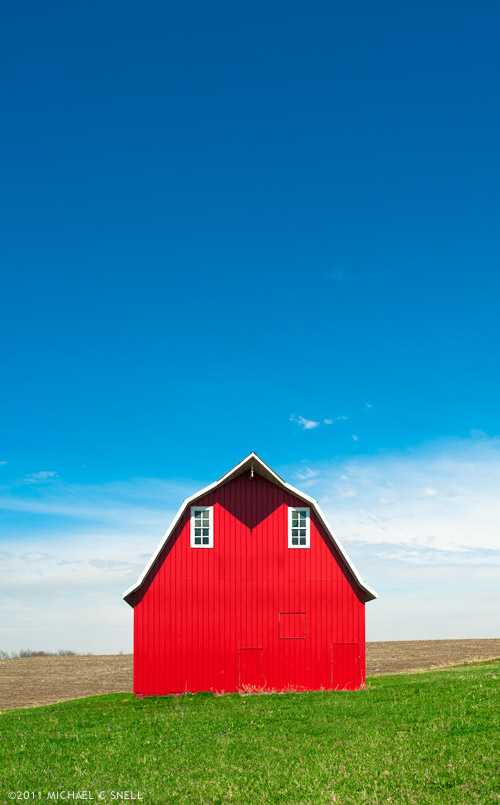
Taking advantage of a nice Spring day, I rode along with my buddy, Doug Stremel, as he scouted a Kansas Byways project he’s working on. We covered a good portion of the northeast corner of the state and ran across some great locations like this amazing red barn. I think I’ll be coming back here once the crops are in — and I won’t be surprised if I run into Doug there when I do.
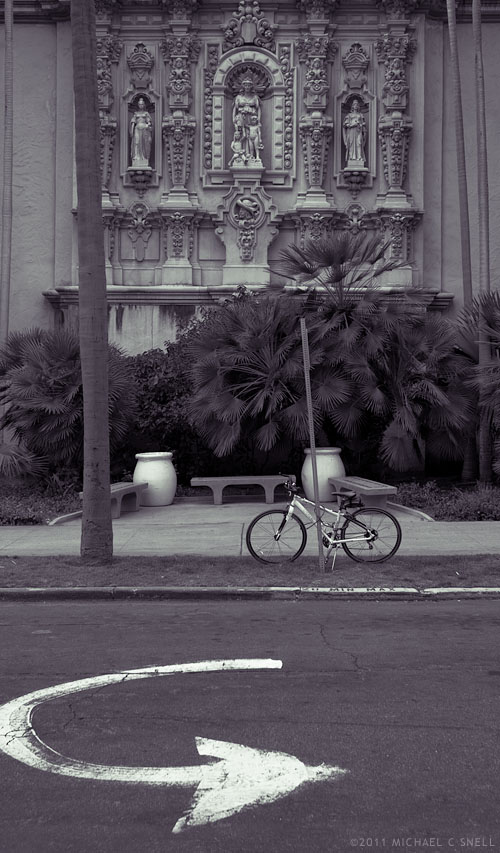
Freshly home from San Diego, California, where it was sunny and 70 to 80 degrees every day. Palm trees, t-shirts & shorts, sun, sun and more sun. Lest you feel envious, I was barely able to find the car in the airport lot when I got home due to several inches of snow that fell the day before:
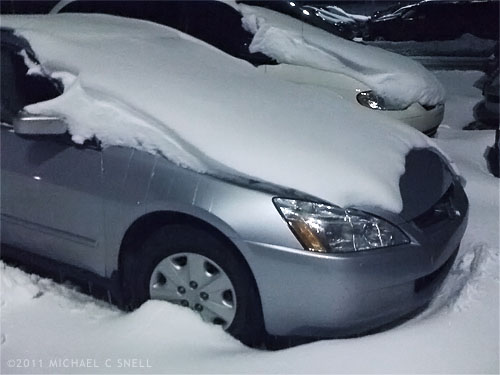
Back to reality.
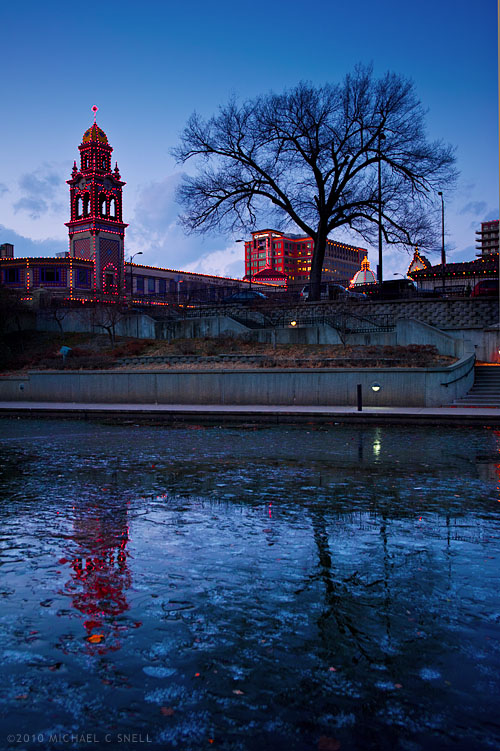
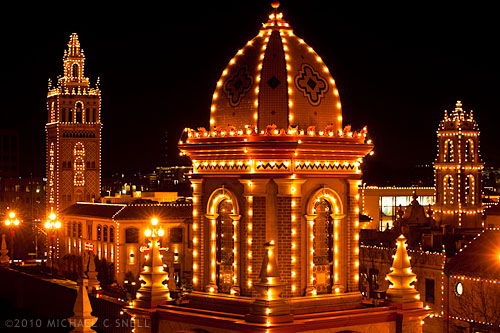
The Country Club Plaza lights are a holiday tradition in Kansas City. They’re lit on Thanksgiving and stay on until New Years. It’s been a while since I’ve photographed them so I wanted to make sure to do it this year. The thing is… I wanted a day that wasn’t cloudy (low clouds turn brownish when they reflect the lights) and wasn’t too cold. Oh, and I obviously had to be in town.
As Christmas was rapidly approaching, the weather was not cooperating. Clouds, cold temps AND high winds were pretty much the daily norm. It was beginning to look like it might not happen this year. The week following Christmas wasn’t much better until yesterday. We actually hit 70 degrees and there were only scattered clouds. It was windy, but the wind began to die down around 3:00 and I decided to go for it. I called by friend and fellow photograper, Bhaskar, who has recently moved to KC and we arranged to meet on the plaza.
I arrived less than half an hour before sunset. Bhaskar had already scouted around a bit and I found him along Brush Creek where we began our 45 minutes or so of frantic shooting. I like to catch that cobalt blue sky that happens right after sunset and before it goes solid black. Those few minutes go by fast when you’re trying to cover a several block area of a landmark 1920s shopping area. The creek was still frozen from the previous cold days and it was killing the reflections so we headed to the streets and eventually the tops of two different parking garages. The light began to die while we were on the first garage and was pretty much gone for good when we arrived at the second one:
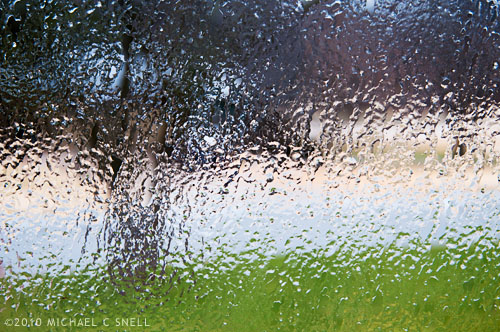
My last shoot of 2010 but the weather was so amazingly cooperative! This morning I woke to the sound of sleet hitting the roof and windows. Not just light sleet, but a regular downpour. Lightning and thunder soon followed and by the time the sun came up, my front window was iced over like this:
I’m thankful for that one summer-like evening but it looks like we’re solidly back in winter again.

In my last post I talked a little about how the things that you leave out of an image can change the impression given to the viewer. Here’s an example of going the opposite direction. I first made the shot of the RSA office tower in Mobile, AL, that appears on the left. It’s a clean shot. Simple. Nothing extra. But there is no context. The building could be anywhere from Mobile to Moose Jaw. I took a few steps to the side and took the right-hand shot, framed by some palm fronds. Now the viewer has a little extra information. Climate. You’re somewhere warm and tropical and more of your senses are engaged.
I’m not saying either of these is a great shot — I’m just trying to give an example of how including one extra element can sometimes provide a lot more information to those viewing your photos. While I agree that it’s generally best to edit a scene as much as possible and include only those critical elements in your frame, don’t go too far and eliminate something that can add a little context.
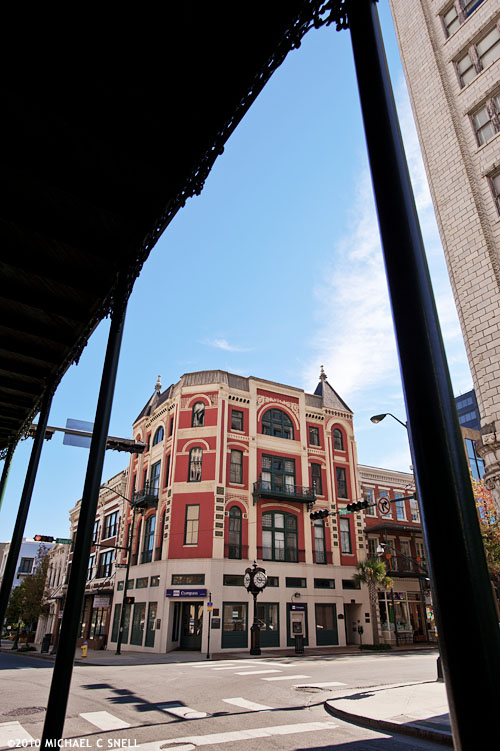
Reality and truth are concepts often discussed when it comes to photography these days. With the rise of Photoshop, people question what’s real — or perhaps they don’t question it enough. When I’m shooting for editorial use, I try to be “truthful” and show the “reality” of the place I’m photographing, but that doesn’t mean that some interpretation doesn’t creep into the images. In fact, it’s often my intention to boil an image down to focus on one single concept rather than to convey an entire, complicated reality.
There are often many truths and many ways of expressing them. Take these shots of downtown Mobile, Alabama. The one above gives the impression that the city is historic and shares much of the character that one thinks of when one thinks of New Orleans – brick buildings and ornate cast iron balconies. I would say that this is true of Mobile and it’s an accurate representation.
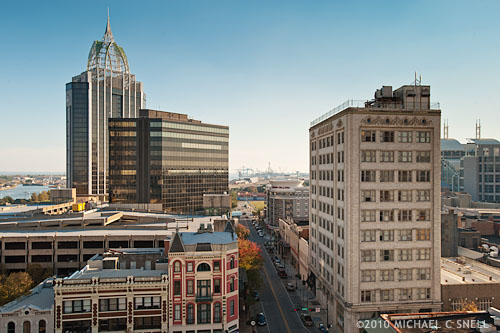
Then there’s this shot taken of the same block but from a higher vantage point. The same brick building can be seen in the lower foreground but this time it is minimized by the office towers looming above. Now Mobile appears to be a progressive city, a growing urban center.
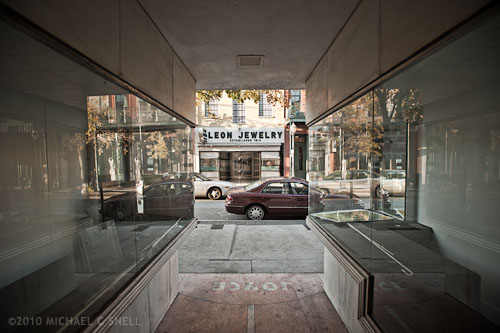
Taken just a few blocks away, this photo shows yet another side of Mobile — one of a city that is struggling. Empty storefronts are emphasized by the camera viewpoint being moved back inside a shop entrance with vacant display windows. The vibrant shopping area that actually flanks this particular shop is hidden from view, giving the impression that this is a neighborhood in decline.
None of these images have been manipulated in Photoshop to give a false impression. The three sides of this city are conveyed simply by camera position and the choices made in composition. Is one shot more real than the others? I feel that they all represent my reaction to the city I was exploring. They do, however, contain my own personal point of view and reactions. Put a dozen photographers in Mobile for a day and you’ll have a dozen different perspectives. Maybe a dozen different truths?
I talked a little bit yesterday about how to best handle less than ideal weather situations. My day in Passau was white-skied and a tad dreary. I actually like that kind of weather and think some great shots can be made when there’s a little more “atmosphere” than usual. Unfortunately, from a business sense, my likes are trumped by what sells. I’ll still shoot for myself and make the shots available to publishers, but they’ll typically take those dramatic sunsets or clear blue skies over this:
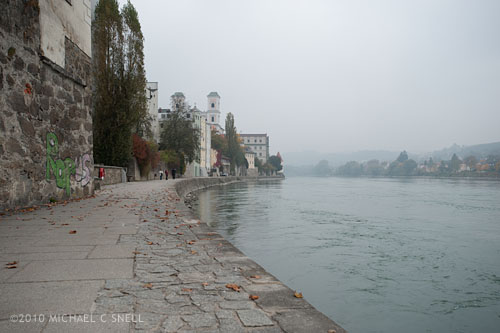
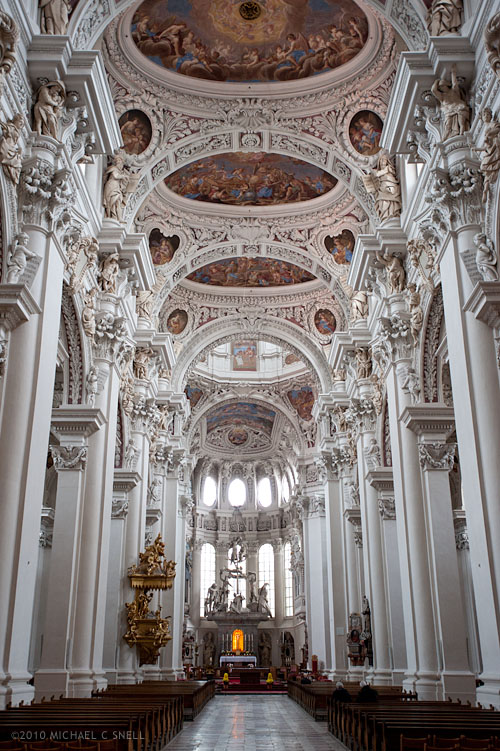
That’s the Passau I saw last month. Beautiful city, actually. And I had a great time wandering its streets finding incredible vantage point after more incredible vantage point. But… reality sets in and you need to make some photos that will sell, too. Heading inside is one option as seen by the church interior at the top of this post. The softened light from the overcast skies didn’t give those dramatic shafts of light that you might sometimes see streaming through the windows but — with an interior as bright and white as this one — you don’t really need them. The soft light did a great job of modeling all of the ornate features and did so with lower contrast than direct sun would have.
Passau also has a great glass museum. We’re talking about a rambling, multi-story maze of room after room of extraordinary glass. You can seriously get lost in there, but you won’t mind much because there’s good stuff around every corner. The lighting doesn’t look too sympathetic to photography at first. There are all different color temperatures from pink to blue to green. Happily, the auto white balance on my Nikon was able to clean that right up without a second thought from me. I just popped on the 60mm Micro lens and went crazy. Most of the glass was behind glass, but limiting depth of field and blocking the background with my own body allowed me to deal with most reflections. Some of these shots will make nice cutouts (like the one on the right) for those guidebooks that want a little detail shot to break up a long block of copy.
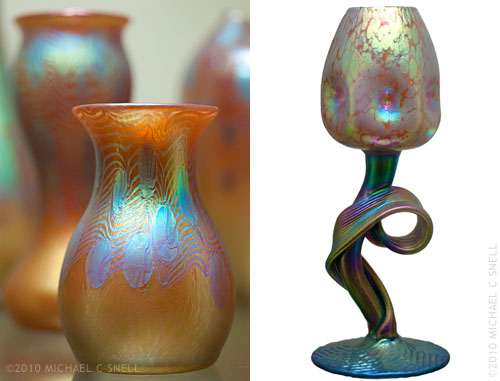
All in all, not bad for a rainy day’s work.
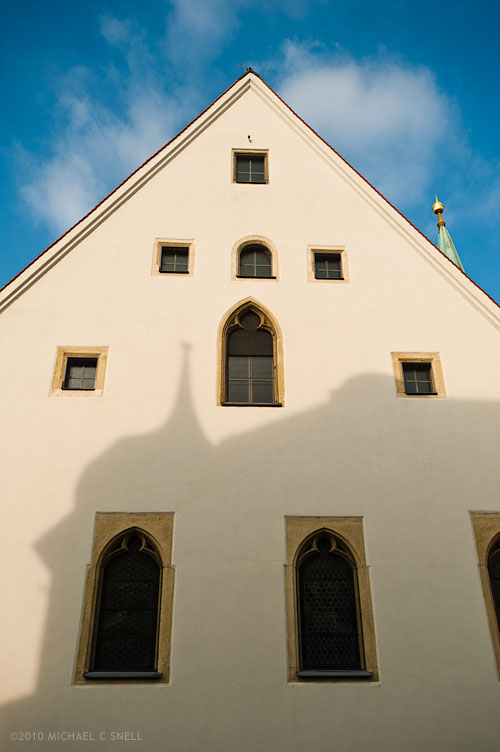
I liked this two-for-one shot from Regensburg, Germany. The crisp lines of the building against the sky, and the shadow of the more ornate, turreted building being cast on it.
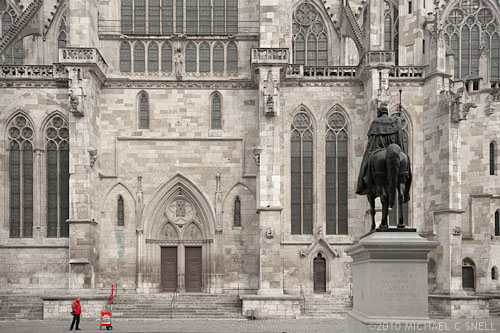
I’d love to see this shot run as a double-page spread one day. At a large size it’s chock-full of detail and nearly entirely monochromatic except for the tiny red-coated figure in the lower left. Not only does he give a little splash of color, but he makes it apparent just how large the cathedral in Regensburg, Germany, really is. Often with something huge like this the impulse is to get it all in frame, but that can actually make it look quite small in the final image. Cropping in and using just a portion of the church so that it bleeds off on all sides emphasizes that it’s so big it won’t even fit in the shot. Even so, without that lone figure in the corner the effect would not be nearly as strong. (And thank you, sir, for wearing your red coat that day!)
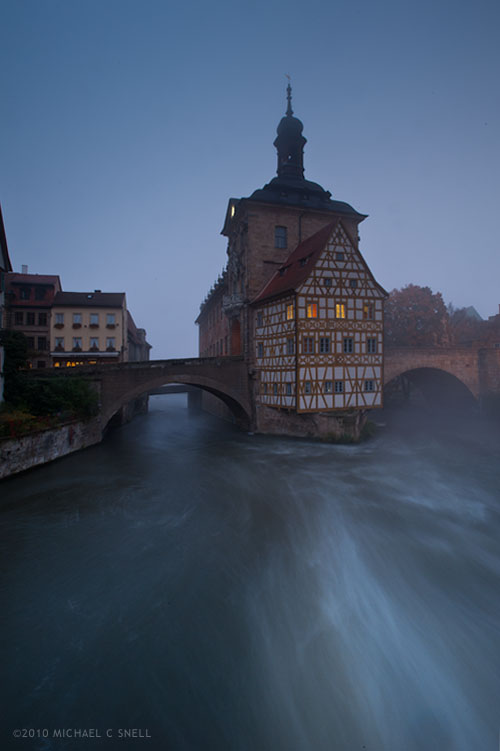
As soon as I saw the 14th century old town hall — the Altes Rathaus — built in the middle of the river Regnitz in Bamberg, Germany, I knew I needed to dedicate some time to shooting it. Unfortunately, I was leaving the next morning at 8:00 am. It’s okay, I thought, I‘ll get there before sunrise and shoot some long exposures with the tripod before it gets too light out and be back in time to check out of the hotel and catch my ride to Regensburg. I rose very early the next morning and looked out the window to thick fog drifting past the streetlights. Not such bad news — I love fog — I just hoped I could see the town hall from the footbridge I had scoped out on the map the night before.
I packed up so that I’d be able to leave the hotel quickly after my shoot and headed out into the mist with my tripod over my shoulder. Through the winding streets, I eventually found the river and the footbridge. It was foggy, no doubt, but it was lifting. There was just enough left to give a nice mood. It was still quite dark out but I added a neutral density filter anyway. I wanted to cut out even more light in order to extend the length of my exposure to let the water blur and give some sense of motion. The rivers run fast in this part of the world and I wanted to convey that.
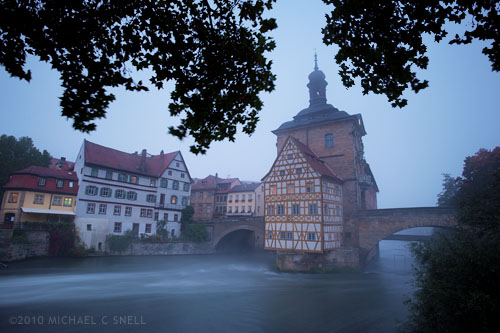
The footbridge had a little bounce to it and I had to time my shots between the locals crossing on bicycles so that the vibrations wouldn’t blur my shots. Once I had a few variations I was comfortable with, I set off to find other vantage points. I had little time but wanted to make the most of it. There are a whole series of bridges crossing the river in this area and I zig-zagged my way back and forth down the river shooting from each of them.
I left myself a little time so that I could continue to shoot a few things on the walk back to the hotel. This is one of my favorite times of the day when traveling. It’s when you get to experience the real town. People sweeping the sidewalks outside their shops, others walking to school or work, everyone just going about their day. The tourists haven’t arrived yet so the place is still real.
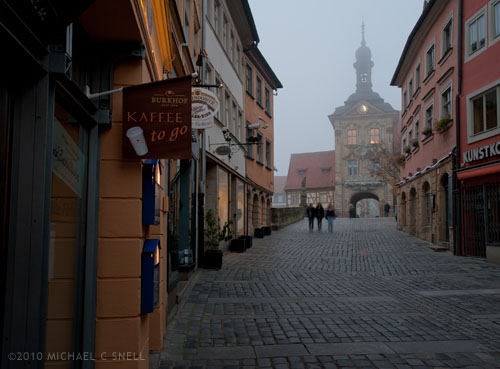
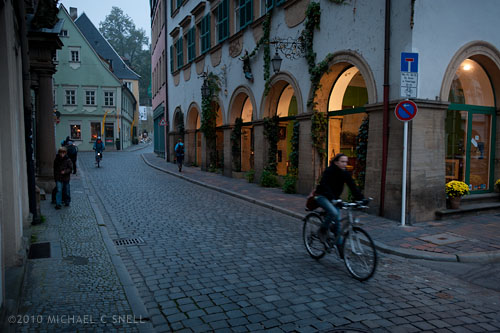
I don’t know if these shots will ever sell — sunny skies often have a better chance — but they are among my favorites from my trip to Germany because it was one of my favorite mornings. Off on my own watching a strange city come to life, the weather crisp and cool — it doesn’t get much better than that.