
Here are a few more shots taken in Arkansas with my 85mm 1.4. Having a manual focus lens again has been interesting. I used to love manual focus and only grudgingly adopted autofocus when I upgraded film bodies years ago to get other features. I’m enjoying a return to that slower, more thoughtful way of shooting but I am finding that changes in my own eyesight and in camera viewfinders have added some additional challenge. Not to mention that at f/1.4 you get very little wiggle room. That plane of focus can be wafer thin.
The big viewfinder on my D700 is pretty manual-focus friendly but I do miss my old split-view finders. I’ve looked at options online for getting a replacement focusing screen, but I’ve seen enough comments from people who have experienced exposure issues that I’m not sure it’s worth it to me. Instead, I think I’ll just continue to practice, practice, practice. I also think I’ll try and rely more on my eye and less on the focus-confirmation dot in the viewfinder that tells you when you’re sharp. I’m not so sure that it isn’t “drifting” a bit depending on my subject distance. It must be the camera – it couldn’t be me, right?
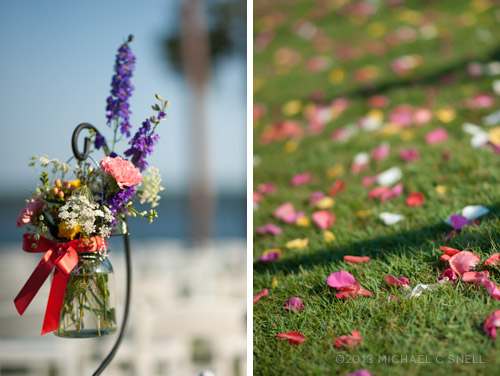
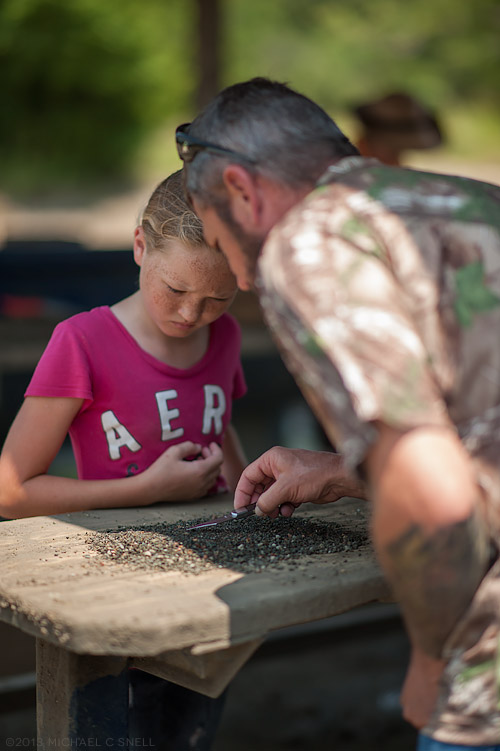
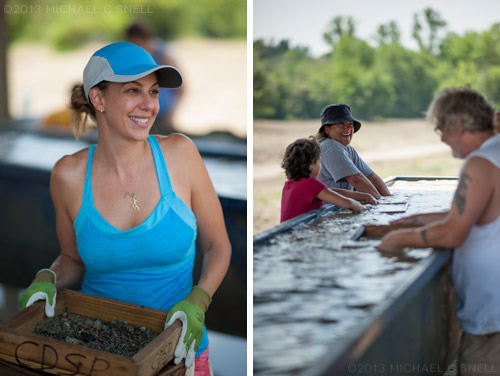
Above: I happened on this beautiful lakeside wedding location, just after the ceremony had finished. Below: a few shots of people hunting for diamonds at Crater of Diamonds State Park.
Hi Mike, What I have found myself doing after some issues with auto-focus is to zoom in as tight as can be with whatever lens I’m using, hit the focus button (which I have set to be different from the shutter button on my Canon 7D…and on every digital camera I’ve used, actually) on whatever I want to be in focus, then zoom out to compose my shot as I want and shoot…. of course, there are times, such as a fast-happening event, this isn’t practical, but I use it a lot.
I also use these three rules of thumb about depth of field in the classes I teach (and I also tell the students, who have a hard time understanding “depth of field” that it also means “the zone of what’s in focus”….they lock onto that description immediately).
1) The greater the distance you are from a subject–either physically or optically, the greater your zone of focus will be;
2) The greater the width of your image (wide angle versus telephoto), the greater your zone of focus will be; and
3) The greater your aperture number (f11, f16, f22, etc.), the greater your zone of focus will be.
–Mike Whye
Good tips, Mike. I haven’t tried the zoom technique but I have heard of others using it. It seems to be popular among those that are shooting video on their DSLRs now, too. I do tend to “focus, lock and recompose” like you because I generally prefer using my center focus sensor which is more sensitive than the others (or at least seems that way). It’s now that I’m moving back toward manual-focus prime lenses that I’m finding I need to develop new tricks – or re-learn some of my old film habits. I’m liking the results a lot, though.