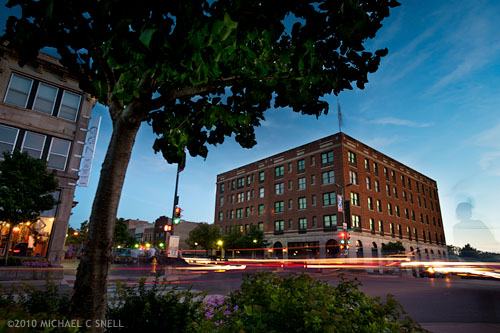
I returned to the Eldridge Hotel for another twilight shoot last night. You may remember a recent post where I shot it from a rooftop across this street. This time I went street-level and parked myself under a tree along the sidewalk catty-corner from the hotel. I was again going for a long exposure with some traffic streaking and a combination of the dying light in the sky and the warm street lights.
I’m discovering that this particular building is not lit very well, nor do there seem to be many lights on in the windows in the early evening. My solution has been to merge several shots together. The image above was a quick attempt this morning to see how it might look, but I’ll need to do a more involved layering later. While I was locked down on a tripod, I was also changing apertures. The differing depth of field between shots means that I need to mask out some areas to preserve the focus where I want it. Otherwise I end up with ghostly halos around the foreground elements.
The advantage I gain by using multiple shots is that I can use one as the base image — here I’ve chosen a later shot with a good sky — and then “paint in” elements from other shots. One example is using a shot taken earlier in the evening where the building itself had more light on it. While it’s nearly silhouetted in the base image, I put the earlier exposure on a layer above, added a black layer mask to hide it entirely, and painted the building back in using white as my foreground color. I could reduce the opacity of the upper layer to better blend it and achieve the level of light that I wanted on the building.
Another advantage was that I could get more traffic streaks than what actually appeared in any one photo. I picked dark shots from my bracketing that had good headlight and taillight streaks, stacked them on layers above the base image and set those layers to “lighten” in the layer mode menu. That made only the areas that were lighter than the base image visible — in this case, the light streaks.
Headlights from the street to my left would also occasionally throw some light into the leaves of the tree above me. I was also able to paint in some detail there using the same technique as I used on the light streaks.
The downside of this kind of shoot is that I’m tied to one position for about an hour. I usually move around and find different angles, trying to make the most of the light as it changes and fades. Here, I need to dedicate myself to one angle and stick with it in order to have all the layers I need for the final product. Last night the sky was surprisingly dramatic for a short period in the middle of this sequence an I regretted positioning that tree where it hid the sky but I was committed to stay put in order to keep all of the images registered. Since this is a local shot for me, it’s not such a bad thing. I’ll just keep going back and trying different things.