Author Archives: Michael

Memorable meals, part 2

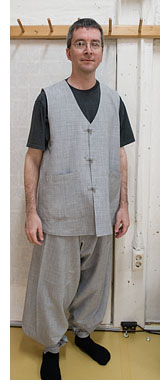
Me as a monk Yesterday I wrote about the amazing kalbi dinner I’d had in South Korea two years ago to the day. Today, I’ll once again go back two years to the next evening when I participated in the Beomeosa Templestay program.

In the morning we had traveled to Busan and, after spending a couple of hours exploring their amazing fish market, headed over to the Beomeosa Temple where we would spend the next 20 or so hours living among — and learning about the daily life of — Korean buddhist monks. The first task was to dress the part. Here I am after donning the provided gear (the t-shirt and socks were mine).

Believe it or not, a short Powerpoint presentation came next that explained a bit about what we would be experiencing during Templestay. Soon after it was time for Balwoo Gongyang, the communal Buddhist meal service. We were each provided a stack of bowls wrapped in white cloth and we were led in single file through the temple grounds to the dining hall.
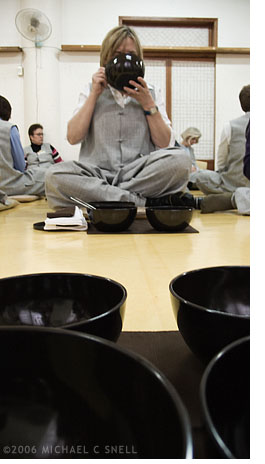
Temple dinner Balwoo Gongyang is no simple event. The entire process was described to us in detail by a young monk. He began by getting us properly arranged and sitting on the floor in four rows. Once we were arranged, it was time to arrange our bowls and other utensils that we had brought with us. There were four bowls and they each needed to be placed in a certain position in front of us and each had a specific purpose. The nested bowls were removed one by one using the thumbs only and placed in their correct spot without making a sound.

I’ll skip ahead here because dinner took several hours due to the lengthy description of each step. I’ll just say that you were to take less food than you needed to be full, you were to eat everything you took, the bowls were rinsed one into the other in a specific sequence, scrubbed with a radish slice which you then ate, and the wash water was then poured into a large pot that was circulated around the room. If there was any food particles remaining in the water when everyone had finished, the water would be divided among all of us to drink. The idea was to teach young monks (and in this case, us) not to waste. And, believe me, we didn’t waste.
Temple crafts

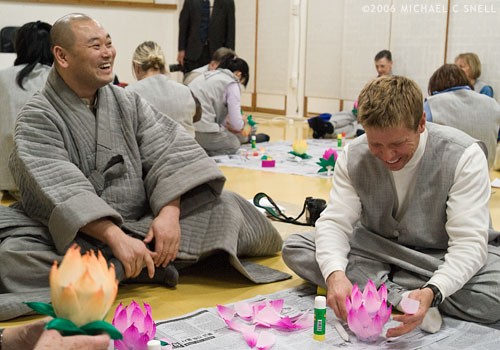
After the meal, we had a surreal arts & crafts session with the monks and made paper lotus lanterns out of paper cups and candles. It was dark by now and we went outside where our candles were lit (my lantern immediately burst into flames and was destroyed entirely) and we paraded through the temple grounds passing a variety of huge golden buddhas in small buildings along the way.

Back inside we had a lengthy tea ceremony with teachings on buddhist philosophy and we were finally led off to our communal rooms for the night where we slept on the heated wood floors just as the monks.

While the meal was not memorable in the same way as the kalbi feast of the day before, this was definitely one experience I will never forget.
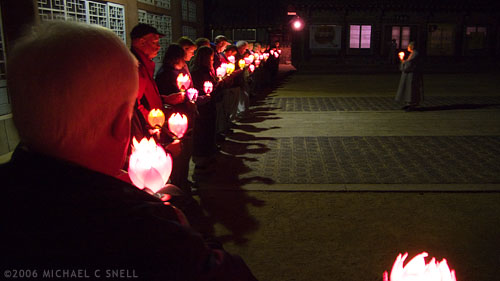
Lantern walk

Memorable meals, part 1

Kalbi cooking

Today has been a catch-up day. I’ve prepped over 500 images from recent trips for submitting to my stock agency and compiled over 1200 photos to send in to the US Copyright office as part of my ongoing effort to keep my registrations current. Add to that the installation of various system and software updates and it’s just been one of those mind-numbing days that have to be endured.

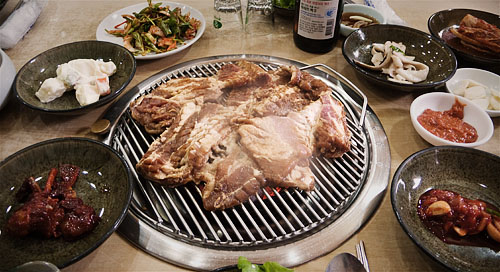
While shuffling around all of these image files, I made a realization. I just happened to notice some photos that were dated exactly two years ago today from a trip I made to South Korea. Two years ago today, I had one of the best meals of my life. Happily, I had recorded it with my little Panasonic LX-1 — see the image above.

By March 30, 2006, we had been in Korea for 5 days and had eaten about every kind of dried and/or processed fish (and various sea-dwelling invertebrates), sprouts, leaves, and the always-present kimchi that you can imagine. Kimchi, I would say, is an acquired taste and our stay in Korea was not long enough for me to develop a full appreciation. By the time we reached this point in our trip I was ready for something a little more substantial.

We arrived in Daegu after a morning of Buddhist temple touring and walked into an all-too-familiar looking dining room in a small restaurant on an unassuming side street. Pale grass-cloth wallpaper, low tables with inset charcoal burners, and a hardwood floor with pillows in place of dining chairs. The tables were covered in small bowls of side dishes that included various sprouts, mushrooms, processed fish, pickled things, and — of course — kimchi. Pretty much the setup we’d come to expect by this point.

What came next was unexpected — at least to me. We were having a very special local Kalbi, or barbecue pork, marinated in herbs and spices. The meat was dropped onto the hot grills at the center of each table and the aroma began to hint at what was in store. The result was — as best as I can describe it — the best bacon you’ve ever tasted in your life. Thick, meaty chunks of herb-marinated bacon.

I’ll stop here because to describe it any further would be cruel. I’ll post part two of “memorable meals” tomorrow. It will describe the dinner I had the very next day. And it couldn’t have been more of a contrast…

Tidbits…

My copy of Joe McNally’s “The Moment it Clicks” arrived earlier this week and I have to say, I had trouble putting it down. If you aren’t familiar with this photographer, check out his blog or website. He’s seen it all, done it all. Each spread in the book has an image and the story behind it, told to provide a little nugget of inspiration or technique that you can use in your own work. I don’t expect to be working on any Joe-Mcnally-esque projects soon (ie – I won’t be renting a trained elephant for $8000 a day) but I do plan on using his creativity as a good kick in the pants. We all get used to doing what we do and it’s nice when a book like this comes along to relight that fire and get you thinking again. Thanks, Joe.

A couple of other interesting things this week:

Adobe released its new online tool called Photoshop Express. I haven’t had a chance to look it over yet but I was made a bit leary of it when I saw this post on John Nack’s blog about the rights you grant Adobe to the images you put on the site. Hopefully they will get that sorted out soon.

And my brother pointed out this info about the new version of Apple’s Aperture software that was posted on DP Review. Sounds interesting as it allows the use of third-party plug-ins within Aperture.

Texture experiment #152

Texture test

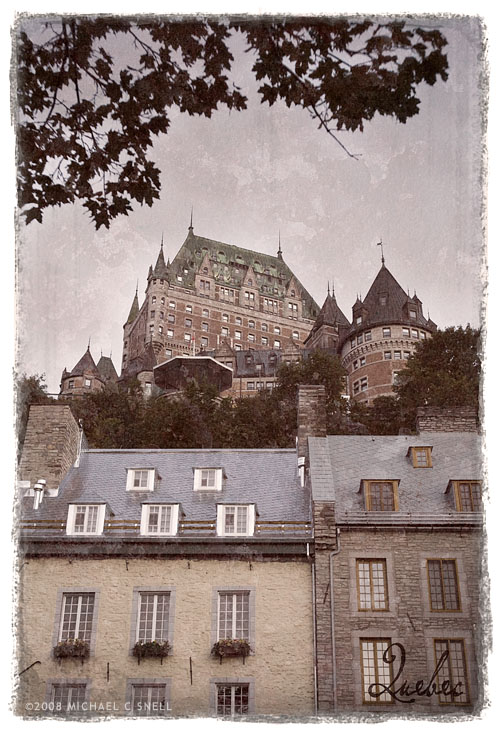
I’ve long been interested in finding a way to get that messy edge similar to what you see on Polaroid transfers but I want to achieve it in Photoshop and in a way that I can easily reproduce it without having to go through too many steps. Today I revisited this project and moved a little closer to my goal. Through the use of various texture shots I’ve collected over the years, masks made with rough-edged brushes and a liberal use of layer blend modes, I can now drop any image into this Photoshop document and it will give the above result with minor tweaking.

It’s still not entirely what I was shooting for. I wasn’t initially going for the overall aged look — I just wanted the edge. But, to my eye, the edge fit better when I textured the entire image. I’ll keep playing with it. Every attempt comes closer…

Siesta

Sol

It’s 70 degrees out. If anyone needs me, I’m on the deck with the Mrs. and a couple of long-necked friends…

Kristen in red

Kristen in red

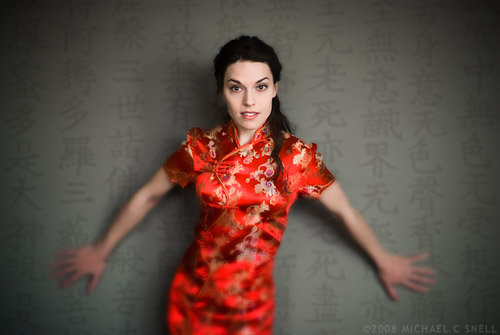
Here’s one more from the shoot with Kristen last weekend. This one is obviously a little more “processed”. I added the vignette and the blur in Photoshop and also overlaid a shot I had in my files of an old Korean manuscript. The background just felt like it needed a little texture.

Portrait of Kristen

Portrait of Kristen

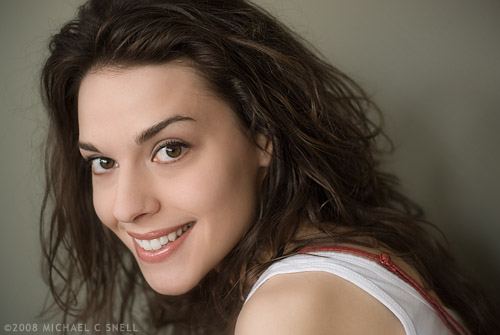
Something a little different today. A bunch of photographer friends and I have formed a rag-tag group called The Photodudes. We try and get together every now and then to make some photos and drink a beer or two. This past Saturday, we met at Doug Stremel’s office to shoot some lifestyle and fashion portraits. Doug had arranged for a few models to stop by — this is Kristen, shown above. Some of us shoot portraits professionally, others (including me) don’t. But that’s the fun of it. We share ideas and techniques and try something different. And it’s a lot of fun.

My brother, Bruce, actually IS a wedding and portrait shooter and he brought his new, tiny lighting kit along for the day. I had as much — or more — fun watching him work as I did shooting myself. And I think I’ll have to put together a light kit like his for the road. It would be really handy for the occasional location portrait.

Thanks, ‘Dudes, for another great day. Let’s do it again soon.

Peyto Lake Panorama

Peyto Lake

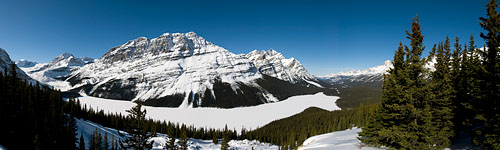
I returned from Canada late Saturday night and jumped right back into work on Sunday. Today I finally had enough of a breather to start the post-processing from this trip. The shot above is a pano created with the Photo Merge command in Photoshop from eight separate shots I took at Peyto Lake. I shot them vertically from left to right, handheld, with a fair amount of overlap between frames. What I ended up with is a 70+ megapixel image that has detail that’s hard to believe. I am so spoiled by Photo Merge. This would have been hours of work to manually fit these images together.

More Canada photos to come as I work my way through the files. It’s almost like taking the trip twice — although I’d much rather be there in person again. What a great location and great people. I hope to get back soon.

Maligne Canyon ice hike

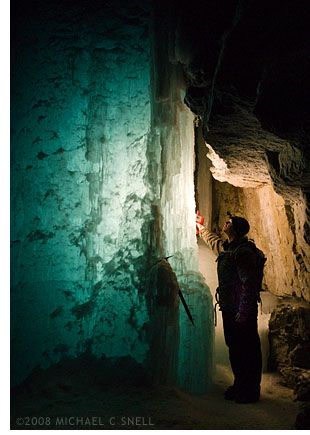
Maligne Canyon ice hikeI had a great experience last night on the Maligne Canyon ice hike in Canada’s Jasper National Park. This is a trip you must make with a guide. Boots and ice spikes are provided — a necessity for the second half of the hike when you are literally walking on the frozen and sometimes slushy river. It’s a pretty good trek from the parking area to the ice falls and fairly disorienting in the dark with only an LED headlamp to show you the way. There are a few overlooks at the top of the falls that are accessible during the day on your own but the fun of the night trip begins when the guide leads you off of the path and down into the canyon. It’s similar to exploring a cave except you can see the stars between the high canyon walls and many of the formations are ice instead of stone. This is not a trip that can be made in the summer as the river prevents all access.
To say that this was a challenge to shoot would be an understatement. It’s a three-hour trip and you’re not encouraged to linger too long in any one place. In my case, I was with a group which added the challenge of getting time exposures without other’s flashes going off. Still some nice images were made. Here the guide shines his hand-held light behind a frozen ice flow.

It’s a great trip and I would highly recommend it. Just be aware that it is exceedingly slippery in places and it pays to follow the advice of a good guide to get the best footing and avoid a wet and chilly surprise.

Snowshoeing at Lake Louise

Lake Louise

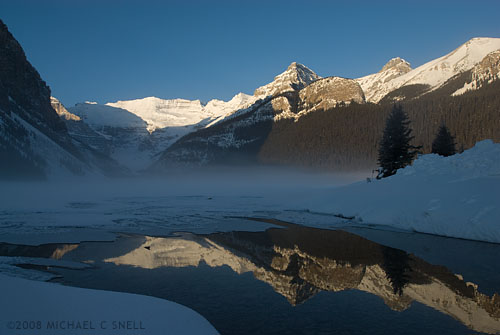
SnowshoeingGrabbed a few shots of Lake Louise this morning with some fog coming off of the ice. There was a patch of open water at the lake’s outlet that provided another nice opportunity for a reflection. The fog came up almost instantaneously and only remained for 15 minutes or so but it was beautiful while it lasted.

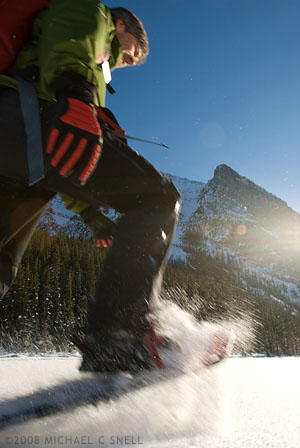
Afterward it was time to do some snowshoeing and grab a few shots of local outdoorsman Paul Sylvestre. I particularly liked this shot that I grabbed blind from a low angle as he walked past. “Kinneared”, if you will. I held the camera right down to the snow and panned with him as he went by, moving into his shadow as he passed to get him backlit. I ended up with several variations that I really like and I appreciate Paul’s choice of clothing for the day. It really popped against the snow and sky.