Category Archives: sunset

Lizhuang, China

150917lizhuang01_sotc

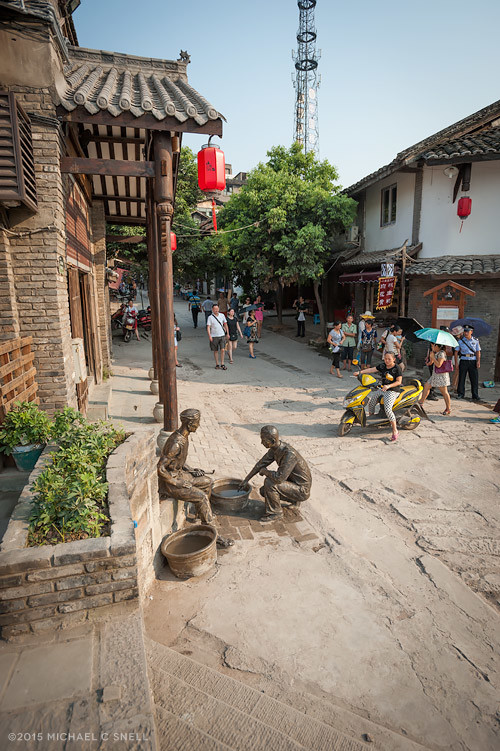
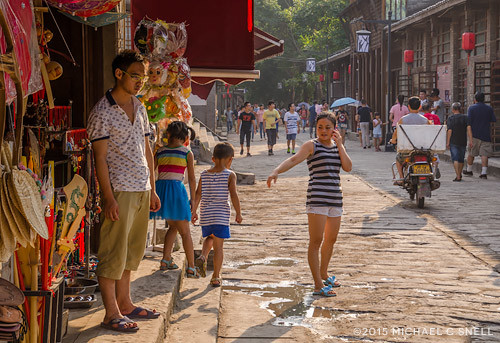
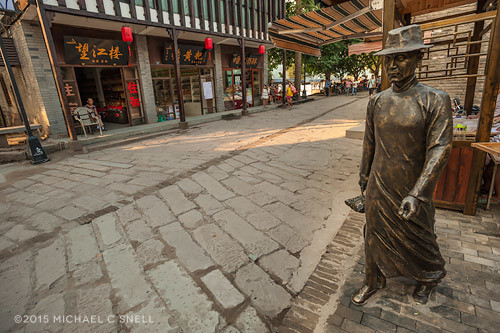
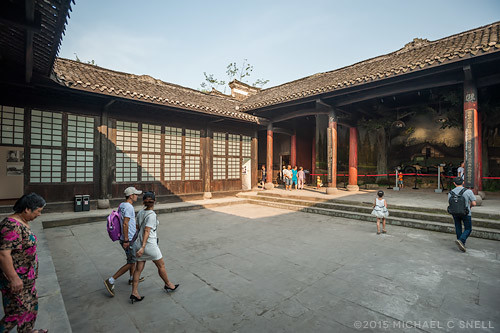
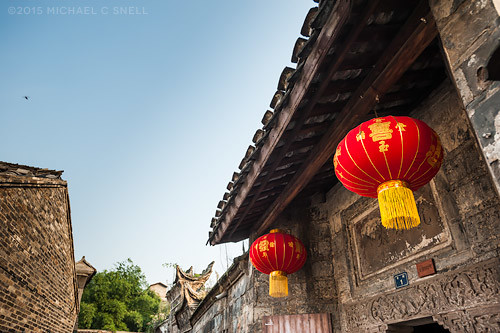
After the crazy distillery tour I wrote about in my last post, we seemingly went back in time by visiting the historic village of Lizhuang, China. The riverfront has apparently had quite a bit of recent investment put into it and the buildings have either been restored or rebuilt in an old style to house a variety of shops and restaurants. Here and there along the streets are bronze, life-sized statues depicting daily life.

150917lizhuang02_sotc

150917lizhuang03_sotc

150917lizhuang04_sotc

There was an interesting WWII museum in Lizhuang as well. In 1937, when the Japanese invaded China, many academic institutions relocated to towns like Lizhuang to be a safe distance away from the frontline. The museum tells that story through dioramas, artifacts and artwork:

150917lizhuang05_sotc

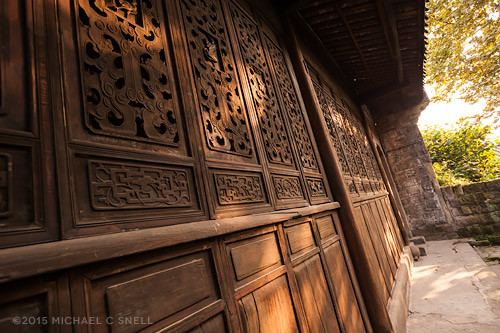
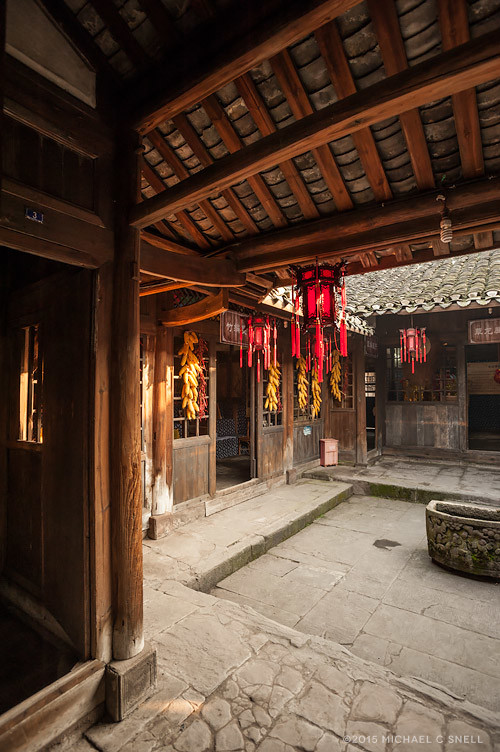
After the museum, we made our way back to the buses through the less-restored sections of the old town which were, in my opinion, more interesting than the more touristic sites along the river:

150917lizhuang06_sotc

150917lizhuang07_sotc

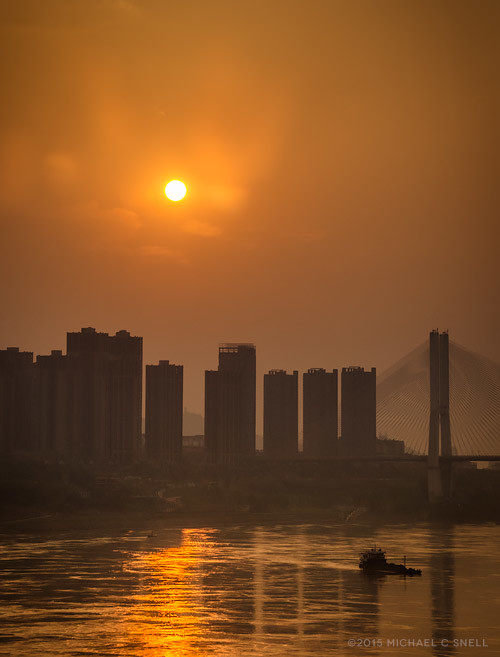
The sun just barely broke through the clouds as we neared Yibin, where two rivers join to create the Yangtze River:

150917yibin01_sotc

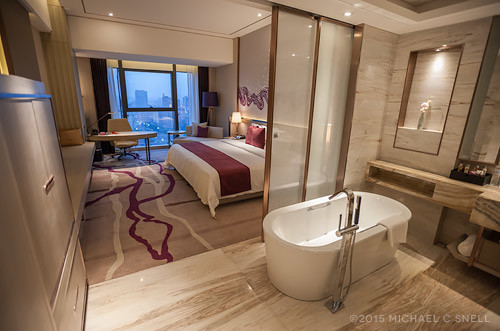
Time to check in to the hotel for the night. As it turned out, a group of us would be among the first guests to ever stay in the Crowne Plaza Yibin, which was having a soft opening (possibly just for this tourism event). I would be quite comfortable, if not spoiled, during my stay:

150917yibin02_sotc

All in a day’s work

150625heron_sotc

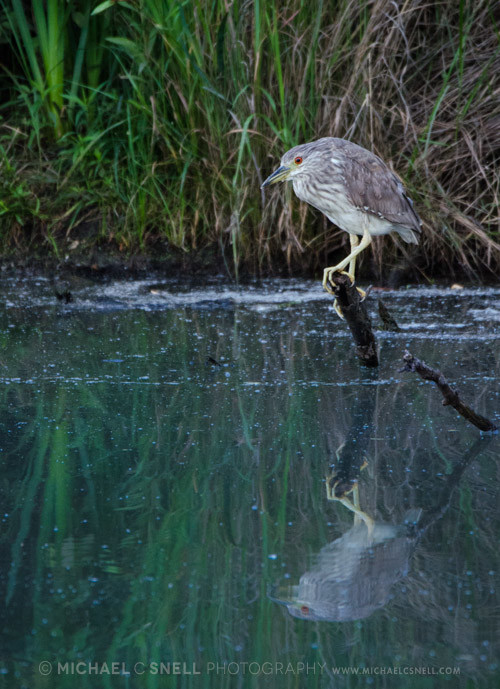
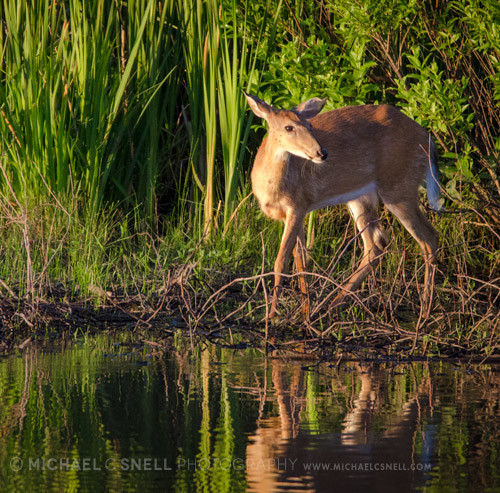
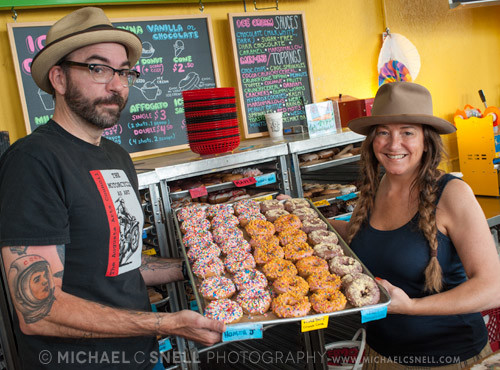
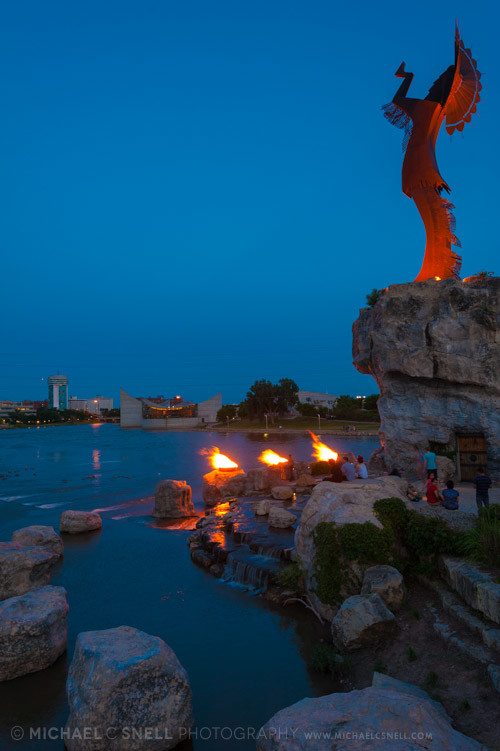
There’s not too much to tie these images together other than that they were all shot on the same day in Wichita, Kansas. Started off the morning with a little wildlife outing, managed to find myself in the awesome Donut Whole and finished things off seeing the flames lit at the Keeper of the Plains. There was much more in between, but it was really kind of a typical day in the life of a travel photographer. Never time to get bored.

150625deer_sotc

150625donut_sotc

150725keeper_sotc

The Grand Canyon

150405canyon_sotc

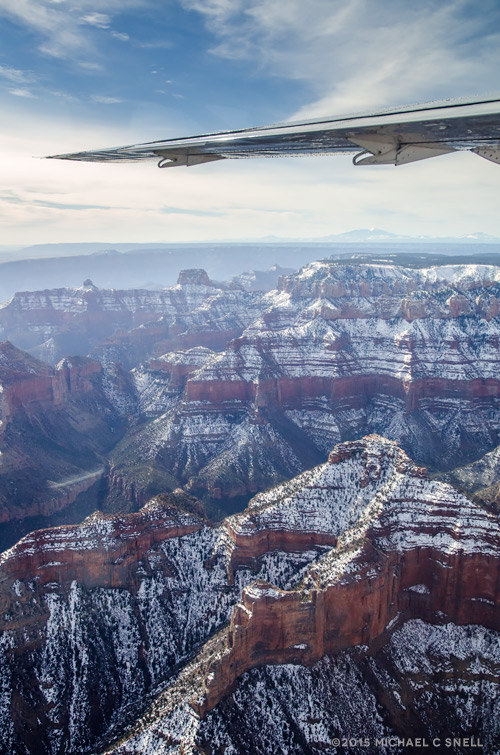
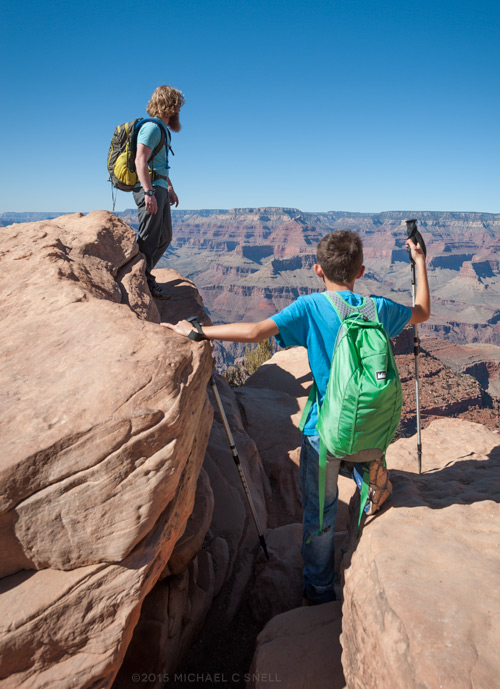
I consider myself to be fairly well-traveled — especially within the United States — but, even so, there are a few top-tier destinations that have eluded me for no good reason. The Grand Canyon has been one of those until last month. It had become almost embarrassing to admit that I had never seen it but now I can put those days behind me.

150405canyon02_sotc

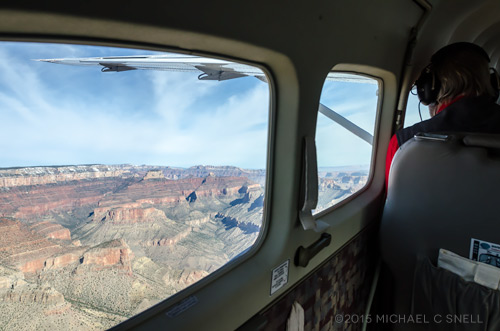
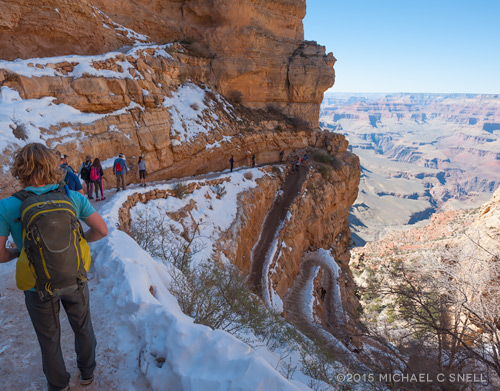
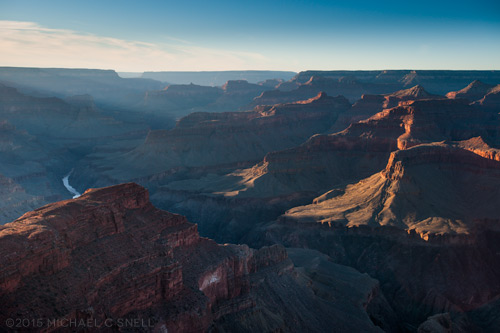
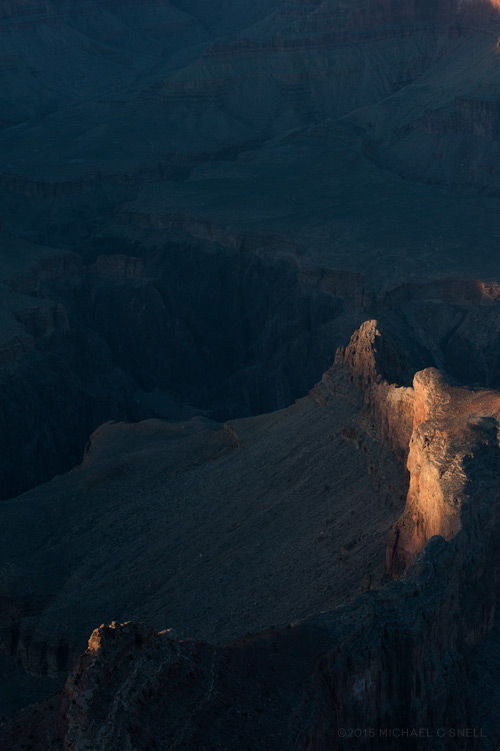
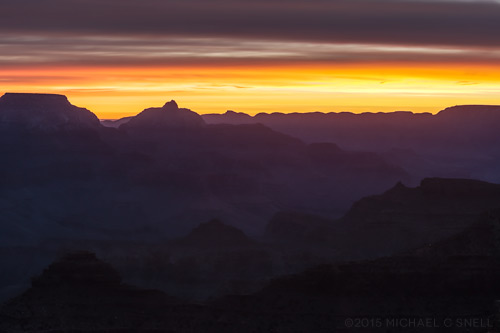
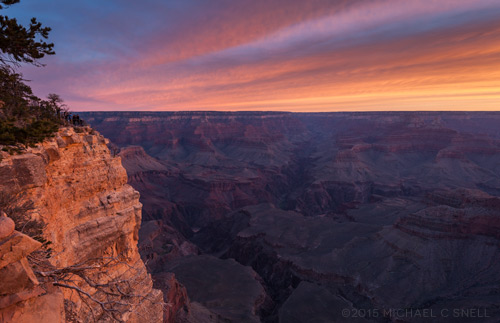
Statistics show that the average visitor spends very little time in the park — like as little as an hour, with maybe only a few minutes at an actual overlook. While I didn’t spend a huge amount of time there either, I did beat the average and actually got to see the canyon from the air, from the perspective a trail, and I photographed both a sunset and sunrise from the rim. Not bad for a first visit, but I’d happily return for much, much more. I feel I barely scratched the surface, and that is probably an overstatement.

150405canyon03_sotc

150405canyon04_sotc

Sunset:

150405canyon05_sotc

150405canyon06_sotc

Sunrise:

150405canyon07_sotc

150405canyon08_sotc

Iceland, Day 3, continuing eastward

141003iceland02_sotc

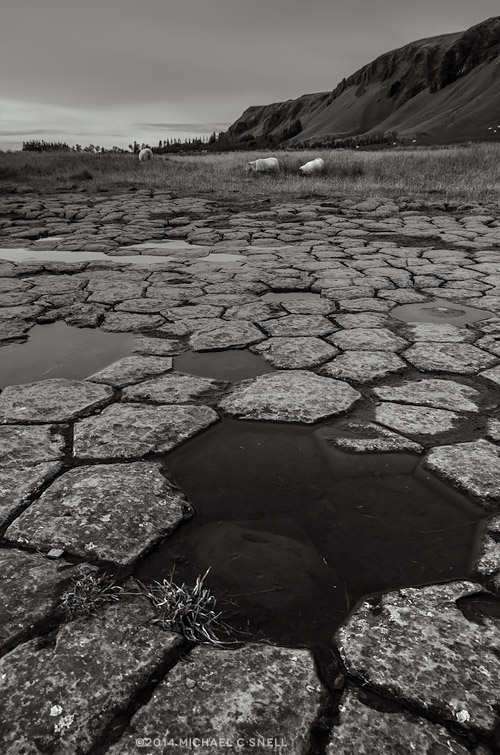
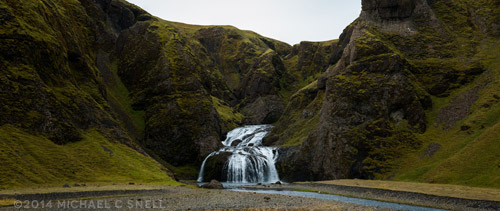
My third day in Iceland was going to require a lot of driving but I made a couple of quick stops not far from my hotel in Kirkjubæjarklaustur before hitting the road. First up was Kirkjugólf, or “church floor” (above). A natural feature of basalt columns that resembled a tiled floor. Nearby was the waterfall, Stjornarfoss:

141003iceland03_sotc

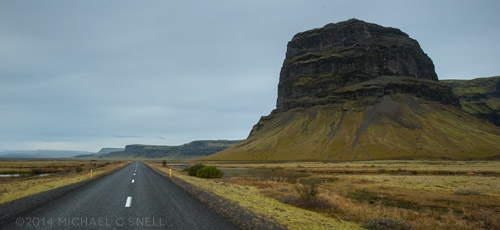
I was still trying to make up time for the day before when I’d had to return to the international airport to retrieve my “lost” luggage. I’d hoped to have gotten to another waterfall, Svartifoss, on day two and then photographed the mountain Lómagnúpur at sunset on my way back to the hotel. I’d had to cut my day short, however, so I finally passed Lómagnúpur early on the morning of day three:

141003iceland04_sotc

I stopped at the trailhead for Svartifoss but the shorter trail appeared to be closed and I didn’t have time to take the longer route. It became another thing for my “on the way back” list and I kept moving eastward, occasionally distracted by the glaciers which were now beginning to appear to the north:

141003iceland05_sotc

141003iceland06_sotc

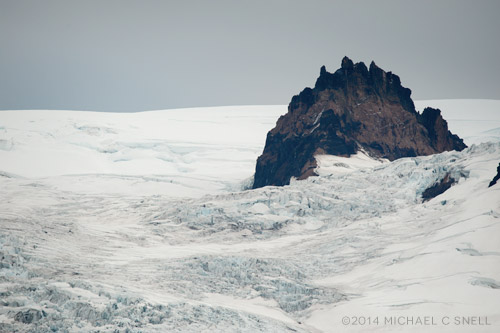
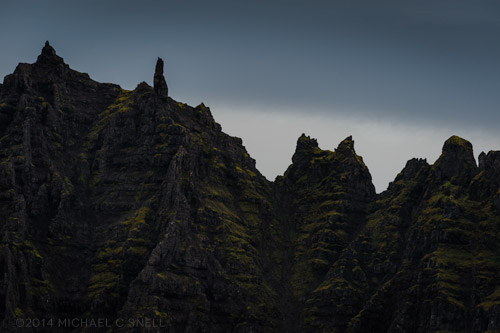
It’s really amazing the amount of diverse landscapes that you can encounter in a few hours driving along Iceland’s south coast. There’s generally a flat plain along the shore that makes for easy, level driving but, just to the north of the road, the land often abruptly rises up in a fantastic array of crazy mountains. Then, after crossing another vast field of black sand and rock, you suddenly arrive at Jökulsárlón — the iceberg lagoon:

141003iceland07_sotc

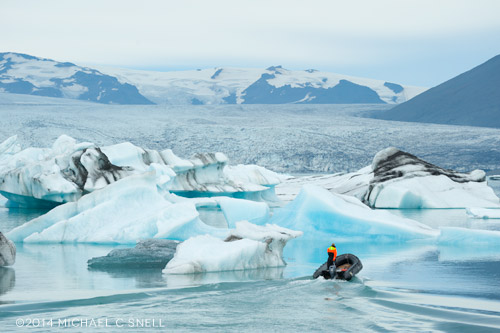
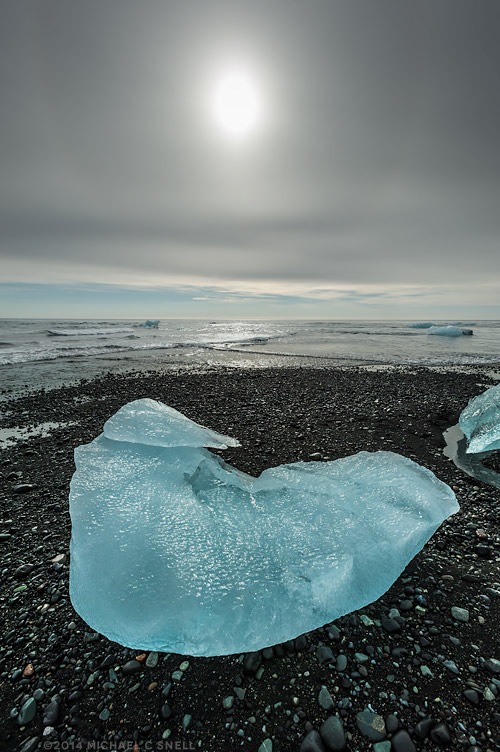
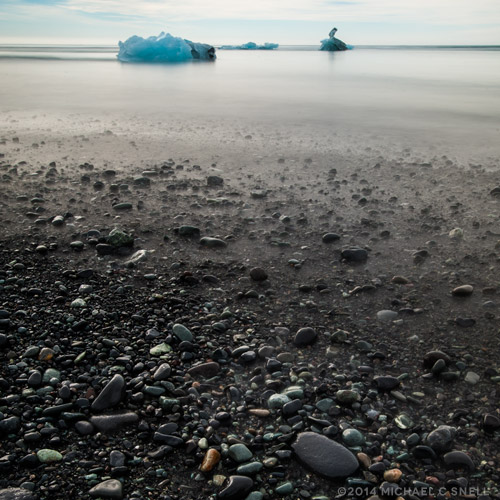
Here, large chunks of glacier calve off into a bay and are trapped until they melt enough to drift out to sea. On the ocean side of the road, remnants of the ice dot the black beach waiting for the tide to return and take them out into the Atlantic.

141003iceland08_sotc

141003iceland09_sotc

Back on the ring road, I continued east and eventually found myself in Iceland’s East Fjords:

141003iceland10_sotc

I stopped for a late lunch (mushroom soup) in the village of Djúpivogur. I ate at an outside table, overlooking this quiet bay. The weather was absolutely perfect. Pleasantly cool, sunny and very little wind.

141003iceland11_sotc

I also had my first experience buying gas just outside Djúpivogur. Opportunities had been few and far between, the farther east I went, and I didn’t want to get caught with an empty tank on some lonesome stretch of road. I found a station on the outskirts of the village that was unmanned on the weekend, its doors locked, but the pumps appeared to be self-service. I remembered (luckily) that my Tiguan required diesel, and set about trying to decipher the instructions on the pump. I inserted my card and was prompted for a PIN, which I never have to use in the States. I made my best guess, hoping that — if I was wrong — it wouldn’t keep my card and run it through a shredder inside the pump. Luckily, I managed to guess right, but was then prompted to enter the amount I wanted to spend on gas. Hmmm… Diesel… in liters… in krona… who knows? I made another guess — which was woefully inadequate — but in a second attempt at the whole process, managed to end up with a full tank once again.

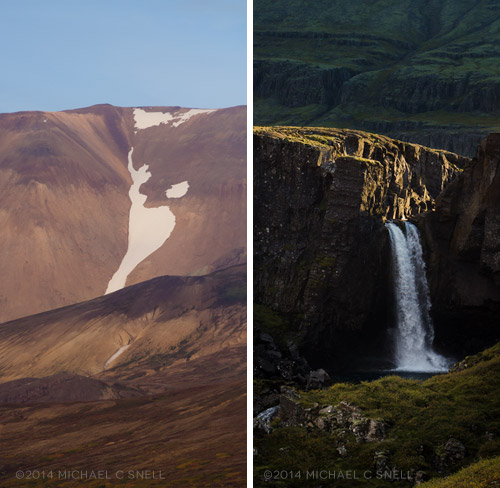
As I continued on, I left the Highway 1 and took a gravel road to a waterfall — Foldafoss — that I’d found during my online research. It was a fantastic setting, with the sun setting and backlighting only a bit of the canyon wall above the falls (see at right, below):

141003iceland12_sotc

I made a few photos here and then decided to continue on up the gravel road to shortcut my path to that night’s hotel in Fljótsdalshérað. The gravel road was well-maintained but became extremely steep with sharp switchbacks as it climbed its way up the mountains. I rejoined Highway 1 once on the ridge and the rest of the drive was fairly uneventful, although it passed through some beautiful country. Occasionally, I’d catch glimpses of the bridges left over from previous versions of the ring road:

141003iceland14_sotc

141003iceland13_sotc

For the first time on this trip, I was beginning to see signs of the volcanic activity taking place in Holuhraun. The eruption had begun even before I had arrived and there was some question of whether it might progress to the point that it would disrupt air traffic like the eruption in Iceland in 2010. So far it was fairly well behaved, although the hotel lobbies in the eastern part of Iceland had large signs giving volcano updates. Air quality was getting poor in some areas but the wind direction had so far kept the smoke and vapors well away from the area I had been traveling in. Now that I was circling back on the east side of the volcano, however, the sky began to show signs of volcanic particles. The sunset was one of the odder I’ve ever seen, at times taking on an almost oily quality.

141003iceland15_sotc

I settled in to my hotel and walked across the road to a grocery store, thinking to lay in a supply of snacks for the next few days of driving but, being a saturday, the town seemed to close down after 6:00 and all I could find that was open was a Subway sandwich shop. Not my most glamorous meal while in Iceland, but a welcome one after a long day’s drive through some spectacular scenery.

Almuñécar, Spain, on the Tropical Coast

140630almunecar01_sotc

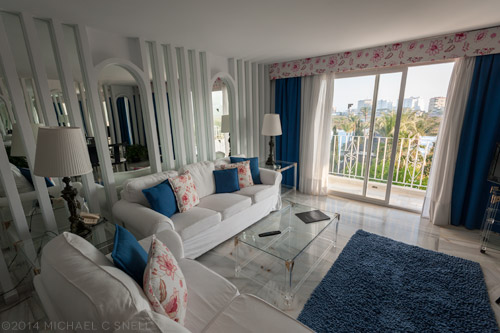
Almunecar, Spain, sits on the Mediteranean Sea, fringed with palm trees. At first glance, it seemed the kind of place I could have spent a lot of time. Happily. We’d had a busy day along the Tropical Coast, however, and we were running a bit late. Sunset was not far off when we arrived in town. I had mapped out a couple of promising looking spots on the beach to photograph the last light and I was rushing to get checked in to the Hotel Suite Albayzin del Mar. The hotel is a spectacularly mirrored palace with sprawling gardens. When I was given my room key, it came with an elevator number, a floor number and the room number. It seems that each elevator only served about four rooms per floor and there weren’t connecting hallways beyond that. When I arrived at my room, I realized the elevator was not the only thing special about this hotel.

140630almunecar02_sotc

The rooms — no, suites — were enormous. This is just the living room half of my main room with a full dining area to the right, out of frame. I opened one door, expecting to find the bathroom and realized it was a full kitchen, with an extension that served as a laundry room. Another door led to a hallway opening onto a bath and two bedrooms. All along the sea-side of the room was a balcony. I dropped by bags and rushed out to assess the situation regarding the remaining light.

140630almunecar03_sotc

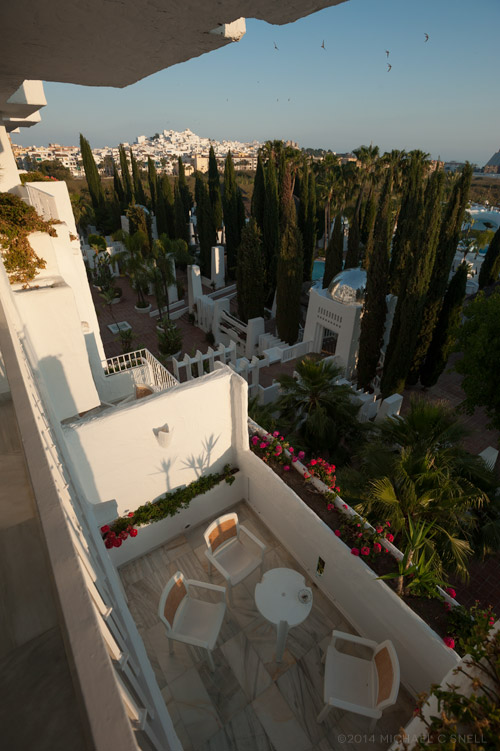
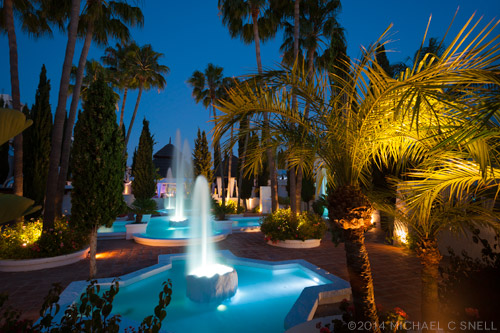
Out on the balcony, the view to the old town was stunning, as were the pools, fountains and gardens of the hotel property.

140630almunecar04_sotc

Looking west, I could see that the sun was already dipping behind a hill, so my time with any remaining sunlight was very limited. I decided to ditch my plans to head for the beach, and I made an executive decision to make what photos I could from the balcony and other parts of the hotel property.

140630almunecar05_sotc

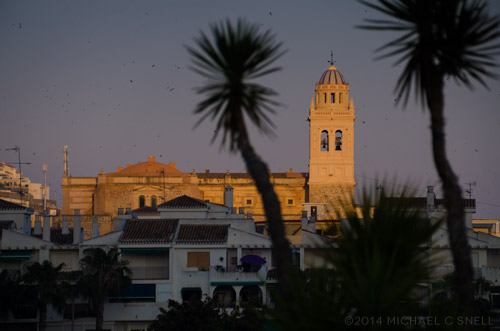
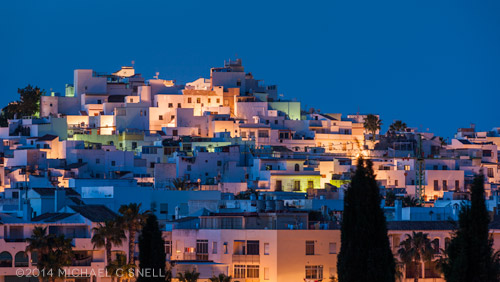
As it turned out, I didn’t feel overly limited in subject matter. I loved this view through the trees of the old church catching the last rays of the sun. That was made from a raised area above and behind the pool seen below.

140630almunecar06_sotc

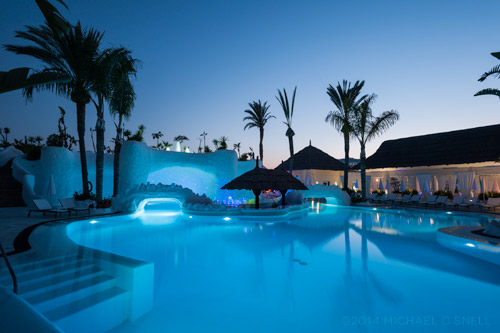
The pools themselves were amazing. This one had a sunken bar in the middle and a grotto filled with twinkling lights.

140630almunecar07_sotc

I dashed around the property taking time-exposures on the tripod until the light failed and my battery was dead. It wasn’t the evening that I had expected, but it was a productive one and I had enjoyed myself immensely.

140630almunecar08_sotc

The next morning I was up before sunrise and caught some more beautiful views of the old city to the east of the hotel. Not long after, I was back in the van and headed to the next town.

Flames in the Flint Hills

140407fire01_sotc

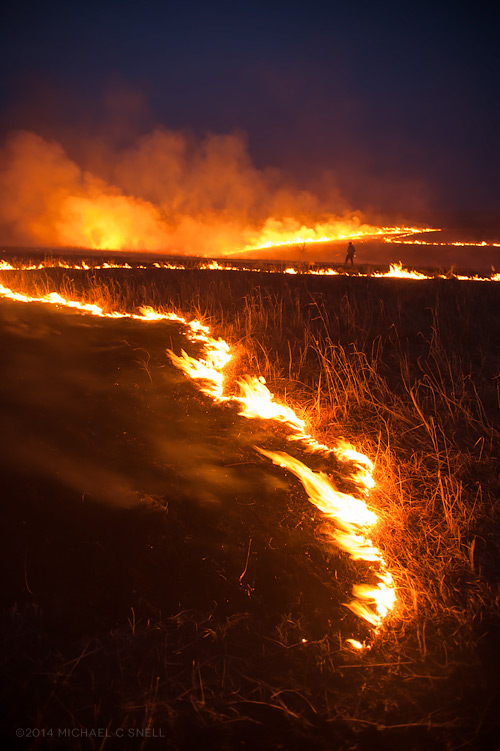
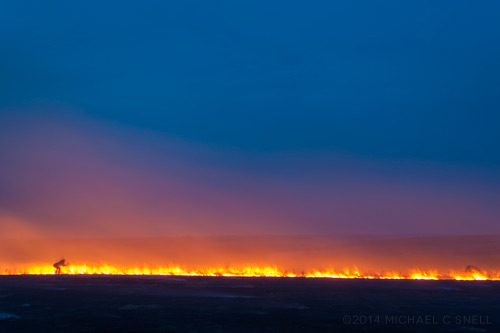
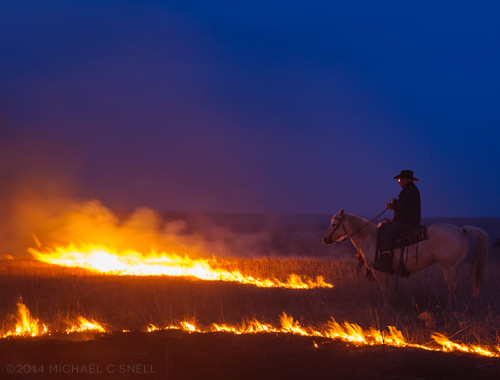
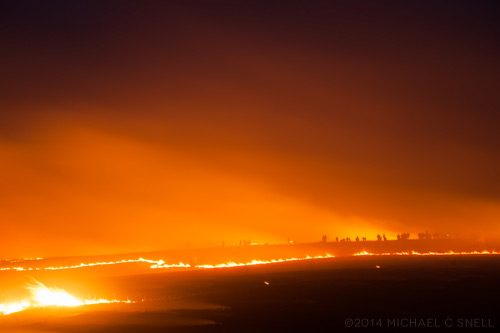
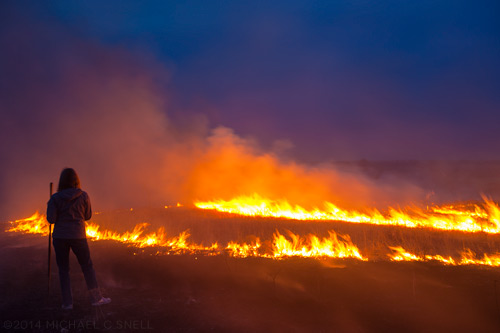
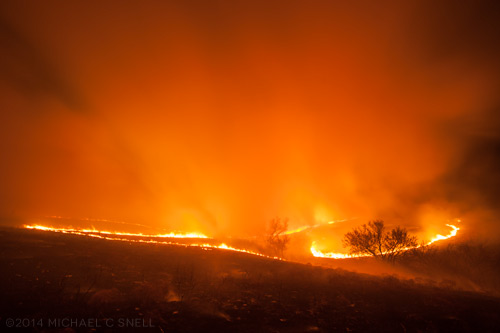
Flying W Ranch near Clements, KS, puts on a great show with their Flames in the Flint Hills. Ranchers in this part of Kansas burn their grass in the early Spring to encourage new growth and Josh and Gwen Hoy make an event out of it. Typically a sold-out event, at that. For those of us that live around the Flint Hills, the smell of burning grass is a sure sign of Spring. It’s not uncommon to see fires in the distance from the highway, but to be on foot right in the midst of the burn at twilight… well… that’s something special.

Here are a few of my favorite shots from Flames in the Flint Hills last Saturday night:

140407fire03

140407fire06

140407fire04

140407fire02

140407fire05

Balcony views

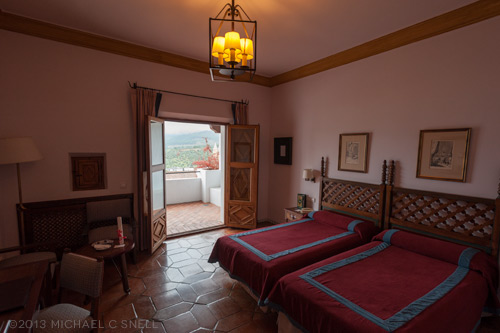
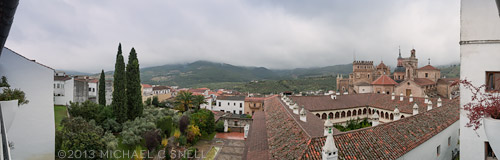
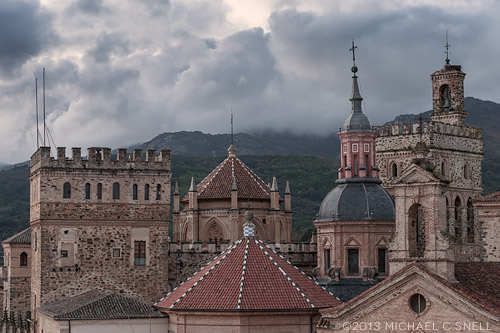
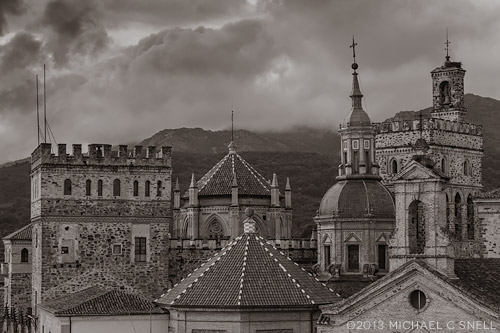
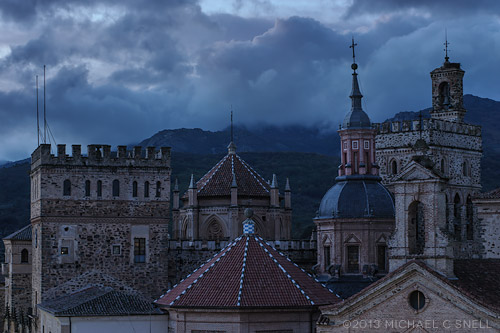
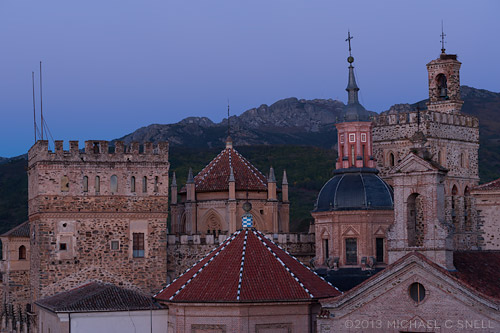
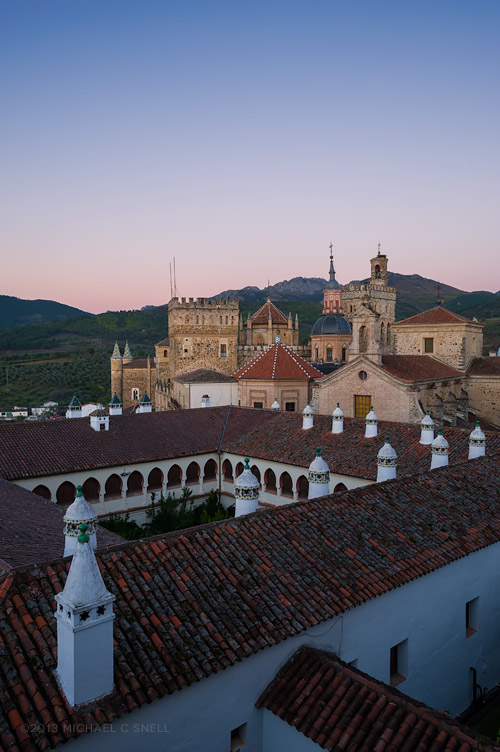
I thought I’d follow up on my last post with a few shots from my room at the Parador de Guadalupe. As I mentioned before, we stayed in Paradores most of our nights in Spain and they never disappointed. Each is unique architecturally, food/service was excellent, and you just couldn’t beat their locations. However, of all of them I encountered, I think I was most taken with the balcony view from my room in Guadalupe. I had very little time to spend in the room, but both sunset and sunrise found me out on the balcony, photographing that view. Sometimes you have to really work hard to find the right location — the perfect angle — and sometimes it’s just handed to you.

Here is a view of my room and a stitched panorama of the overall view from my balcony:

131226guad20_sotc

131226guad13_sotc

These were taken just after checking in and before taking a tour of the monastery, seen in the right of the panoramic image. By the time I got back to the room, the clouds were more defined and the sun was beginning to set, so out I went on my balcony:

131226guad05_sotc

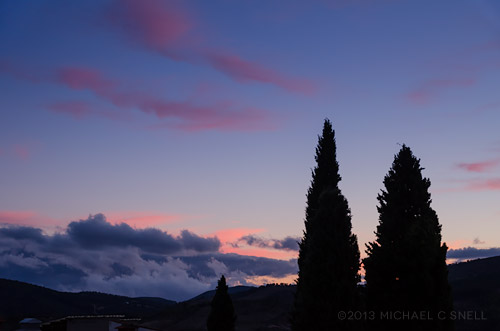
I settled on this view (above) with my full-frame Nikon D700 and locked it down on the tripod to get a series of shots as the light changed. I was hoping that, at some point, some exterior lighting might come on to contrast with the cobalt blue skies that I expected just after sunset. The sun was actually going down to the left of this scene so, while my one camera body was occupied with the monastery, I shot variations of the sunset itself with my D7000:

131226guad12_sotc

The D7000 shots were hand-held so I had to increase my ISO to achieve a faster shutter speed. I knew that would result in more noise, but I was less concerned about that in these shots than in my primary images that I was shooting with the D700.

131226guad10_sotc

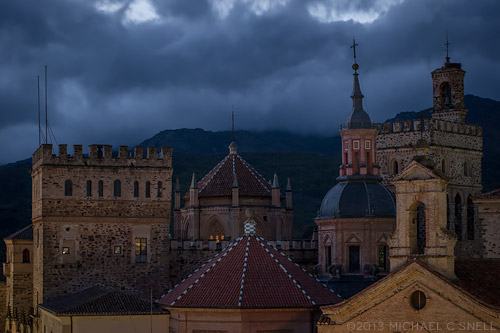
The coloration was less interesting at first, but the clouds were fairly dramatic. Converting some of these early shots to black and white (using Lightroom 5 and/or Photoshop CC) was a nice solution. The next series of images shows the gradual darkening of the sky and the subtle warm colors that began to emerge from the street lights that were bouncing back to illuminate the towers.

131226guad06_sotc

131226guad07_sotc

131226guad08_sotc

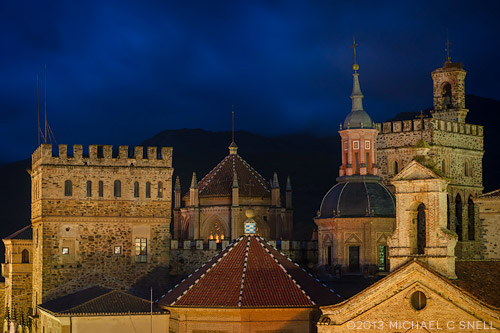
While there never were any floodlights or other exterior illumination on the monastery, the bounced street lights were enough to add quite a bit of warmth as the evening got darker. The shot above was taken well after dark and the intensity of the colors shown here was not visible to the eye. Only the long exposure was able to draw it out, softening the sky at the same time by the blur of the moving clouds. I was using 30-second exposures at this point.

The next morning I resumed my position for sunrise and caught a few pre-dawn images with a beautifully clear sky:

131226guad09_sotc

131226guad11_sotc

One last shot of the monastery just before sunrise with the main courtyard of the Parador seen in the foreground. Once the sun broke over the mountains, the light was actually a little too harsh for my taste and several of the towers were casting harsh shadows on one another. It was time to pack up the gear anyway before grabbing a quick breakfast and heading off to our next stop: Merida, Spain.

You can learn more about the Parador de Guadalupe on their website, which I notice has been redesigned just in the last couple of weeks. Lots of good info there if you’re planning a visit in Spain.

Caparra in the dying light

131206caparra1_sotc

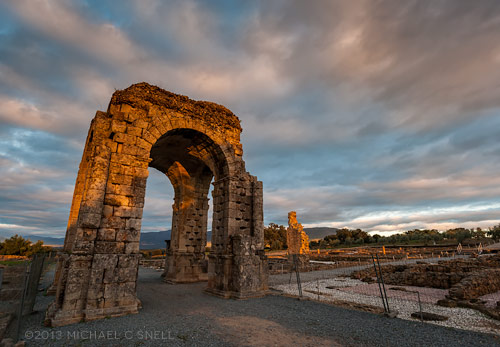
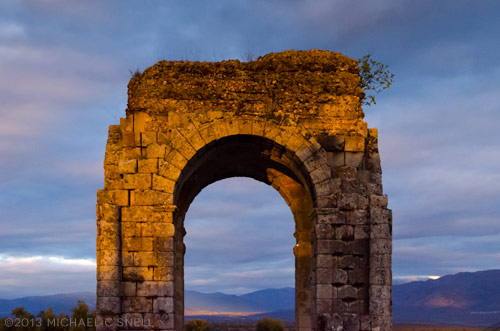
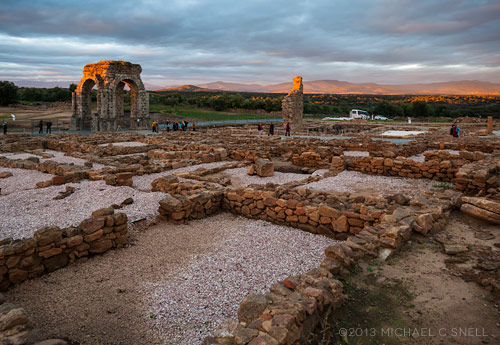
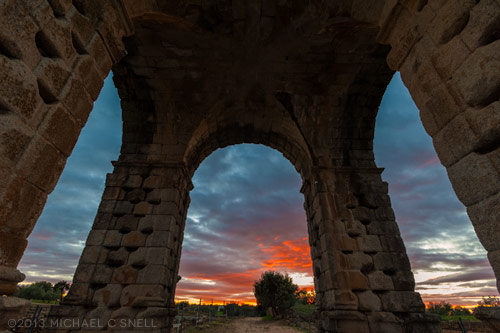
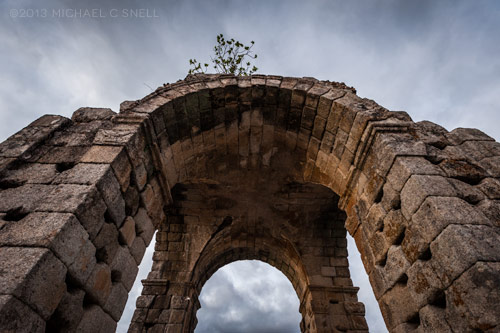
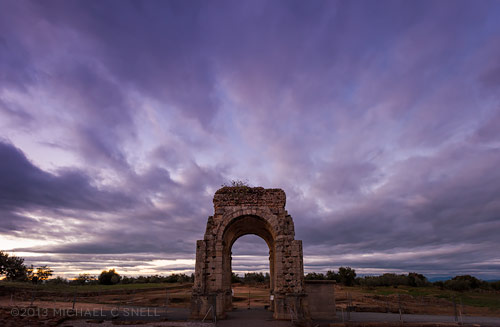
As I was researching the Extremadura region before leaving for Spain, I was surprised to keep running across mentions of Roman ruins. Obviously, the Empire was huge at one time and there are ruins scattered all over Europe and points beyond but we tend to only hear about a handful. The first we visited on this trip was the site of the Roman city of Caparra. Most notable of what remains is this 1st-century, 4-way arch, built at the intersection of two prominent Roman roads on the Via de la Plata (Silver Way).

131206caparra2_sotc

We arrived at the Caparra ruins just as the sun was setting and for the next 30 minutes, I scrambled to make the most of the fading light and ever-changing sky.

131206caparra3_sotc

131206caparra4_sotc

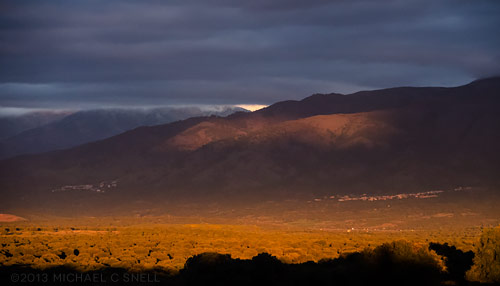
The surrounding countryside was equally stunning as the sun slipped below the low hanging clouds, painting the distant hills in gold.

131206caparra5_sotc

131206caparra6_sotc

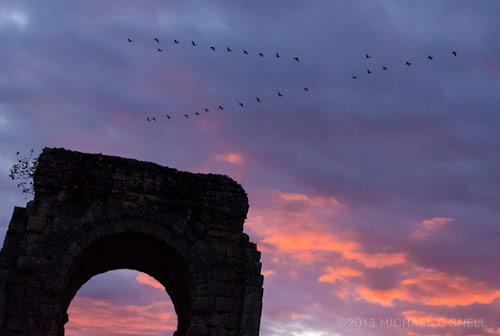
Migrating cranes, right on cue.

131206caparra7_sotc

131206caparra8_sotc

One of my final shots after the sun had set but while there was still some purple twilight remaining. Next, we were off to Plasencia with another stunning Parador and an interesting 2-in-1 cathedral. More on that in my next post.

Shooting tethered

130323robot_sotc

It’s snowing outside so I’m playing indoors today.

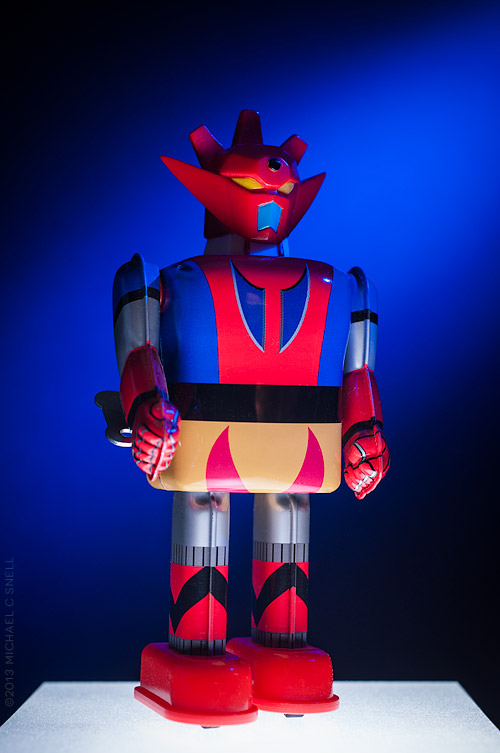
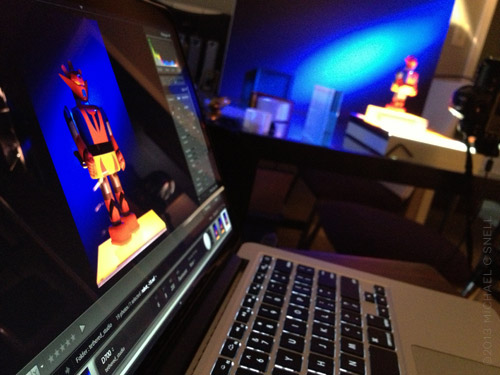
I’ve been setting up my new 13″ Retina MacBook Pro and ran across an article about shooting tethered in Lightroom 4. I thought I’d give it a try, even though I only do a small amount of studio photography compared to field work. For some reason I always thought that tethering would be a lot more involved than it turned out to be. In fact, all I needed was a USB cable to connect my Nikon D700 to my MacBook. Turn on the camera and open Lightroom and, under the “file” menu, you can initiate tethering. Lightroom found the camera automatically and in no time I had a little toolbar added to my Lightroom interface that showed my camera settings: shutter speed, aperture, white balance, etc. Here’s a glimpse of the setup:

130323robot2_sotc


The Lightroom toolbar has a shutter button so you can fire the camera from the laptop. Hit the button and the camera makes an exposure that is immediately transferred to the laptop and opened for review right there in Lightroom.

I know. Lots of photographers have been doing this for years and it’s nothing new, but it was a revelation how easy it was to set for a first-time user like me. I’m reminded of the first time I realized that my Nikon had a built-in intervalometer for shooting time-lapses. More and more often, features that used to be costly added expenses are now built into modern gear, although sometimes they’re not heavily promoted. It pays to noodle around a bit every now and then to see what wonders are hiding in those electronics.

You know, I was thinking that this tethering feature wouldn’t be all that useful in the field but, now that I think about it, it could be extremely handy when doing things like night photography. I know when I was shooting the Milky Way in western Kansas last summer, it would have been nice to have had a way to be able to check exposure and focus during the shoot better than I was able to do on the camera LCD. The USB cable travels with me anyway, so this capability comes at no extra expense, weight, or bulk. Just the kind of thing I like.

Fountain shoot, behind the scenes

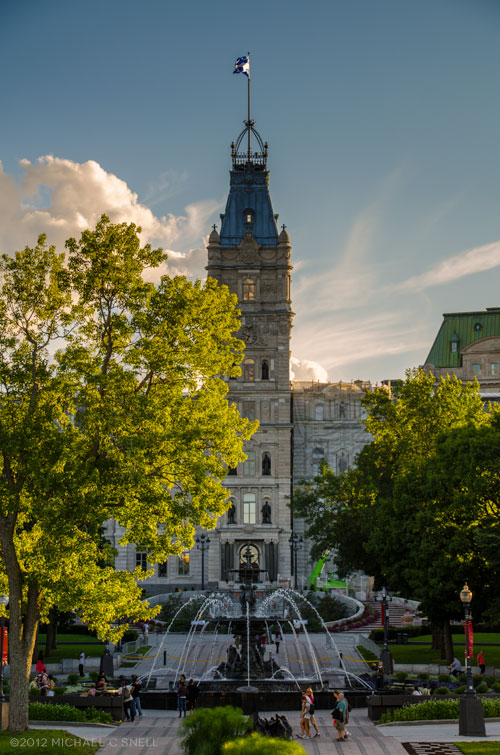
On my last trip to Quebec City in 2007, I never had an opportunity to get a good shot of the Fontaine de Tourny, located in front of the Parliament Building. The fountain was brand new at that time — if you can call something new that was built in France in 1855, put in storage in 1960, and relocated to Quebec in 2007. You can find the whole story here.

Anyway, it’s one of those shots that I felt should be in my files because the fountain has such a great story and it is rapidly becoming yet another landmark of this already beautiful city. So… when I went back to Quebec last month, this fountain was high on my shot list.

I captured the above photo on my next-to-last day in town but it’s not the one I originally had in mind. I really wanted a shot that made the fountain the hero and included the Parliament Building as context. I also wanted to shoot at twilight to get the most impact from the color in the scene.

Early on my first free evening in Quebec I set out with my D700 and a tripod and began scouting out my angle. Things are rarely perfect and this day would be no different. It was cloudy, first of all. Not puffy, dramatic clouds but heavy, overall grey clouds that pretty much made for a dead sky. Grey sky, black fountain, stone building. Not a lot of color so far. Still, you never know what will happen and twilight can be magical in any weather. Secondly, I found that half of the Parliament Building was covered in scaffolding and there was a big, lime-green crane right in front. Scaffolding had been everywhere on this visit — even the most prominent element of the Quebec skyline, the Fairmont Le Chateau Frontenac, was getting a new copper roof. The Parliament Building I could work with, though. It just took a little finesse to hide of the bulk of the scaffolding behind trees and hopefully the green crane would disappear as night fell.

Here’s my initial exposure at 7:29 with the composition pretty much established:
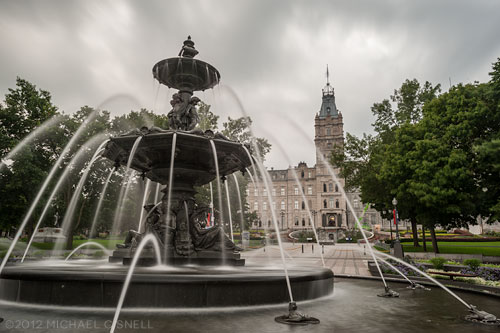
A little grey overall but it was early yet and I knew from experience that even grey skies can go cobalt blue for a few, short minutes at twilight. Patience.

A couple of other details for you photographers: I wanted not only the fountain’s water to blur but also the clouds, which were moving fairly quickly. To achieve this before darkness, I stacked my ND filter and my polarizer to cut down as much light as possible. I stopped down mostly around f/11 or f/16 because I find this lens (my Nikkor 17-35mm)  to be sharper in that range than it is all the way down to f/22. That first shot was 5 seconds at f/16.

Here’s a shot from a bit later in the evening around 7:48 — 30 seconds at f/22 (I accepted the loss of sharpness for more blur on this one):
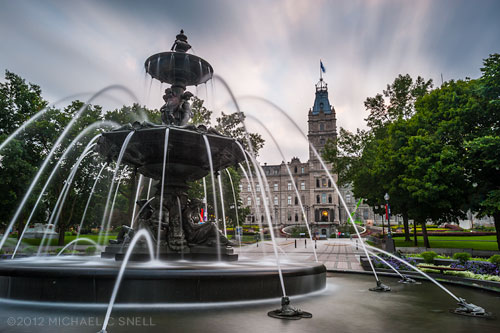
You can start to see the cloud effect in this one. I kept firing a shot off every few minutes, whether it looked like anything had changed or not. I tried some shots with traffic blurring in the background, while on other shots I tried to avoid any cars at all by taking advantage of the nearby traffic signals.

Right around the time of that last shot, this guy shows up:
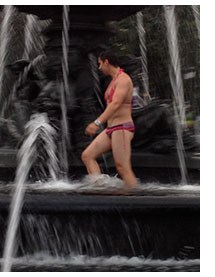
I have no explanation. A group of guys had wandered up with “protest” signs in French, so I had no idea what they said. Then this guy then strips down to his… bikini (mankini?)… and proceeds to strut around in the fountain while all of his buddies video-taped him. Okay, to be honest, I shot some video on my iPhone as well. What are you supposed to do when something like this happens?!? His friends seem thrilled with his performance and were shouting and cheering and egging him on.

Huh. Luckily he didn’t stay around long enough to ruin any of my long exposures during the fleeting prime light.

This is the kind of thing that could easily distract the amateur photographer. But, as a consummate professional (ahem!), I took it all in stride. I shot my little video to share with friends later, and returned my thoughts to the task at hand. There would be time to ponder this moment later. Strange as it may seem, this isn’t the craziest thing I’ve encountered on a shoot.

I’m starting to get a little color in the sky at this point and there are even occasional cloud breaks and patches of blue. Happily most of the breaks occurred right about sunset time, giving some really nice color for just a brief period of time:
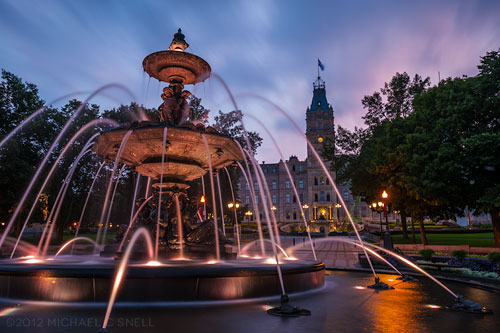
That’s about 8:03, 13 seconds at f/11. The fountain lights were coming on just as the sky was getting nice. I’m liking the balance here. But there’s still more to come. Little by little more lights come on. I notice the floodlights on the front of the parliament building come on extremely green at first but, after they “warm up” a bit, they gradually become a more pleasing tungsten-like color. A good reminder to not pack up too early but to wait and see what happens with time.

During all of this time I played with different apertures and color balances. The latter is mostly just to experiment in-camera. I can easily change the white balance later in Lightroom but it’s interesting to see the changes it makes in such a mixed bag of color temperatures while on location. I tend to like a fluorescent balance on the camera’s screen but I do still tweak it considerably later in Lightroom. Here’s where I was at by 8:24 (30 seconds at f/8):
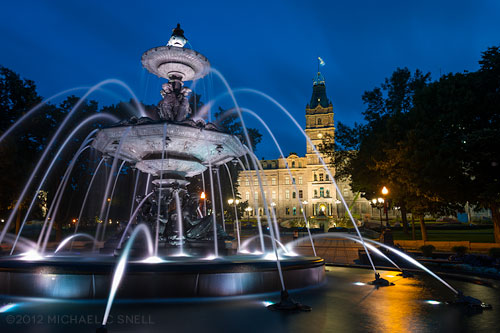
This is closest to the shot that I had pre-imagined, but I now actually like some of the earlier shots better. Even with the cloudy sky, I knew I had a good shot at getting that cobalt blue color after sunset (which contrasts nicely with the warm artificial light on the building), but the earlier pinks and purples in the sky were an unexpected treat.
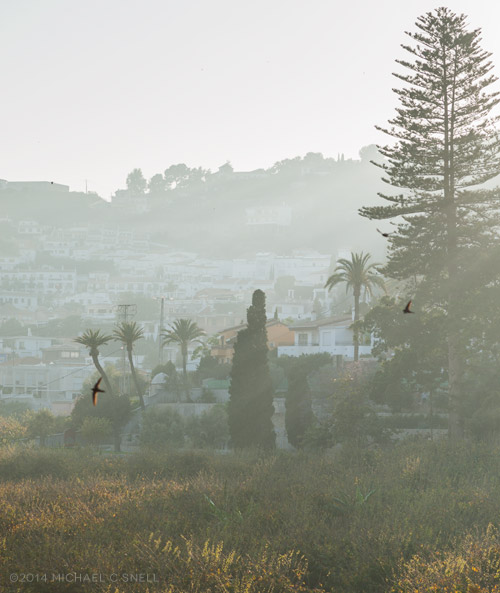
In the end, that’s about an hour of actual shoot-time but it yielded quite an array of looks. Some of the early, grey shots might make really dramatic black and whites, while I have three or four pretty different twilight looks that might each appeal to different buyers when these get into the stock libraries.

Not bad for an evening’s work.