Category Archives: germany

Altes Rathaus

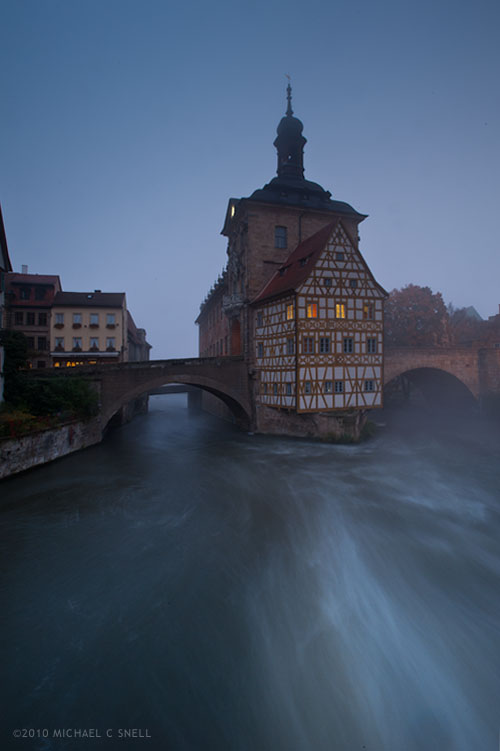
As soon as I saw the 14th century old town hall — the Altes Rathaus — built in the middle of the river Regnitz in Bamberg, Germany, I knew I needed to dedicate some time to shooting it. Unfortunately, I was leaving the next morning at 8:00 am. It’s okay, I thought, I‘ll get there before sunrise and shoot some long exposures with the tripod before it gets too light out and be back in time to check out of the hotel and catch my ride to Regensburg. I rose very early the next morning and looked out the window to thick fog drifting past the streetlights. Not such bad news — I love fog — I just hoped I could see the town hall from the footbridge I had scoped out on the map the night before.

I packed up so that I’d be able to leave the hotel quickly after my shoot and headed out into the mist with my tripod over my shoulder. Through the winding streets, I eventually found the river and the footbridge. It was foggy, no doubt, but it was lifting. There was just enough left to give a nice mood. It was still quite dark out but I added a neutral density filter anyway. I wanted to cut out even more light in order to extend the length of my exposure to let the water blur and give some sense of motion. The rivers run fast in this part of the world and I wanted to convey that.
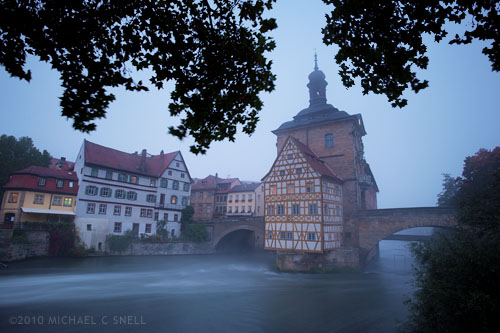
The footbridge had a little bounce to it and I had to time my shots between the locals crossing on bicycles so that the vibrations wouldn’t blur my shots. Once I had a few variations I was comfortable with, I set off to find other vantage points. I had little time but wanted to make the most of it. There are a whole series of bridges crossing the river in this area and I zig-zagged my way back and forth down the river shooting from each of them.

I left myself a little time so that I could continue to shoot a few things on the walk back to the hotel. This is one of my favorite times of the day when traveling. It’s when you get to experience the real town. People sweeping the sidewalks outside their shops, others walking to school or work, everyone just going about their day. The tourists haven’t arrived yet so the place is still real.
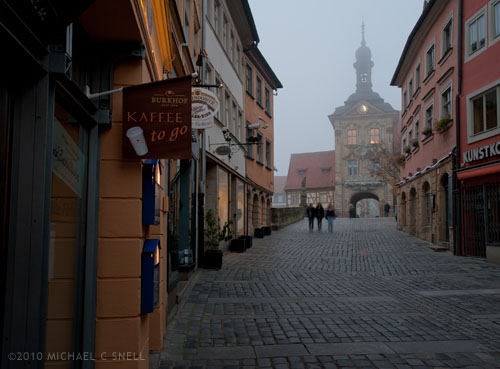
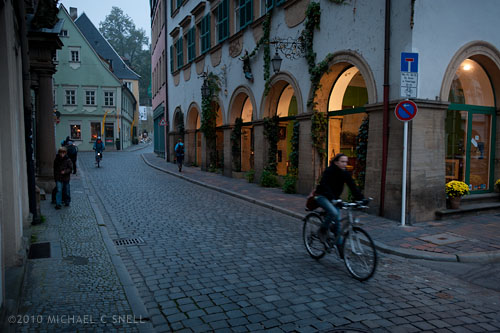
I don’t know if these shots will ever sell — sunny skies often have a better chance — but they are among my favorites from my trip to Germany because it was one of my favorite mornings. Off on my own watching a strange city come to life, the weather crisp and cool — it doesn’t get much better than that.
Bamberg, Germany

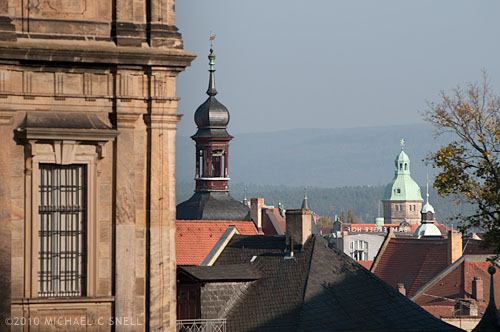
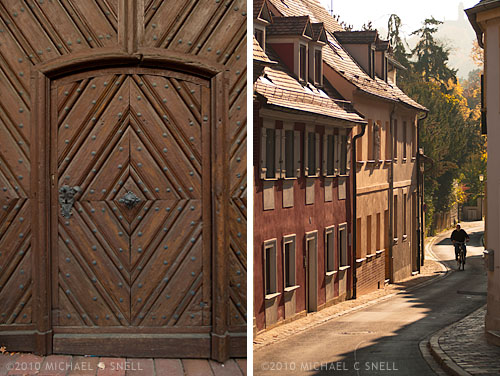
There are some towns where I immediately feel at home, even if I’ve never been there before. Bamberg, Germany, was one of those places. I spent a total of less than 24 hours there and could have easily spent months. It’s a great, walkable town with a huge variety of photographic subjects. This town is definitely going on my “must return to” list.

Porsche Leipzig

I’ve said it before — many others have said it — and I’ll say it again: always bring your camera.

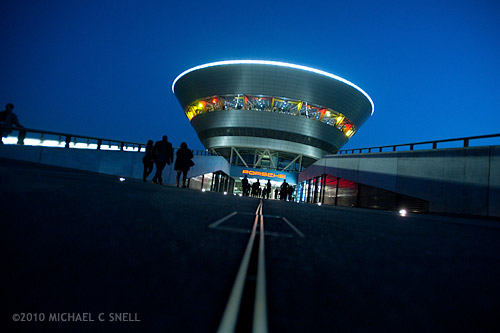
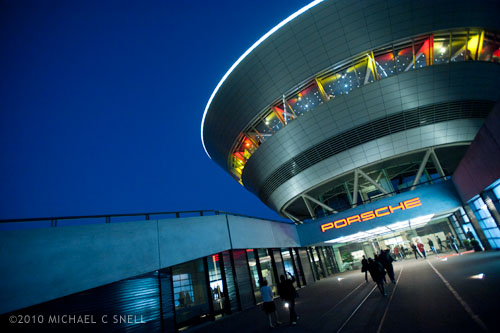
My main reason for being in Germany last month was to attend the Annual Convention of the Society of American Travel Writers. On the final night of the convention, there was a gala dinner at the Porsche customer center in Leipzig. You’ve probably been to these kinds of events. You put on a tie, there’s a little cocktail party first, then a long dinner with plenty of speeches. What’s to shoot, right? Well, you never know. Especially with this group. The setting for this dinner was spectacular and we arrived at Porsche just as the light was perfect — that time just after sunset when the sky goes cobalt blue. It was a perfect backdrop for the futuristic building.

It’s always a little inconvenient to have a big hunk of camera with you at a nice dinner but, in this case, I’m glad I did.

Saxon Switzerland National Park

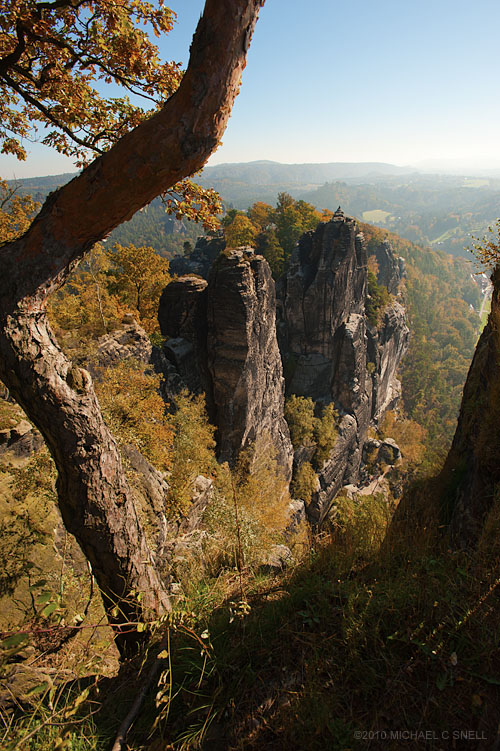
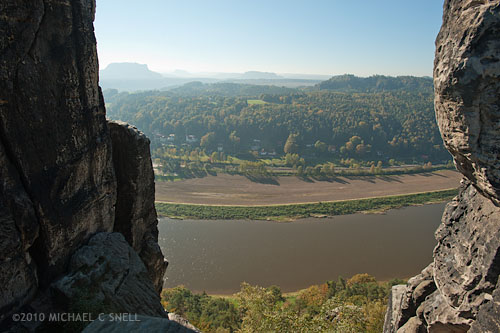
The few hours I had to explore the Saxon Switzerland National Park in the Elbe Sandstone Mountains of Germany was not nearly enough. I had only enough time to see this one overlook area and to take a fast hike down through a gorge to the village that you can barely see in the distance on the upper-right-hand side of the shot above. Hopefully I’ll be able to return someday and really spend some quality time. It’s truly a beautiful area.

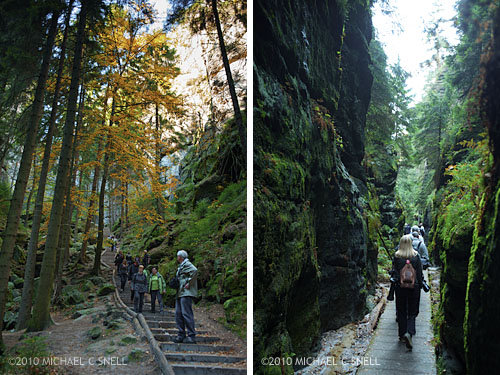
The gorge hike was amazing but I would strongly suggest to anyone thinking of visiting — do it the way I did and hike DOWN. I believe someone said there were something like 900 or 1000 stairs and my only amazement at that number is that it seems way too small. It was even more amazing to see so many people hiking UP. Insanity! The gorge would sometimes be a fairly wide valley and then occasionally narrow to a crack in the rock that you had to turn sideways to get through. A great hike, but be prepared for those stairs.

Frauenkirche in Dresden, Germany

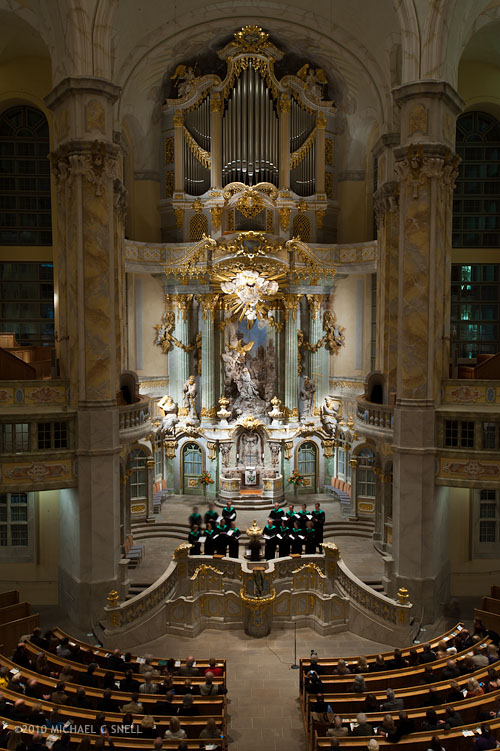
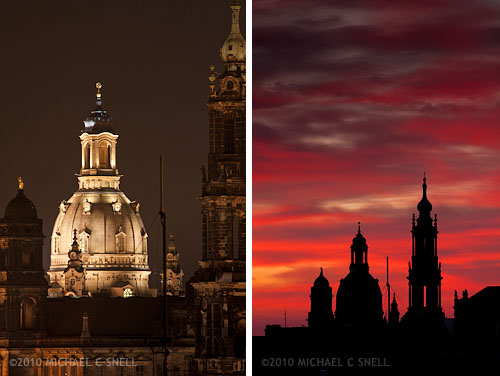
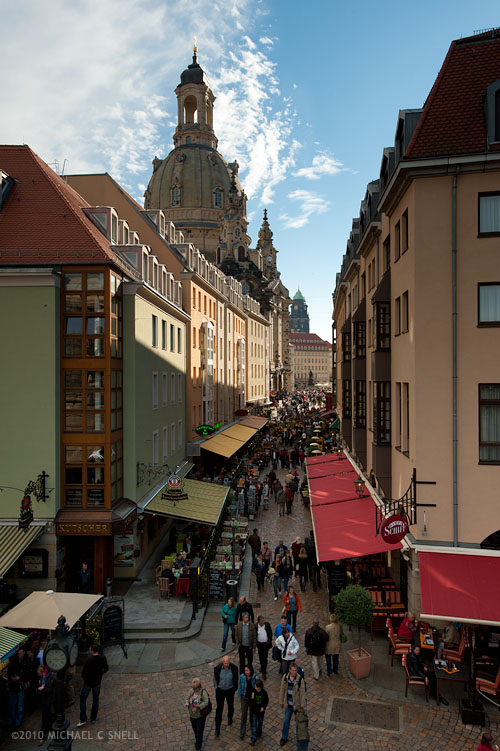
Here’s an interior of the Frauenkirche that I mentioned in my last post. It’s hard not to be impressed by the effort that went into the reconstruction of this building when you look at the condition it was in from 1945 through the early 1990s. Beautiful inside and out, its dome is once again a prominent element of the already stunning Dresden skyline. I was lucky enough to have a room that overlooked this skyline and made good use of it at sunrise and sunset to capture a range of light both artificial and natural. Much of the skyline is lit in the evenings but the Frauenkirche seems to be lit the longest. I would start shooting while all the lights were on and continue as they winked out one by one until just that dome was lit. In the mornings, the whole thing was dark and silhouetted by the sunrise. Here are just a couple of shots from my window at the Maritim — sunset and sunrise:

Dresden, a comeback story

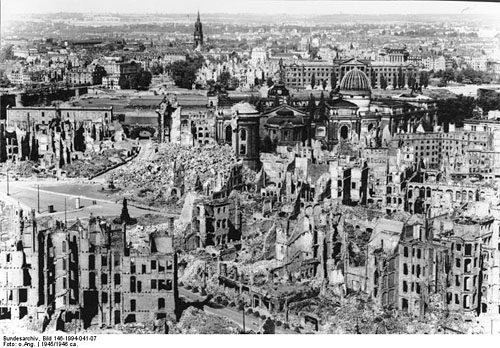
The fire bombing of Dresden in February of 1945 effectively destroyed the city center of what had been known as the Florence on the Elbe. Much of what I knew about Dresden before visiting came from reading Kurt Vonnegut’s Slaughterhouse-Five as a kid. Vonnegut had been a POW in Dresden during the raid, and drew heavily from that experience for the book. This is what Dresden looked like following the air strikes:

Image found on Wikipedia here. Bombing info can be found here.

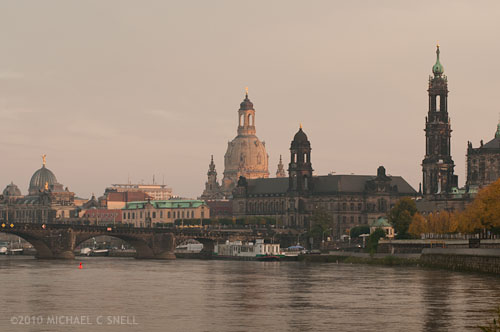
That’s nearly a reverse view of my shot that opened this post. The dome in the upper right of the historic photo is on the left in my photo. The bridge on the left of the historic photo is in the foreground of mine. The pile of rubble just left of center in the old photograph is the remains of the Frauenkirche, which you can see has been rebuilt in the recent photo — it’s the white dome at the center.

The reconstruction that has taken place in this city is unbelievable. Just when you think that the only things humans are capable of building anymore are Walmarts and Home Depots, you see something like this and realize that true craftsmanship and vision are not a thing of the past. I’m sure it would have been much easier for Dresden to have rebuilt in a modern style with reinforced concrete and steel towers but they didn’t. They respected their traditions and heritage and look at what they achieved.

Grimma, Germany

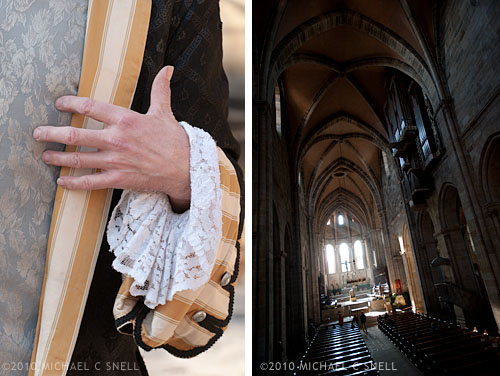
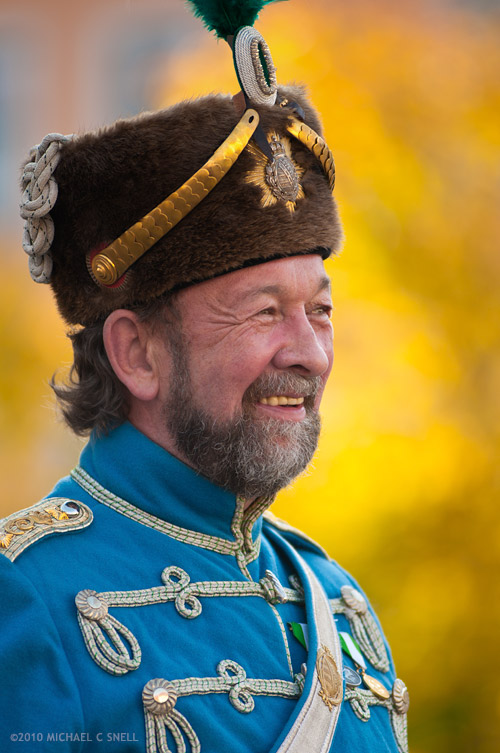
A portrait of a man in a traditional military uniform in the beautiful small town of Grimma on the river Mulde (just east of Leipzig) during a quick stop on the way to Dresden. I’m afraid I was much like an annoying fly to this poor man, as I photographed him from all angles while he stood in the square. I was using my Nikkor 80-200mm zoom, so at least I was a distant fly. This angle with the fall color in the background against his blue uniform turned out to be my favorite. To be honest, he was a great sport and seemed more amused by the attention than annoyed.

Special access

When I get special permission to shoot in museums, I take advantage of it. I’ve been in some situations — even on press trips specifically arranged for journalists — where photography was not allowed and note-taking was even banned. As a photographer, that kind of tour is of no use to me. I could enjoy myself as a tourist but as a business person, if I’m not walking out with images on my card, there was no point in my being there. I can tell when the point has really been lost when the museum’s PR person tells me that images are available for free from their office. That’s fine if I’m writing a story on their museum — at least I’d have some way to illustrate it — but I’m a photographer. I make my living by licensing my own images. Knowing that they have images available for free doesn’t really help me. Actually, it doesn’t really help them either as more major publications won’t want to use free images from a PR department because they want something unique and not the same photos that are appearing in every other magazine.

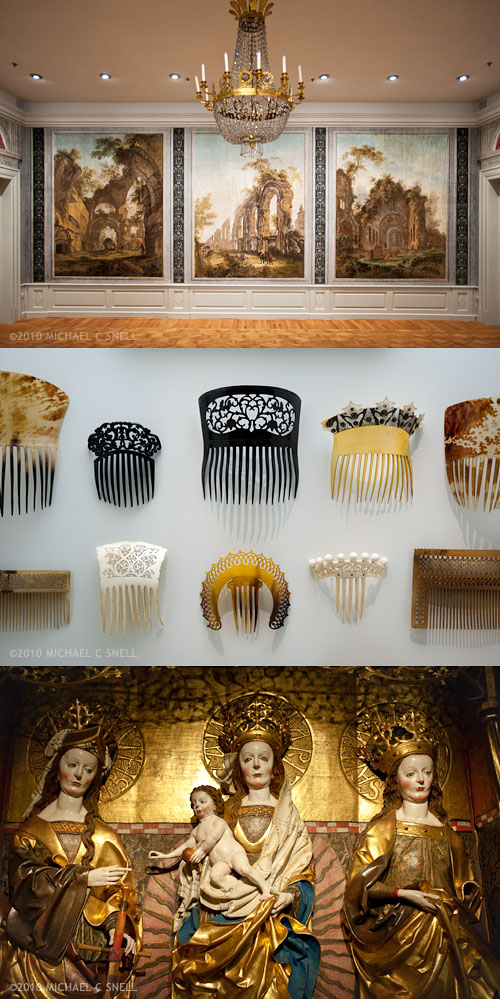
The three photos above came from the Grassi Museum in Leipzig where I was allowed to shoot by special permission. No flash, but that’s fine. I can understand them wanting to limit damage to the artifacts. Thank you, Grassi Museum, for understanding why I was there and seeing the benefit of having more images of your collection available to publishers. I hope that every image I get published sends people through your doors.

Leaving room for type

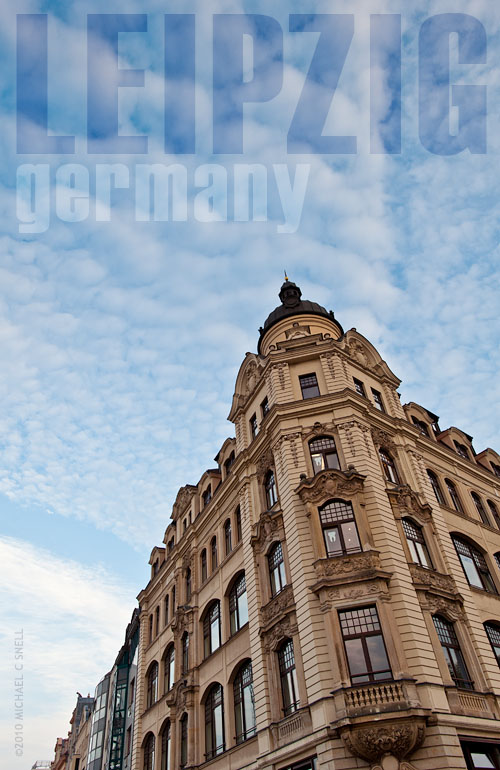
One side-effect of my background in graphic design is that I tend to compose images with an art director in mind. When I compose a shot, I’m often leaving room for typography. I suppose if you looked at my photos assuming that I were a fine art photographer, you might think that my compositions are sometimes strange — sometimes leaving large spaces empty — but that’s intentional. A vertical with some empty space at the top makes for a great magazine cover. The title needs to read clearly on the shelf and a busy background can create confusion. A horizontal shot with an open space to one side and an off-center subject can make a nice opening spread. The magazine’s gutter won’t cut directly through the subject and the open space can be used for a headline or the opening paragraphs of the story. Other shots fill the frame but may be graphically simple so that they will hold up at small sizes. Perfect for small “spot” uses to brighten copy-filled pages.

I’m not a fine art photographer. I do sell some prints, but I’m primarily composing with an editorial use in mind. Having been on the other side as an art director with travel and tourism clients, I think back to the images that I would have liked to find when it was me that was laying out that story, or me designing that cover. It’s always interesting to see how other art directors use my images as well. Sometimes I’m amazed that they saw a way of using one of my photos that I would never have thought of. Hopefully, I amaze them every now and then as well.

Arrival: Leipzig

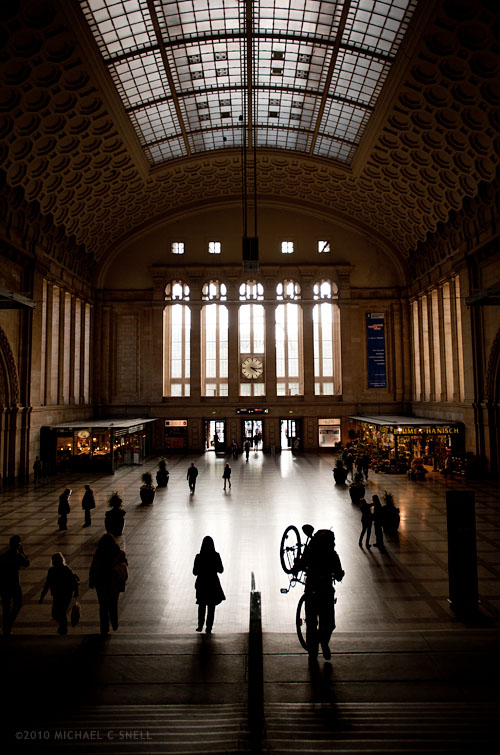
I didn’t arrive in Leipzig by train but the main station — or Hauptbahnhof — was just a few blocks from my hotel so it was one of my first stops. Built in 1915, this grand station was heavily bomb-damaged during WWII and was restored in the 1950s. In the years following the reunification of Germany, the building was modernized to include multiple levels of shopping and dining but the architectural grandeur remains. Even though this was not the portal through which I entered Leipzig, it seemed a fitting place to begin my exploration of this city and the federal state of Saxony. Often the first glimpse of a new place colors your impression of everything that follows. That’s what these train stations were all about. They were symbols of progress and status that left no doubt that you had arrived at a great destination.