Category Archives: kansas

Shooting stars

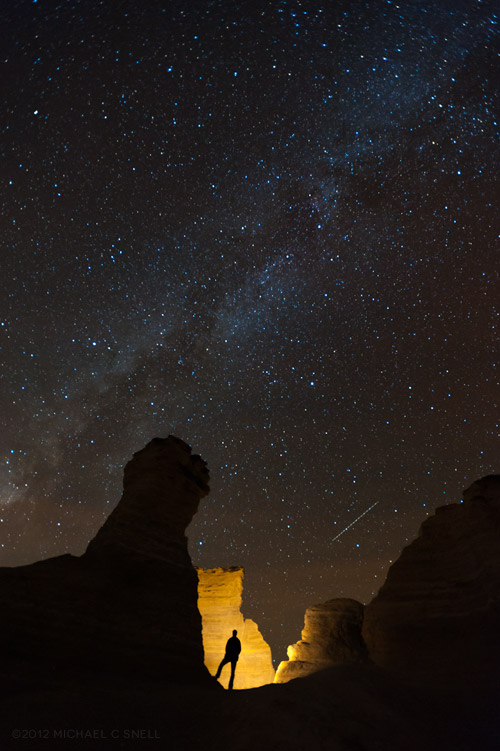
In yesterday’s post I promised to provide some insights into last Wednesday’s night shoot at Monument Rocks in Western Kansas. It’s a different animal, shooting in near total darkness, and takes some getting used to. I learned a lot last week and I look forward to my next opportunity to improve my process.

None of the images in this post have had huge adjustments made in post-processing. White balance was probably the biggest challenge — especially when getting into mixed light sources — but I’ve decided not to get into localized color changes and instead go with how the camera recorded the images.

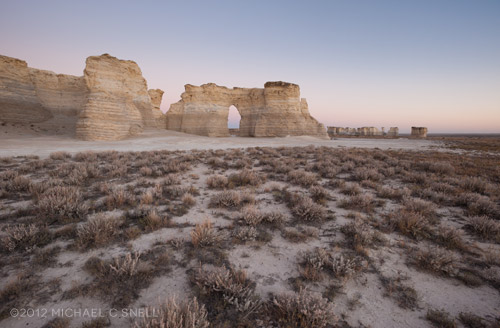
But first things first: if you’re not familiar with Monument Rocks, it’s an area of the high plains of Western Kansas that used to be the bottom of a vast ocean millions of years ago. Eons of erosion have left behind spires of chalk that stand up to 70 feet above the mostly flat surrounding landscape. According to Wikipedia, this was the first region to be designated a National Natural Landmark by the US Department of the Interior.

But why try to describe it when you have photos? Here’s what it looked like just after sunset last Wednesday:
The rocks are also remote enough that there wasn’t a lot of light noise from nearby towns to cause problems with our attempts at night photography. I think the nearest town is at least 20 miles away. We could see a few lights from surrounding farms and ranches, but they didn’t cause huge problems. The stars where clearly visible in the millions, but I do think that the color shifts that I observed in some of the shots may have come from artificial light bouncing around in dust that was being carried in the slight breeze. It was a far calmer night than I had ever experienced at Monument Rocks, but it has been an extremely dry year and the dust was very fine and easily made airborne.

After the sun went down, it didn’t take long for stars to appear and be bright enough to photograph. In this shot, there is still a fair amount of ambient light in the sky and the rocks are still being lit slightly by the dying light of the sunset:
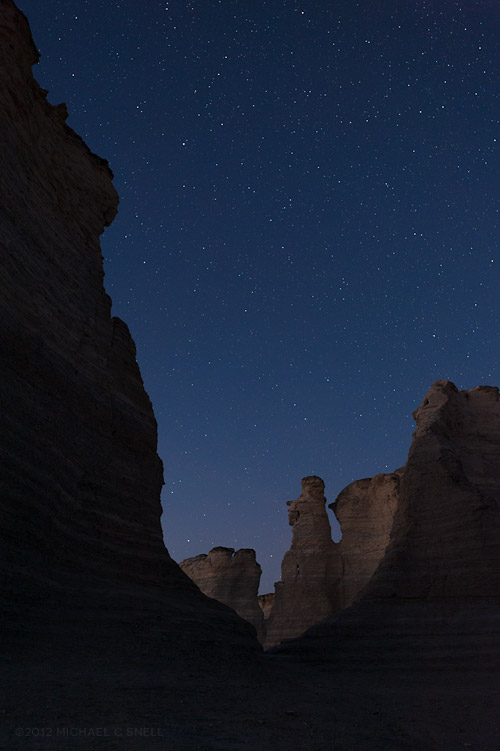
To the eye, it was fairly close to total darkness at this point but the camera could still draw quite a bit of light from the scene. I tried to keep all exposures shorter than 20 seconds, or 30 at the most, in order to keep the stars from streaking due to the earth’s rotation. Focusing was a bit of a trick since many modern auto-focus lenses don’t behave quite like old manual lenses did. On the old lenses, you could often just rack them all the way to infinity and you’d be fine, but with some earlier testing on my 17-35mm Nikkor that I used for these shots, I noticed that I had to pull it back a bit to get things sharp when focussing manually. I’d made a note of where the focus point needed to be on the lens markings and just used that once it was too dark to visually attain focus anymore.

As it got darker still, I started experimenting with adding some light painting. This was done with a variety of sources but the two I found that worked best were 1.) a small, hand-held flood that I picked up at a hardware store for less than $20 and 2.) an even smaller Maglite that I tend to keep in my camera bag to help me locate things in the dark on night shoots such as this. It was this small Maglite that was used in the shot at the top of this post. One of my fellow photographers stood in to give some scale to the scene and also used my Maglite to “paint” the distant rock during the exposure. The hardware store floodlight was used on the following shot:
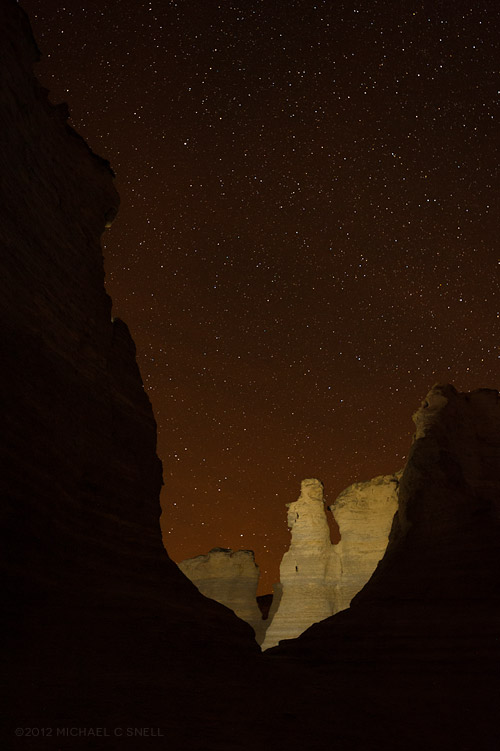
The light was far too bright when pointed directly at the rocks so I used the silhouetted rock in the foreground as a giant bounce card. I walked around the foreground rock and set the floodlight on the ground, propped but by a small rock, so that it pointed away from the rock I wanted lit. The beam hit the back of the rock that you see in silhouette here, and the light bounced back to illuminate the more distant spires. The redness of the sky is what I believe is coming from some light from surrounding towns and farms refracting in some airborne dust. My best guess anyway.

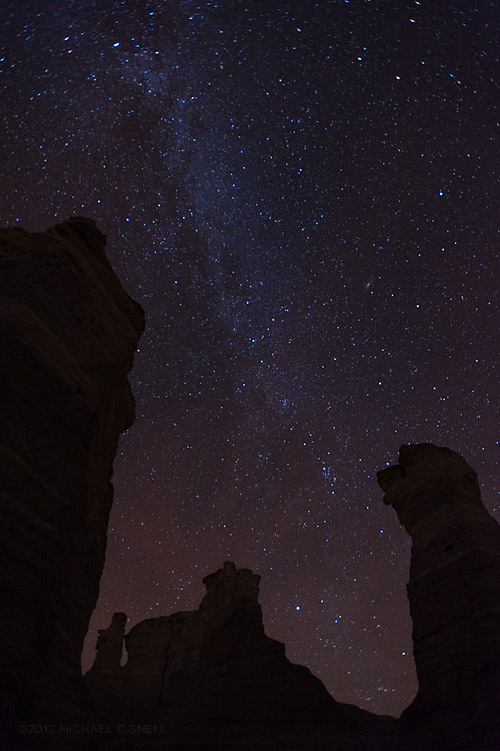
I found that when shooting with a 17mm lens (on a full-frame D700), 20 seconds was indeed about the limit of what an exposure could be before stars began to streak. Twenty seconds or less kept them more or less as pinpoints. To achieve this, I generally shot wide open at 2.8 and used ISOs to control the exposure. By the darkest point in the night I was shooting at ISO 1600. I was surprised to not have to go higher, but relieved that I didn’t need to deal with more noise from even higher ISOs. As it was, these shots required very little noise reduction in Lightroom.

The following night we shot more night skies, including one 15 minute star trail exposure. I’ll share some of those images in later posts.
Billions of stars

I’ve been out shooting in Western Kansas with the Gizmo guys the last few days and we took advantage of a cool, clear night at Monument Rocks to try some night photography of the Milky Way. I’m just getting started on the post-processing and haven’t quite settled on what feels like the right white balance, but I thought I’d go ahead and share this one with you now. It’s amazing how much you can capture digitally in such dim light. I’ll share more later, with details on exposure, some light painting experiments, etc.

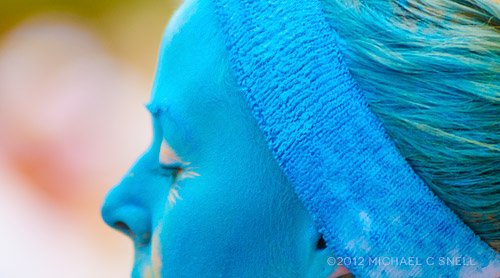
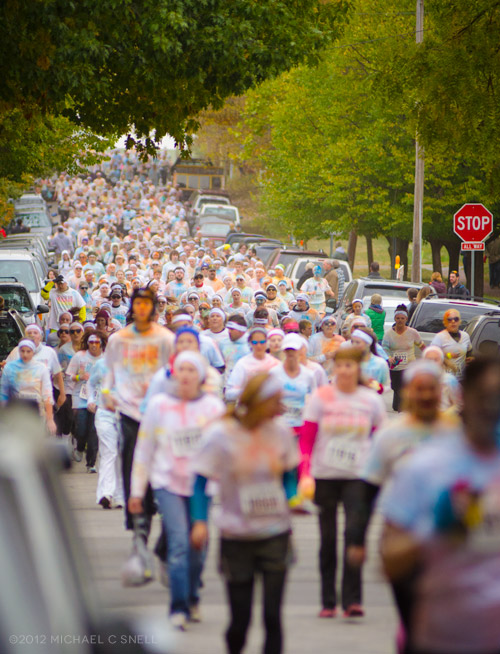
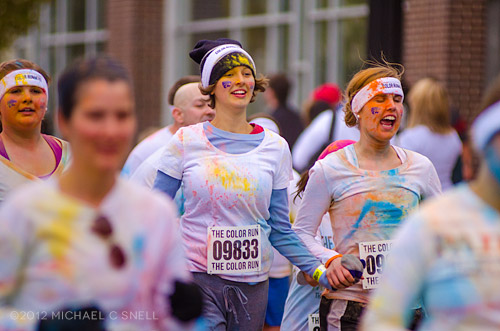
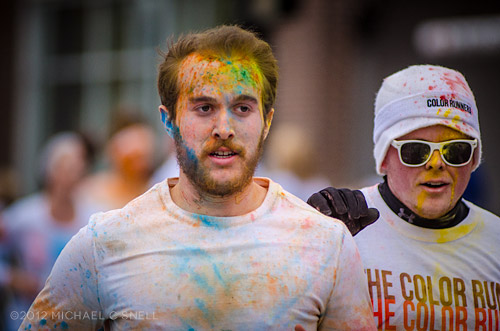
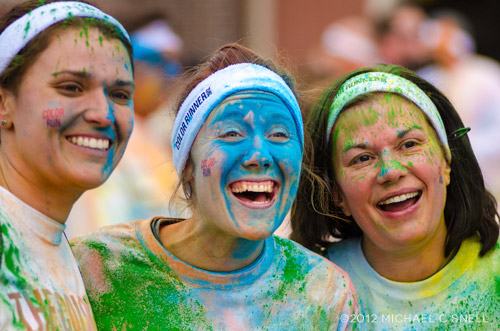
Lawrence Color Run 10-6-12

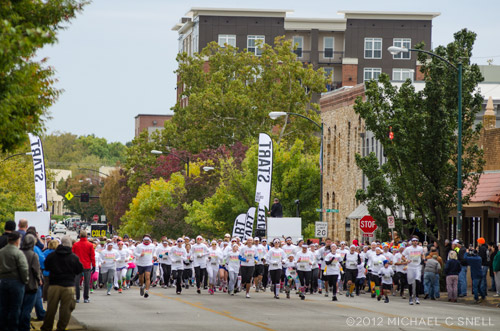
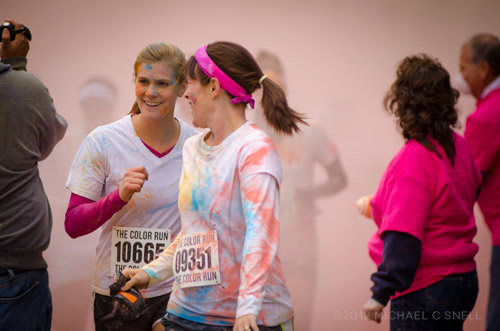
Silly me. I thought that Lawrence’s low temperatures might reduce the turnout for the Color Run yesterday. According to this morning’s paper, 7,000 had turned out by 3:00. I wouldn’t be surprised if the total number wasn’t closer to 10,000 or even more. Here’s a link to more info on the run. And here are more pics:

Wichita’s Keeper of the Plains

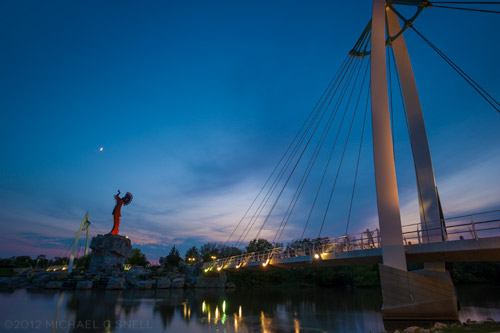
I had a free evening in Wichita last week in between two assignments and decided to update some of my stock photography of that city. I’ve had twilight skyline shots that have done well over the years, especially one where the lights were reflected in the Arkansas River as it cuts through downtown. My initial thought was to update this shot in particular, but the great drought of 2012 caused me to change those plans slightly.

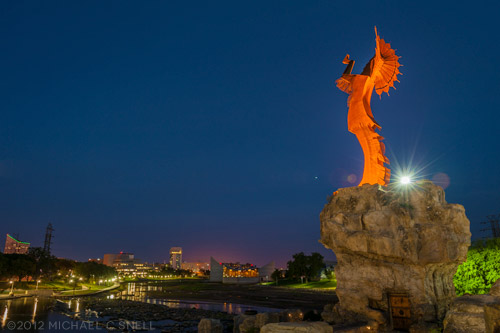
Wichita’s downtown has changed in recent years so I knew I’d need to change my angle of view from my old shooting location to a new one that would include more of the recent landmarks. Using Google Maps, I located downtown and the Exploration Place — which is built out into the river and has a very identifiable shape — and tracked back along a line that would allow me to get both in a shot with the river as a nice foreground. As it happened, it looked like another landmark would make an ideal foreground: The Keeper of the Plains by by Kiowa-Comanche artist Blackbear Bosin. First erected in 1974, it was raised onto a new stone outcropping at the confluence of the Arkansas and Little Arkansas Rivers in 2006. A pair of footbridges echo the sculpture’s shape and provide access to pedestrians and bikes.

Upon my arrival, it was clear that there was not enough water in the Arkansas to make my initially envisioned shot happen. Here’s the best I could do:

Tough to see at this size, but the river is so low that only about a quarter of the skyline is reflected as compared to what normally would be. Luckily there is a bit of a dam on the Little Arkansas at this point so I was able to salvage a shot by crossing on over to the north bank and shooting back at the sculpture and foot bridges as seen in the shot at the top of this post. I got several variations from this point with varying degrees of sunset and twilight and am happy with what I came away with. I’ll just need to keep this spot on my to-do list for next year when the water will hopefully be higher again.

Greensburg, KS, revisited

Greensburg, Kansas, was nearly wiped out by a tornado in 2007. Something like 95% of its buildings were destroyed. I used to travel through Greensburg frequently in the 80s and 90s and remember it as a beautiful community with the typical mix of old brick shops downtown and early nineteenth century clapboard houses filling its surrounding neighborhoods. But I remember it most for having what seemed like more than its fair share of shade trees. It was always a truly welcoming place on the prairies of western Kansas. Most people knew it as being home to the World’s Largest Hand Dug Well and, to be honest, most of the images I have in my files from Greensburg are of the staircases leading down to the bottom of that well. I wish now that I would have recorded more of the rest of the town.

It was quite a while after the tornado before I went back to Greensburg and, even then, I just drove through. I didn’t want to just gawk at the destruction and it was a hard thing to come to grips with, seeing a community that you knew for your whole life, now replaced by an open field that you barely recognized.

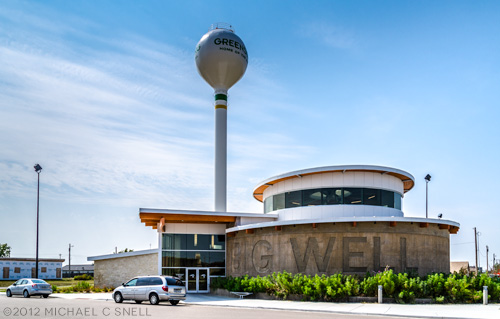
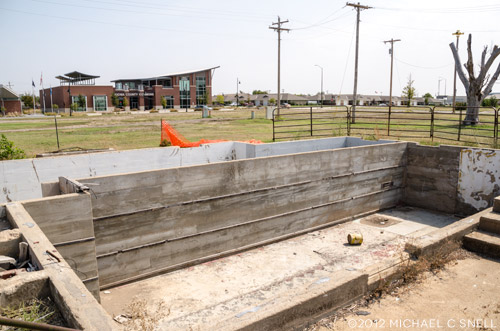
A recent shoot in Dodge City had me driving through Greensburg on the way to my next stop in Wichita. This time I decided to take a little time to see how the community is rebuilding. Of course the first landmark I looked for was the Big Well, which was always easy to find as it was located just beneath the city water tower. The water tower and the museum that sat behind the well (still seen on the Wikipedia page) were both destroyed but a new water tower has replaced the old metal one and a vastly larger and more modern museum has actually been built over the well this time as seen above. As I was running short on time on this visit, I saved the trip down into the well for next time, but I understand the old zig-zagging stairs have been replaced with a circular system that hugs the outer wall of the stone-lined well. If you’re having trouble imagining a well with room for a staircase, we’re talking about a hole 32 feet in diameter and over 100 feet deep.

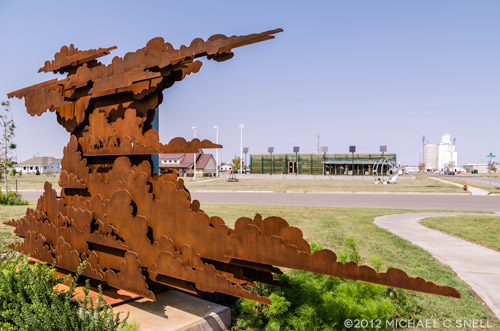
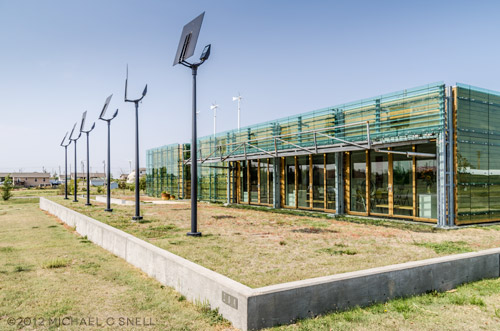
There are still a few damaged trees standing and plenty of sidewalks leading to nowhere, foundations with no homes. But I have to give a great deal of credit to the people of Greensburg and their philosophy about rebuilding. They took a disaster and found an opportunity within it. The townspeople have decided to rebuild better than before, and greener than before. You notice the wind turbines long before you even get to town, then the solar panels. Greensburg now boasts more LEED certified buildings per capita than any city in the world. They have become a testing ground for all kinds of energy-conserving and alternative energy technologies.

It’s nice to see public art being among the first things to return to Greensburg as well. This glass-skinned building is the 5.4.7 Arts Center, the first building in Kansas to receive a LEED Platinum rating.

For me, it’s still a bit painful to walk the streets of Greensburg. In my mind’s eye I’m still seeing what was. But that’s not fair to the efforts of the people who have put such energy into bringing this community back. They have made great strides and I look forward to many future visits to see how they are progressing. The hopes and dreams of these folks are now plainly visible in the new buildings and the new trees and gardens being planted.

more from the rodeo

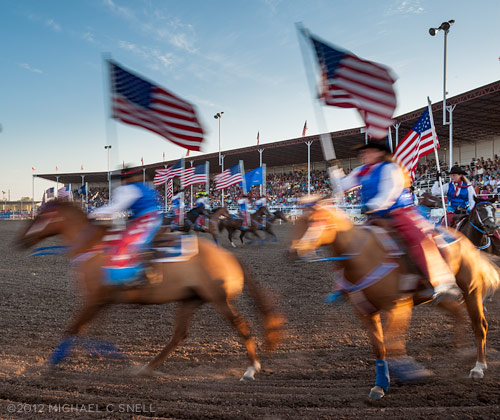
I’m sharing a few more shots from last saturday’s rodeo in Phillipsburg, Kansas. As the biggest rodeo in the state, it’s quiet a show and the grand opening alone is worth the price of admission. I got there early and tried to scope out a good vantage point and settled on this area at one end of the arena where I could shoot through a livestock gate and get views of both the chute and the stands with a nice long throw down to where these riders with their American flags would make their entrance.

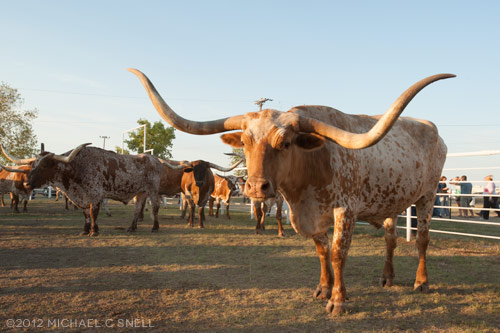
I’d been shooting the beginnings of the grand opening when I turned around and realized I was no longer alone in my little shooting space. In fact, the spot I had chosen was the pen where a few dozen of these longhorn cattle were being prepared for their entrance during a later portion of the grand opening:

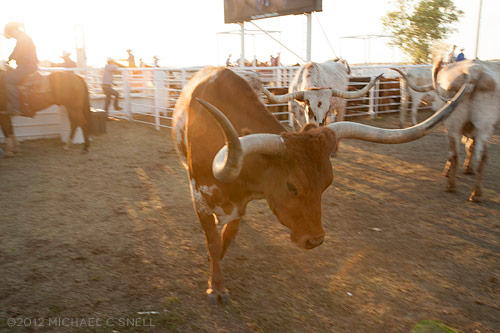
Happily, they seemed willing to share the area with me although they did seem to be extremely curious about my cameras. I was carrying two bodies and, as I would shoot with one, the braver of the longhorns would come up to give the other Nikon a good sniff. There was plenty of drooling going on as well (on their part, mostly) but I managed to get through the evening without it finding its way onto my gear.

It did end up being a very versatile location from which to shoot. One that I would be eager to make use of next time I find myself at the rodeo. Even if I do have to share it with these fellows again.

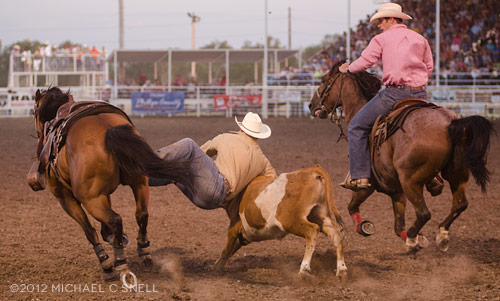
A few more from Saturday:

fast action and slow shutters

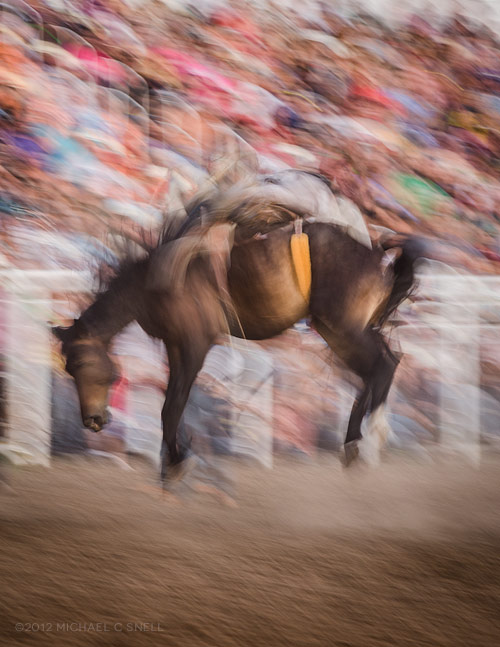
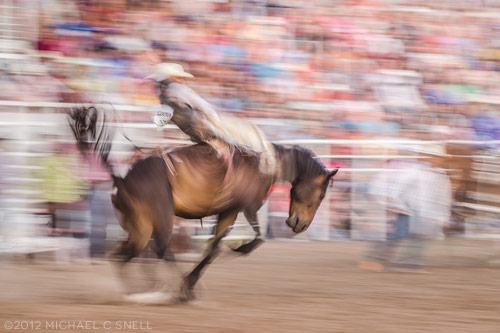
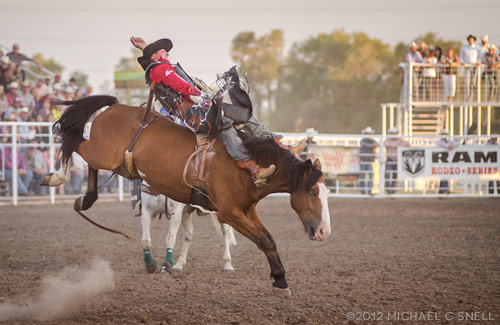
An assignment in Phillipsburg, Kansas over the weekend gave me a chance to catch the rodeo on Saturday night. Always a fun thing to shoot, this time I thought I’d experiment a little with slow shutter speeds to better capture the action. The image at the top of this post was made at 1/10th of a second. For comparison, here’s another shot made at 1/1000th of a second:

Each has it place but I really like the abstract nature of the blurred shot. To me it’s an image that is less about that particular rider and is more about the excitement and action of the overall event.

More to come…

Midsummers Festival, Lindsborg, KS

I spent part of last saturday shooting the Midsummer’s Festival in Lindsborg, Kansas — also known as Little Sweden, USA. I love Lindsborg’s festivals but I hadn’t shot this one since back in my film days so I was long overdue for a return.

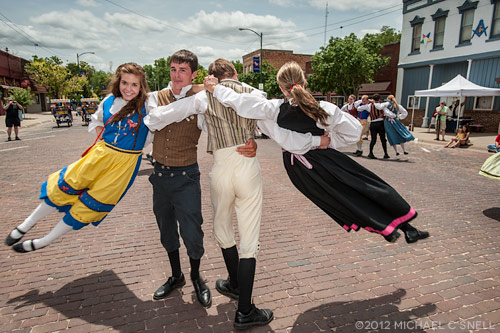
The dances on Main Street have always been great for photos and I decided to shake it up a bit and use some flash to try and overpower the sun a bit. I didn’t want an unnatural look but was hoping to underexpose the bright skies in the backgrounds to pop the foreground dancers out with the flash. I had totally forgotten about this particular dance (above) where the men swing the women completely off their feet as they spin round and round. It doesn’t last long and I was happy to find myself in a fairly decent position when it happened.

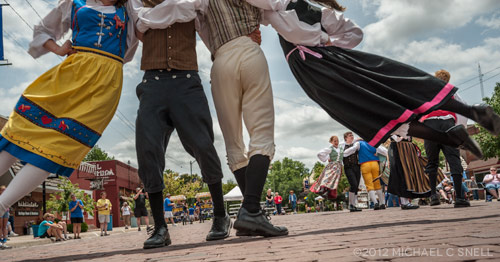
It actually happens twice in this particular dance and for the second time, I decided to try and shoot from a very low angle — basically shooting blind with a wide angle held right down on the brick street. My aim was not perfect, however, and I cropped the heads off of the dancers in nearly every frame. That’s one of the main rules of photography, right? Don’t crop heads off. Well, the more I looked at these shots, the more I thought there was still something there. I cropped a bit more, dodged and burned to redirect the eye, and ended up with this:

Would I have shot it this way purposefully? Probably not. But I now consider it a happy accident. When viewed large, there are some great expressions on the dancers faces in the background on the right side. They actually become the subject and the foreground dancers become more of a frame. I’m liking this shot more each time I look at it.

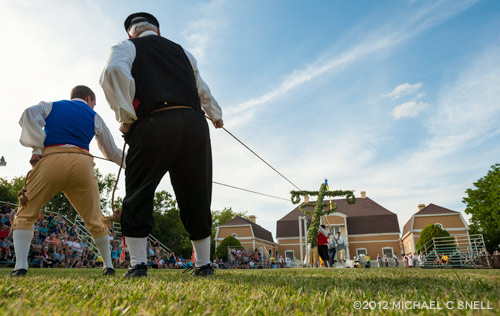
Here are a couple more from the raising of the Maypole. Many thanks to Jim Richardson who was kind enough to wander over before the proceedings and give me a little preview of what would happen. Jim’s a great and generous photographer. If you ever find yourself in Lindsborg, be sure to look up his Small World Gallery on Main.

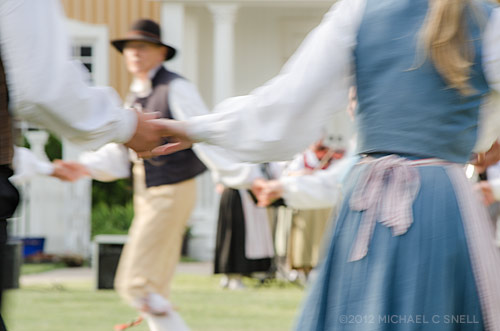
And one last telephoto shot, intentionally blurred for a little movement:

I think my comments are still non-functional here so if you want to leave a note, I’ve also shared this post on Facebook.