Category Archives: landscape

Ulva Island details, New Zealand

Happy New Year, everyone! I’m wrapping up my New Zealand posts with some details from the Ulva Island hike I wrote about in my last post. Some more New Zealand shots may appear later on, but I think I should shake things up for a little variety around here. I’ve been spending the holidays working on revamping my website and that has also had me exploring the archives, looking for photos to feature. I found some oldies but goodies that I plan on sharing during the next few months, since I don’t have much travel on the schedule for a while. Of course, I’ll also let you know when the new site launches. Stay tuned…

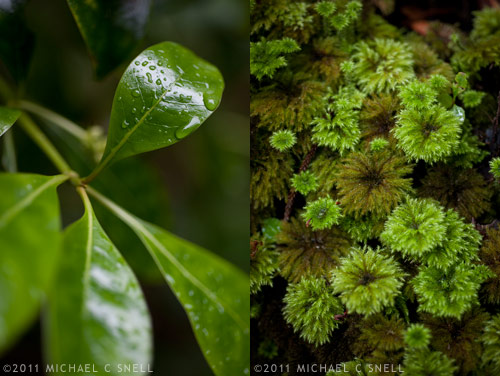
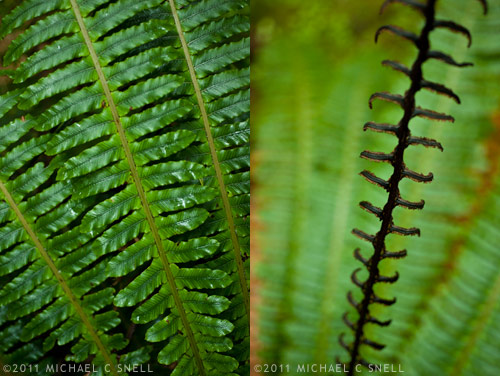
So, back to Ulva Island and the walk in the rain. The light was actually quite beautiful and the colors were lush. I decided to go macro for most of my shots that day to focus on details and textures and to take advantage of the water droplets and sheen caused by the misting rain. I also wanted to take advantage of the shallow depth of field provided by my 60mm f/2.8 to isolate individual plants and leaves from the distracting background branches, etc.


Sometimes I think that a series of tight little shots like this convey more about a place than one wide shot that tries to take it all in at once.

Rainy day strategies

[sponsored post]

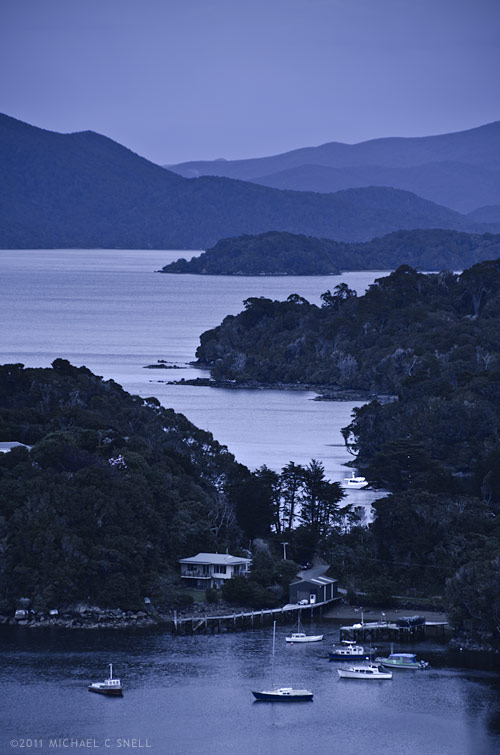
Stewart Island lies off the southern tip of New Zealand’s South Island. In this shot we’re just over the peninsula from the Island’s one town, Halfmoon Bay, and are overlooking Golden Bay, Thule Bay and the Paterson Inlet. Today’s destination is Ulva Island — a small, 670 acre island in Paterson Inlet that is being restored to its original predator-free ecosystem.

It’s also raining, which can make shooting photos during our walking tour challenging. I don’t have any waterproof housings but I do have a jacket and opt for a two body, two lens operation today. I’ll take the Nikon D700 with a 60mm macro lens and the D7000 with the Tamron 18-270. Here’s my thinking:

We’ll largely be in fairly dense rainforest where the reduced contrast of the overcast sky will actually help even out the light. I won’t want to include a lot of sky in any shots since it’s flat grey so I will instead focus on details — macro shots of the plants that we encounter on the walk. It will also allow me to shoot downward for the most part, eliminating the problem of rain getting on the front element of my lens. Neither camera-lens combination is large, so I can keep them both tucked into my partially zipped jacket and retrieve them only when needed. The second body with the 18-270 will be reserved primarily for those times when I encounter something that suddenly requires more than a prime 60. That might be a wide shot where the trail opens out onto a beach, or a telephoto shot of a bird. Birds are a large part of the visitor experience to Ulva Island so I hope to get something along those lines. By taking the 18-270 and a macro, I figure I’m set for nearly anything and I won’t have to deal with changing lenses in the rain.

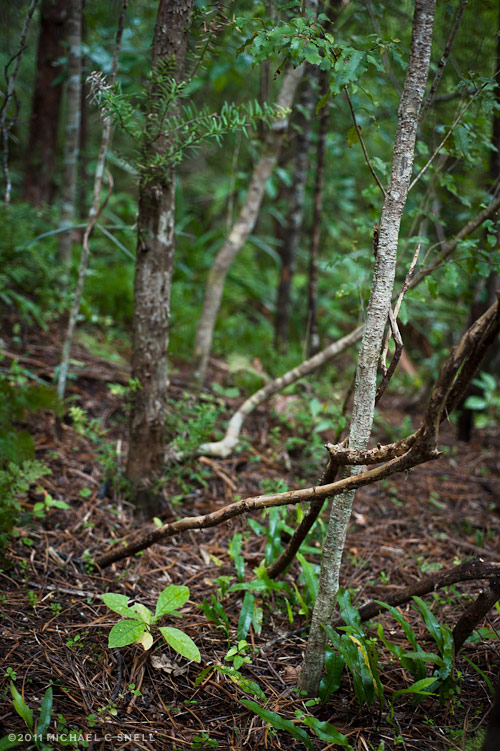
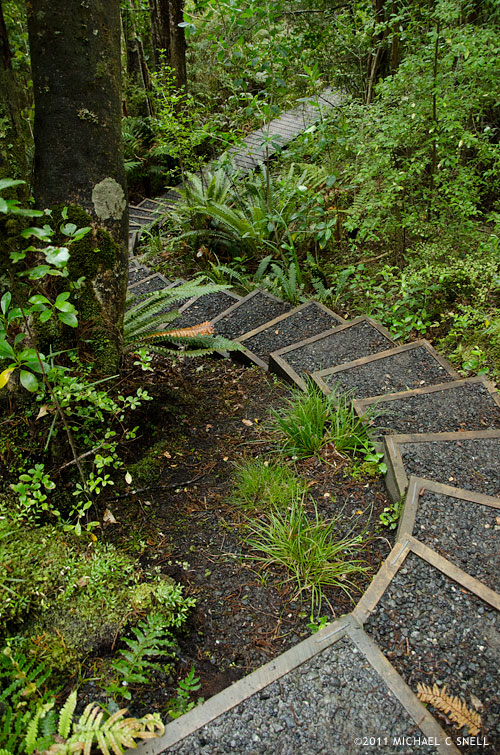
Overall, this plan worked well. Once we made our way off of the beach and into the understory, the rain effect was lessened by the trees overhead, although the occasional drop that would land now was a much larger drop from a leaf than the small, misty raindrops on the beach. The trails wound through ferns and forgotten-looking plants that gave a real sense of what New Zealand must have once been like, before the main islands were largely cleared of trees for cultivation. I’ll show some of the macro shots in the next post but first I’ll show a couple of shots that made me thankful to have had the 270 end of the Tamron 18-270 zoom.

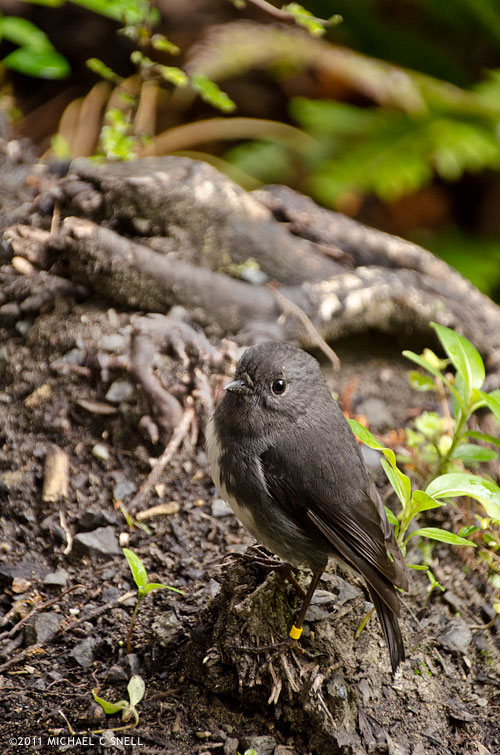
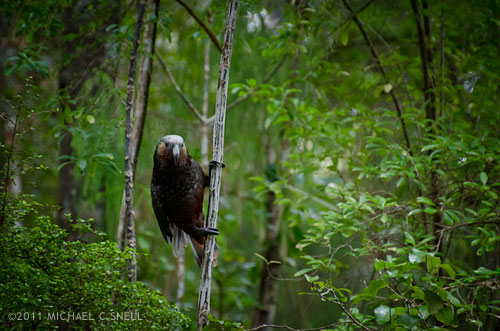
This tiny bird is a Toutouwai, or Stewart Island Robin. On the much larger end of the scale is this South Island KaKa:

A member of the parrot family, Kakas are about 18″ long and weigh a pound on average. That’s a pretty sizable bird. The Kaka didn’t come nearly as close as the Robin. There was another group a few yards ahead of us that he was curious about but the addition of our group coming up behind eventually proved too much and he took off. I was happy to get the images I did with the 18-270, but can only imagine the shots that a person could get with a little more time and patience on this island. For the most part, the birds are not that suspicious of people and will come fairly near. The haven’t really learned fear.

In the next post, I’ll share a few of the detail shots I took on this hike with the macro. Given the weather and limited time, I think the two lenses really allowed me to cover a lot of ground photographically speaking.

I should also mention one other foul-weather tip — the landscape at the top of this post (also shot with the Tamron 18-270) was fairly grey and colorless due to the overcast skies and impending rain. Once I brought it into Lightroom, I opted to alter the white balance to give the scene a cooler, blue cast. The result resembles the light you might get just before dawn or after sunset, even though it was shot near mid-day. Filters can also be used on-camera for this effect but, anymore, I prefer to leave my options open for playing with different color temperatures at the point of post-processing instead. By shooting in RAW, I have the ability to make several versions in different tones without any damage to the original image. One of the great benefits of today’s digital photography tools.

Nugget Point, NZ

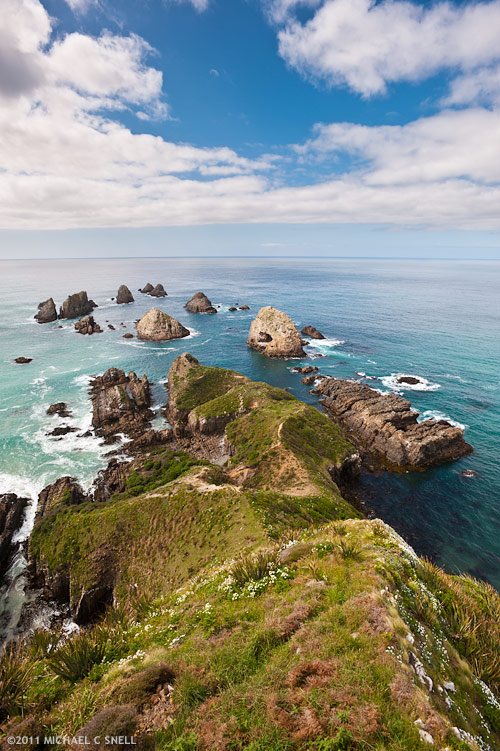
The view from the platform of the Nugget Point Lighthouse on the southeast coast of New Zealand’s South Island. Few places I’ve been have felt more like standing at the end of the world. The next thing over that horizon is Antarctica. An amazing spot, but not our last stop. We were still heading south…

The 10 minute waterfall shoot

I spotted the potential problem when I was typing up my itinerary before even leaving for New Zealand. On the day that we would be driven down the coast from Dunedin to Invercargill, there would be a 10 minute stop to photograph Purakaunui Falls. That’s right — just 10 minutes.

I’ll take a moment here to explain my itinerary process. On a trip like this that incorporates a convention, board meetings, tours, etc., you are generally provided with a whole slew of itineraries. You get one for the board meeting, one for the convention, one for each specific selection you’ve made for activities during the convention, and on and on. The entire stack of itineraries — not to mention flight and ferry schedules — can end up nearly as thick as a phone book. The end result is a lot of weight and bulk to carry around and endless pages to thumb through whenever you’re trying to figure out what your next stop is. My solution is to take all of those itineraries before departure and to re-enter their core information into one, two-sided document that I can print a few copies of and stick them in coat pockets, camera bags, suitcases, etc. It’s my “at a glance” itinerary that gives me only the information that pertains to me and leaves out all of the schedules for things I’m not participating in. I also color-code items that need to stand out: meetings I’m running, professional development sessions I’m conducting, etc. These itineraries have become an essential part of my pre-trip planning, especially for trips like this where I’m not in control of my own schedule.
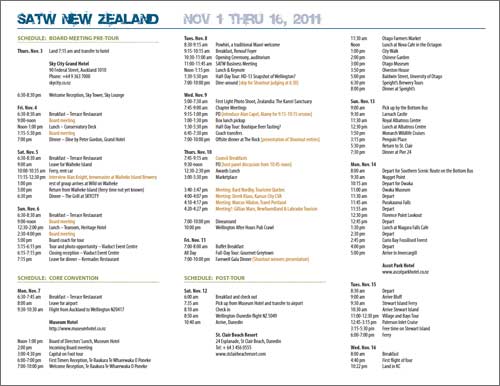
That’s a screenshot of one side of my “at a glance” itinerary for New Zealand. These things take a little time to assemble, but they are a huge help once on the ground.

A happy byproduct of this process is that I get to pre-visualize the entire trip as I put the schedule together. It’s an opportunity for things like this 10-minute waterfall stop to reveal themselves and allow me to think through how to make the most of the situation. I knew I was going to be mostly in cities and towns during my New Zealand trip so any opportunity to shoot a natural landscape was very important to me. A waterfall would make a nice addition to my overall coverage of this part of the South Island and I wanted to make the most of this stop — short as it might be.

I managed to get the front seat, next to the driver, the morning of the waterfall shoot. This can often take some elbowing on a press tour but, in this case, there was no front passenger door so you had to enter the van through the sliding side door and then scramble over the engine hump in order to access this particular seat. Not something most people found appealing, but worth it to me in order to be able to shoot through the windshield, be able to talk to the local driver, and have more room to have my tripod, etc. with me. I made a point of having the tripod easily available on this day — especially because of the waterfall stop.

Our driver was great and said that he’d made note of the 10-minute waterfall stop when he first saw the schedule as well. He knew the area and knew that that amount of time wouldn’t work at this particular location. He’d made some adjustments to the schedule in order to give us 30 minutes at the waterfall because he knew the hike to the falls would take a good 10 minutes itself. With his adjustment, we’d still have 10 minutes at the falls with an additional 20 minutes for the 10 minute walk down and the 10 minute walk back.

When the waterfall was to be the next stop, I made sure to prepare my gear. I set out my tripod and put the mount on my Nikon D700 — I was going to use it along with my Nikkor 17-35mm wide-angle zoom. I believe I also tossed a couple of longer primes in the pockets of my Scottevest, just in case the overlook to the falls was not as close as I anticipated it would be. I made sure to also pocket my ND and polarizing filters so that I could cut the light enough to get a long exposure that would let the falls get all misty and soft. The one thing I neglected to grab was my cable release. I got around this by shooting on timer, but I lost some precious seconds each time I had to wait for the timer to run out.

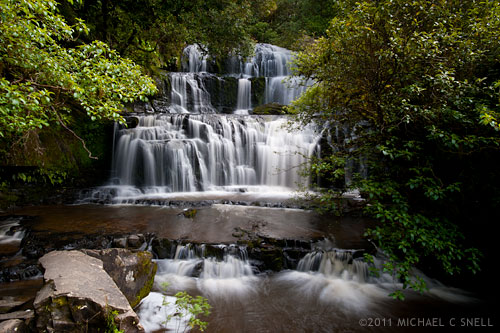
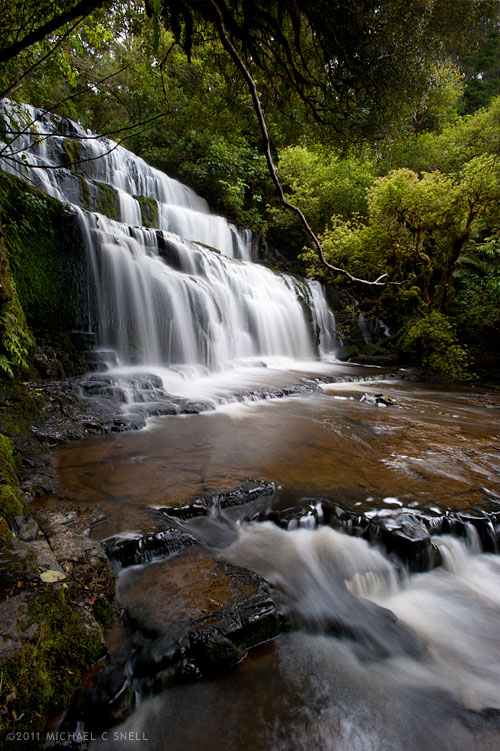
When the van stopped, I piled out as quickly as possible and headed down the trail at a fast walk — checking my watch so that I knew exactly when I’d have to start back. I never want to be the last one to return (that’s bad press trip karma) and I want even less to be left behind because I’m late. On the walk, I multi-task by extending my tripod legs and getting everything ready for the shoot. It takes almost 10 minutes exactly to get to the overlook and I take my “safe shot”, that’s at the top of this post, from that platform (By “safe shot” I mean that it’s a shot that ensures that I have something in the can, even if I don’t get anything else). I actually take a couple for safety and then start looking for more interesting angles. There’s a rocky area to the left that looks like it will afford a better angle and more interesting foreground potential so I start making my way around, over slippery rocks and logs. I stop every so often to take advantage of a new angle and fire off a couple more shots. Here is an animation made from two shots at one of these stops that gives a little sense of the motion of the water and the movement of the trees. Had more time been available, this would have been a nice spot to do some timelapse movies but — as it was — this would have to do:
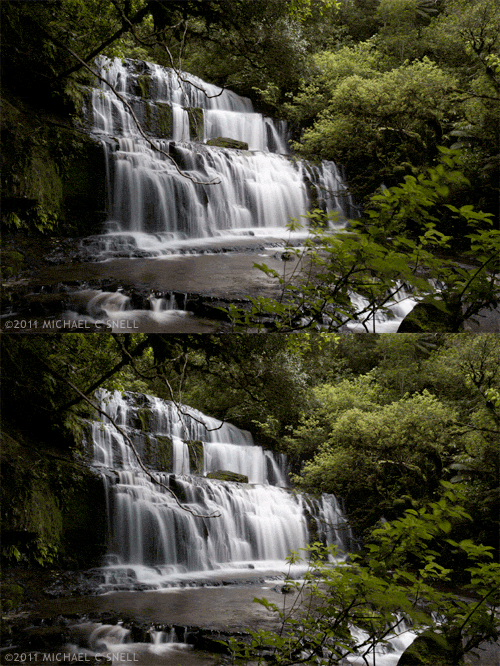
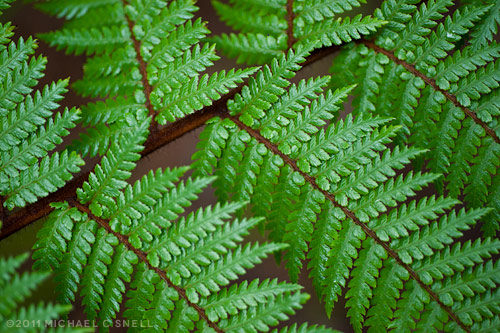
The following shot is the last one I managed to get before having to head back up the trail to catch the van. Looking at the metadata, the first shot was taken at 11 minutes and 50 seconds past the hour and the last — and 14th — shot was taken at 22 minute and 8 seconds past. My math comes up with that being 10 minutes and 18 seconds on location, and I think I managed to make those extra 18 seconds up on the hike back. At least I wasn’t the last to return to the van.
New Zealand’s Otago Peninsula

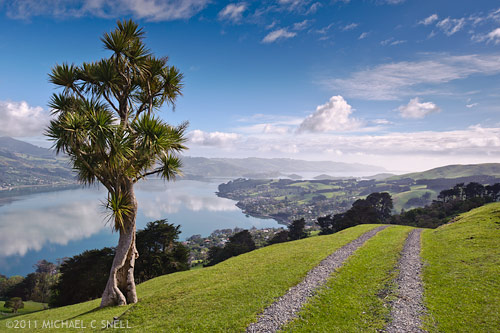
Add the Otago Peninsula to my list of favorite spots on earth. I made this image during a quick photo-stop on Highcliff Road. Actually, I think there would have been a mutiny had the driver not stopped. The scenery had been spectacular for several miles and the crowd of writers and photographers in the van was becoming vocal. Happily, one of the narrow, winding road’s very few turnouts appeared and we were allowed to pile out and make nuisances of ourselves for ten minutes or so. There’s something comfortably familiar and at the same time a bit other-worldly about New Zealand’s landscapes. It’s easy to understand why the Lord of the Rings movies were filmed here. How pleasant is this view? And yet, is that one crazy tree or what?

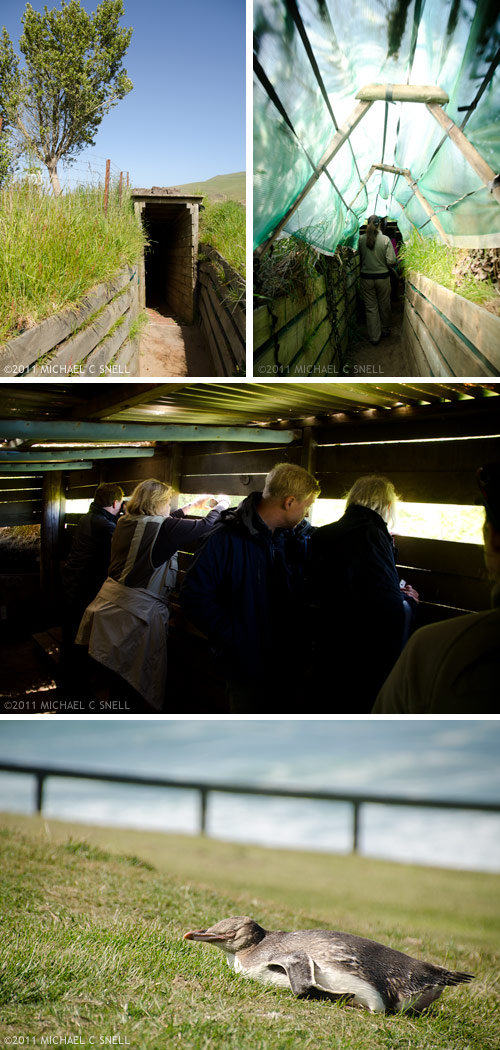
One of the stops for the day was Penguin Place, home of the Yellow-Eyed Penguin Conservation Preserve. According to their website, “Yellow Eyed Penguins are the world’s most endangered penguin, and live only in south east areas of New Zealand waters.” Penguin Place provides a safe breeding area for the penguins, which have struggled to survive since man arrived and introduced predators to New Zealand. Visitors can walk through a complex, maze-like series of covered trenches in order to reach viewing blinds where the penguins can be observed and photographed.

While I did see several penguins from the blinds, the best sighting I had on this day was of the penguin in that last photo. He was just off of the path, sunning himself on a grassy hillside. Our guide told us he was around one year old, and didn’t have the typical markings of an adult Yellow-Eyed Penguin yet. Still, he was a very cooperative model. And little did I know that I would have another penguin encounter the following day…

Stay tuned for the next post.

Chasm Falls, Colorado

Okay, this time my lack of posts is not (entirely) my fault. Last week was spent shooting in Colorado and on the first day of the trip my internet accounts were “compromised” (my hosting company’s term) and I lost all ability to send and receive emails or to log into any of my sites and blogs. Really convenient. At any rate — it’s fixed now and all is well.

The break from the heat was welcome. The day we left home, it hit 111 degrees. We, however, were quickly gaining altitude and getting out from under the “heat bubble” that’s been crippling the central US for the last month or more. It was cooler in Fort Collins and along the front range, but where we really felt the difference was in Rocky Mountain National Park. We drove the just-opened Fall River Road (it opened about a month late this year due to last year’s huge snowfalls and late melts) and back east on Trail Ridge Road — “the highest continuous motorway in the United States” according to the National Park site. At the highest point, the road reaches 12,183 feet and there was a definite chill in the air. I’m guessing mid-thirties with a blasting wind that had your fingers stinging about two minutes after leaving the comfort of the car.

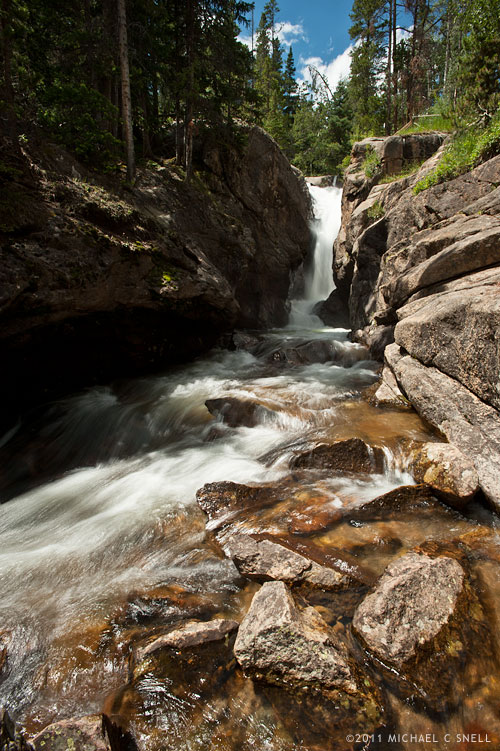
This shot was taken much lower just a few miles into the Fall River Road at Chasm Falls. It’s a short but steep little hike down to the falls from the road but worth it. Also worth it were the tripod and neutral density filter that I’d brought along. With the filter and an aperture of f/22, I was able to slow the shutter to 1/5 of a second — just enough to get some softness in the rushing water.

Resurfacing

After a tough few weeks, I’m returning to a somewhat normal schedule. Some would argue whether I ever operate on a “normal” schedule, but at least things are becoming more normal by my own warped standards. One part of what I like to think of passing as a routine is my morning walk. They’ve been few and far between lately, but the weather — and life — has been cooperating recently and I’m trying to reawaken the habit.

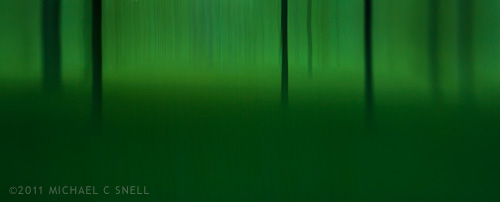
I sometimes build additional purpose into these walks by taking a camera along to experiment with a new lens or technique. On this particular recent walk, I limited myself to my Lensbaby Composer and my D700. The shot at the top of this post was created by swinging the camera downward during a .6 second exposure. I wanted to abstract the scene of grass and tree trunks to its essence and I’m pretty happy with the result. It took more than one try, but this is actually pretty close to what I was looking for.

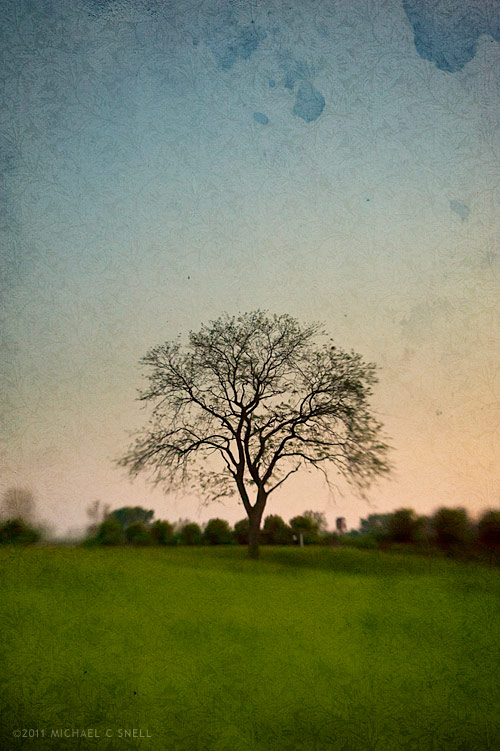
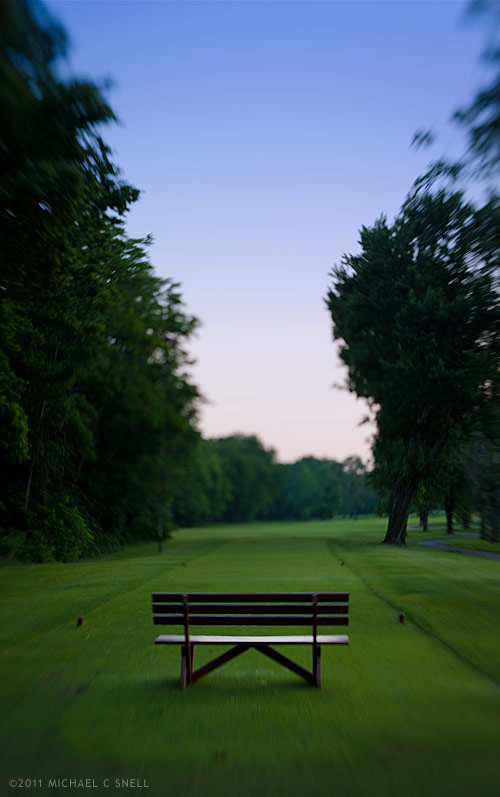
The shot of the tree was pretty straightforward until I applied some textures in post using Photoshop CS5. And here’s one more Lensbaby shot that sums up the serenity of a pre-dawn stroll:

Wicked weather

I’m still catching up from having been gone the better part of April. In some ways my days seem to be mirrored by the current Midwestern weather — chaotic and unpredictable. Thankfully my situation is far less dangerous than the weather system. My heart goes out to all of those who have been affected by the recent tornados and other severe weather in Missouri, Kansas, Oklahoma, Alabama… seems like just about everywhere this year. I’ve lived in the central part of the U.S. all of my life and can’t remember another year like this one.

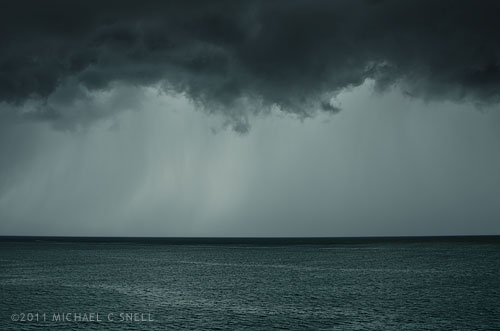
The shot above is not from this weather system but from a brief rainstorm in the South Pacific last month. Lightroom’s contrast, curves and clarity provided a little extra intensity. You can practically make a sunny day look like a supercell megacyclone with the tools we have available to us these days.

Hocking Hills State Park, Ohio

I’m back from a week of shooting in the Midwest — mostly Ohio and Indiana. It’s always bothered me, that name “Midwest”. I live very near the center of the U.S. and the Midwest is east of me. Seems like “Midwest” ought to be Utah — halfway between the center and the west coast. Shouldn’t Ohio be “Mideast”? But I digress…

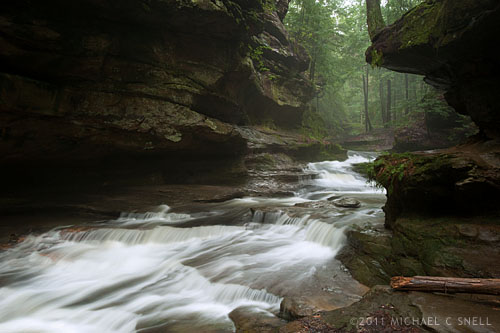
Most of the work I was doing on this trip was on assignment and, unfortunately, I can’t share it prior to publication. I did squeeze in a quick trip to Hocking Hills State Park for my own stock, however. I’d visited before about a year and a half ago, but lack of water made for no waterfalls to shoot. This time was much different. Parts of the park were closed due to flooding but the parts that were open were stunning. I got absolutely soaked by the on-and-off rain, but enjoyed the heck out of it. I know I’ve just come from Fiji — many people’s dream location — but it’s really these dark, misty, craggy, rocky places that I love the most. I’m not sure what that says about me.

I should also mention that I found two pieces of equipment essential for the Hocking Hills shoot. First, a tripod was an absolute must. Without long exposures, the water didn’t have nearly as much movement or mood. The other thing that aided in the long exposures was my 8 stop neutral density filter. It adds no color to the scene (thus the name “neutral”) but it cuts the light down so that I can get much longer exposures than even my lowest ISO and smallest aperture will allow. NDs and polarizers are the only filters I carry any more because they both have abilities that I can’t mimic later in Photoshop or Lightroom. When I reeeally want to cut the light down — say, for a long exposure in full daylight to show clouds streaking across the sky — I’ll stack up all of my NDs and polarizers to the point that it’s hard to see anything through the viewfinder.

More from this shoot and Fiji in the coming days.

Palm trees, two ways

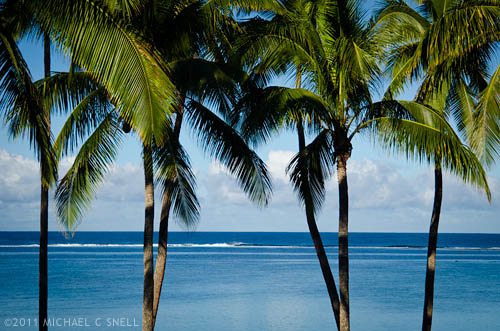
This is the idyllic view that I had from my hotel room for most of my time in Fiji. Abstracted to just palm fronds, trunks and ocean, it tells the story of a perfect vacation spot. I shot this view several times over the course of my stay, taking advantage of different lighting, clouds, etc., but perhaps my favorite version of it was the first one I shot, and in the most imperfect situation:

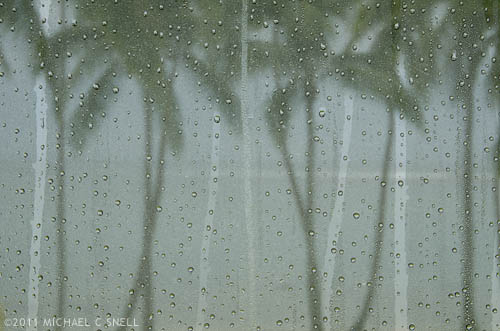
It was hot in Fiji. And humid. And when I checked in to my room, the air conditioning was cranked to the point that water was condensing on the sliding patio door to my balcony. It was also a bit cloudy that first day which, in combination with the “rain” on the glass, painted a very different picture. As a stock image, I like the way this shot says “the vacation that wasn’t”, “rained out”, etc.

When traveling — and certainly when on vacation — I would much rather have the first scene be the one outside my window, but I’m very much hoping that some photo editors out there are in need of the second version.