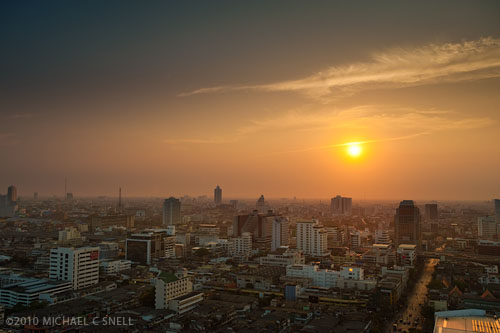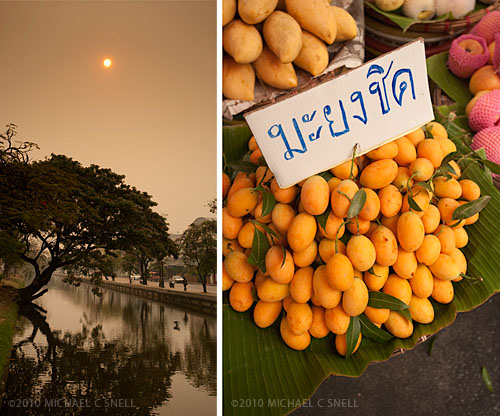
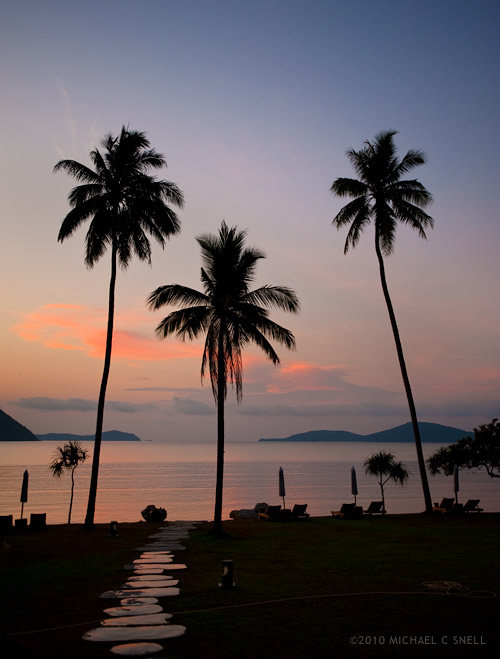
Sorry for the lack of posts lately but it’s been really busy around here between work projects and dealing with the blizzard that moved through this week. The latter may have been what inspired my dad to request a palm tree shot. That or he was just reeeeally tired of looking at those whale-watching photos on my last post. At any rate, here’s one for you, Dad. Some palm trees from a very warm morning nearly a year ago in Thailand. Enjoy.
Category Archives: thailand
Year in Review: 2010
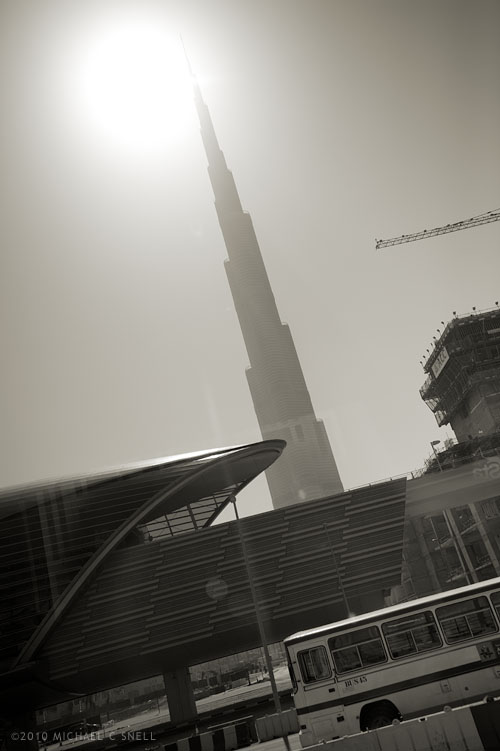
2010 was a year of contrasts for me when it came to travel. I started off with a quick stop in Dubai on my way to Thailand. Dubai is absolutely incredible. The amount of construction going on is mind-numbing — dozens of new skyscrapers going up simultaneously, each trying to outdo the others in terms of whimsical and ground-breaking design. And of course, no trip to Dubai these days would be complete without a stop at the current world’s tallest building, seen above through a bus window as I was on my way to the indoor snow skiing slopes. That’s right. Indoor snow skiing slopes. Dubai was a trip.
But the trip wasn’t over by a long shot. Next came Thailand.
Thailand is one of those places that sticks with you. The longer it’s been since I was there, the more I seem to think about it. I have a feeling I’ll be back.
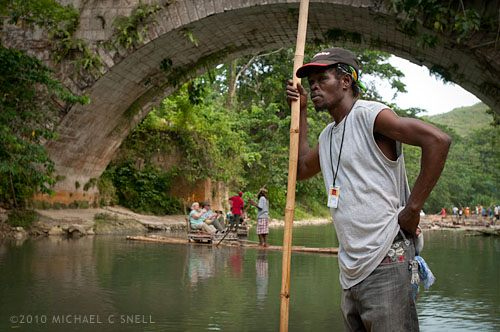
Next, a quick trip to Jamaica:
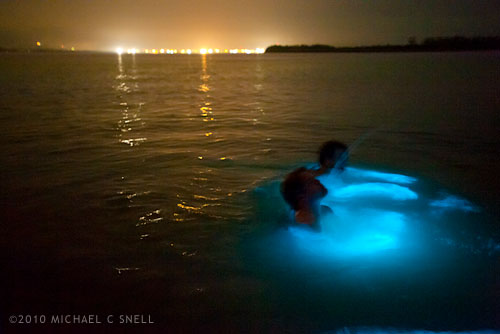
The highlight of which may have been this night visit to the bioluminescent bay. Organisms in the water cause it to glow when the water is disturbed — as it was here when a couple of people from my boat took a swim:
Tough to shoot, but a fun experience.
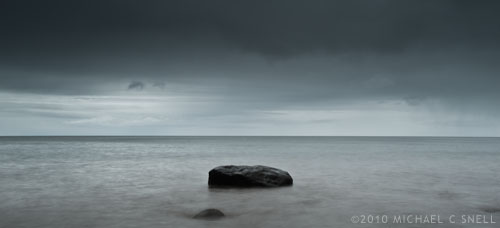
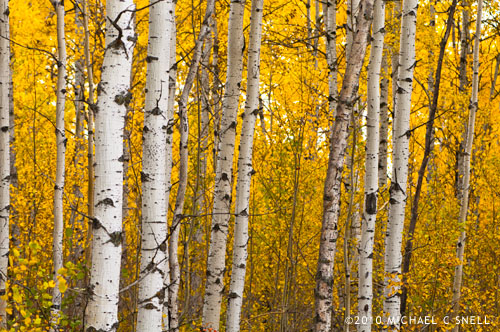
There were several US trips that I won’t take the time to list here, and a Fall drive up the North Shore of Lake Superior to Thunder Bay, Canada.
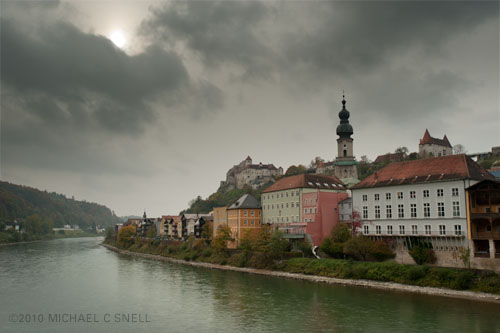
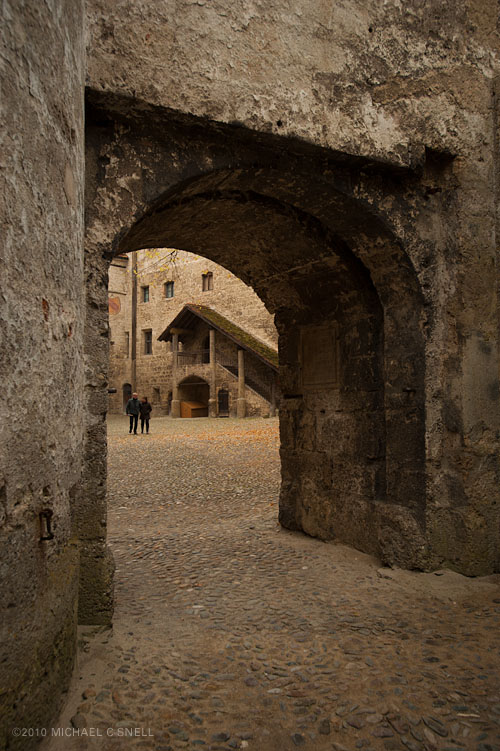
On the heels of that trip, I was off to Germany:
Crossing the bridge in that first shot, I actually set foot in Austria, too.
2010 was a great year for me in terms of travel. I enjoyed each and every place I visited and would eagerly return to any of them. 2011 is already shaping up to be another busy one, however. I have one more year to serve as the Chair of the Freelance Council of the Society of American Travel Writers and already have a fair number of SATW meetings on my calendar including one in San Diego this week. Fiji and New Zealand are also on the agenda for 2011 and I’m sure there will be some surprises as well. Stay tuned…
Google maps to the rescue for keywording

I’ve been meaning to write this post for a long time. While finishing up the keywording of my Thailand files in the last couple of weeks, I ran across a good example of what I’ve been wanting to discuss, and that is: how I use Google Maps to help me identify my images.
Of course, taking notes on site is always the best practice. I carry a small notebook in my camera bag but, in truth, I tend to take most of my notes with the camera itself. Here’s an example: on my last day in Chiang Mai, I had a few hours in the morning to stroll the old city on my own and photograph the various Wats, Chedis and Prayer Halls. I had heard that Chiang Mai has over 1000 Wats so, suffice it to say, it’s important to keep track of which is which when it comes time to keyword and label for my stock agencies.
I set out from the hotel before dawn and headed for the original, walled city. Once inside the walls, I would pass a small temple complex nearly every half a block. While I had been driven through these streets regularly for three days, I never would have seen many of these buildings without being on foot. They are tucked away and need to be sought out.
When I would begin to shoot a temple site, I would first look for a sign with the name in english and photograph that first. This is my way of taking notes. The images can always be sorted by capture time and I’ll have an “opening title” for each location I visited. Hopefully it will even be spelled correctly, but, you never know.
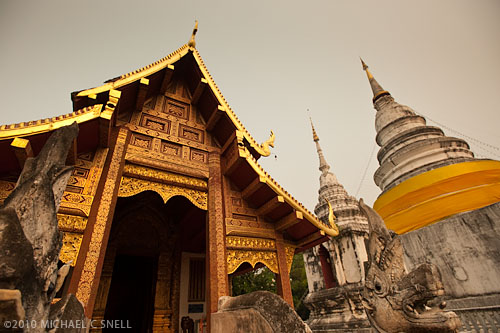
When I arrived at the Wat at the top of this post, I couldn’t find a sign in english anywhere. Nor was there anyone around that could tell me what it was save for a group of monks (who I opted not to bother), chanting inside this main building:
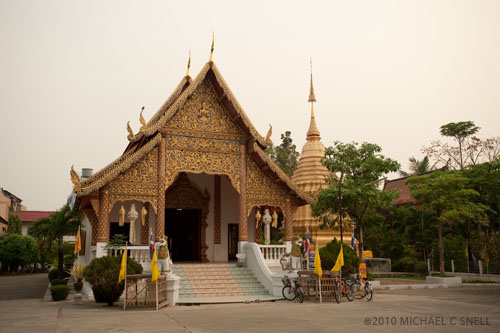
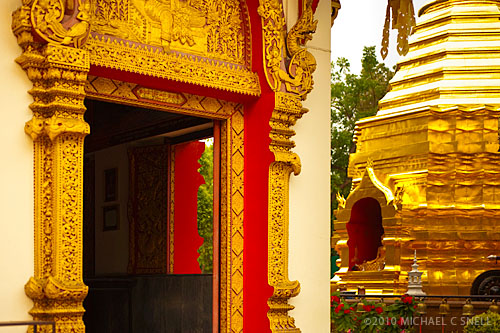
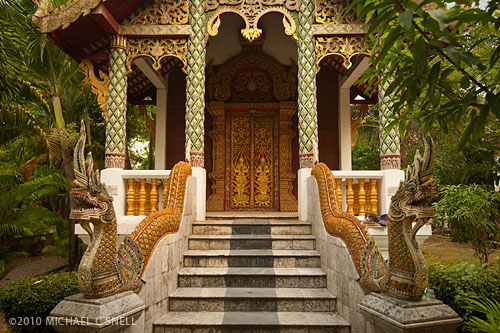
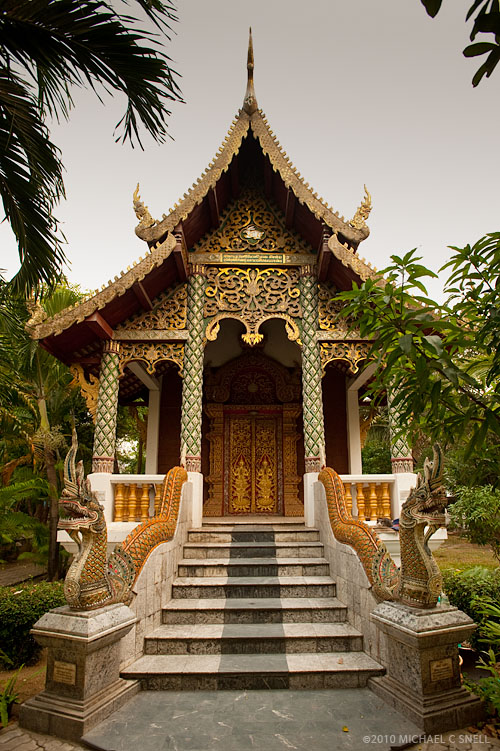
The site was a monastery comprised of a viharn (the building in the foreground), a chedi (the gold spire behind it) and a ubosot (the roof seen peeking over the trees in the back on the right). The english terms for these might be an assembly hall, a reliquary, and a prayer room or ordination hall. The ubosot, or prayer room, is what is pictured in the opening photo.
As it turned out, I never had the opportunity to speak with my local guide again and I continued on my way to Bangkok. Once back in the office at home, I could have tried to contact him by email but decided to do some detective work on my own first. This is where Google Maps comes in.
I knew the route that I had walked through the walled city, and I knew from signage, what the names were of the Wats on either side were. I zoomed in close in this area with Google Maps and switched to the satellite image view. There was my Wat:
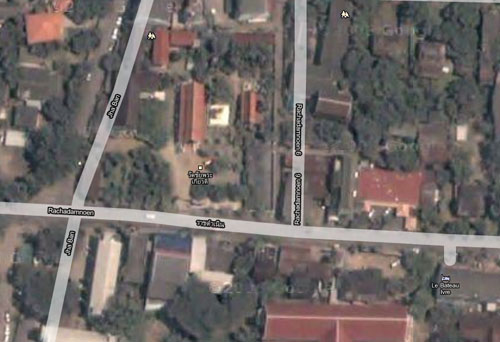
You can see the shiny gold chedi in between the two red-roofed buildings just above and to the left of center in this screen capture. There is a label, but it’s in Thai. I tried using an online translator but didn’t trust it so I tried using Google’s street level viewer in Google Maps. That’s the tool shaped like a little man. While the area had not been mapped for street level views, the tool did show several blue dots for the positions of still images that were on file for the site. Sure enough, by looking at some of these images, I was able to confirm that this was the Wat I was looking for and that it was named Wat Chai Phra Kiat, or Monastery of the Renowned Victory.
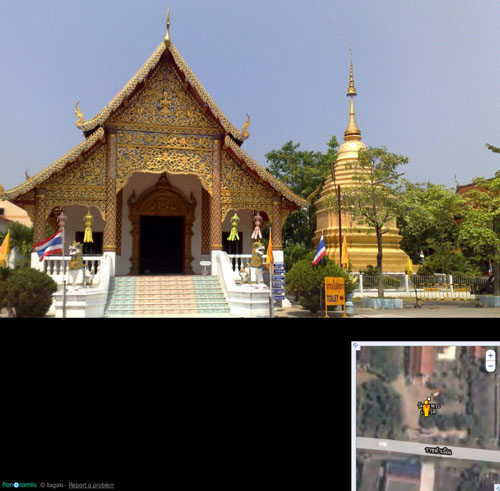
That’s the image that convinced me. Still, just to be safe, I Googled the name and found several other sites that confirmed it was what I was looking for and provided me with some alternate spellings.
The internet has been one of my most valuable tools for researching images and compiling keywords. I would hate to imagine the time it would take to track sites like this down through books, emails to local guides, etc. I still do my best to identify sites while I’m on location — there’s no substitute for that — but at least in situations like this, I can feel confident that I can come up with the information later when necessary.
Ayutthaya, Thailand

After an ugly week in Bangkok, the protests have been dismantled and everyone seems to be waiting to see what happens next. This has been a tough time for Thailand. For a country that thrives on tourism, more tough times will likely be ahead. But this is a resilient region and hopefully the situation will remain calm and the tourists will return soon.
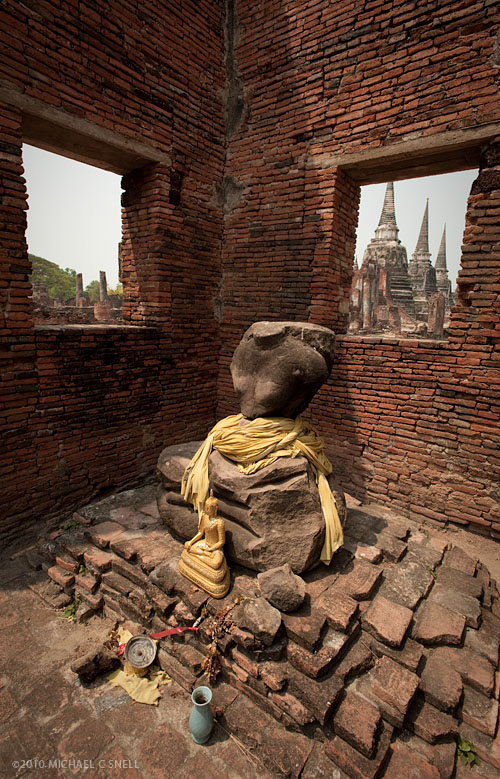
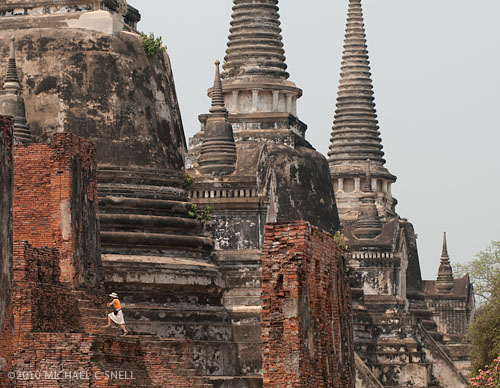
If and when you do find yourself in Bangkok, make sure you get to nearby Ayutthaya, a UNESCO World Heritage Site. The three chedis of Wat Phra Sri Sanphet are shown in both of the photos here. Ayutthaya was the second Siamese capital (founded in 1350) and the city was nearly burned to the ground in 1767 when the Burmese invaded — proof that this region has bounced back before. The remaining ruins are scattered on and around an island created by the confluence of three rivers — the Chao Phraya, the Lopburi and the Pa Sak — as seen on this map from Travelfish. I only visted three or four of these sites and could easily spend a week or more here continuing to explore.

I’d seen photos of these ruins prior to visiting but still wasn’t prepared for their scale. The woman in the white skirt (above) gives you some idea of just how big these chedis — the bell-shaped towers — are. In this case, the three chedis were built to house the ashes of kings.
One day here was not nearly enough. While it would be hard to say what my favorite spot in Thailand was, this would certainly rank up there in terms of places I wish I could have spent more time. There is so much to see and I only scratched the surface.
Bangkok erupts

The situation in Bangkok has ramped up again. Red Shirts maintain the protest they began over two months ago and the government’s patience is wearing thin. While I was there in March — oddly enough arriving on the same day as many of the Red Shirt protesters — things were quite peaceful and the protesters were scattered around various parts of the city. There was a sense of tension but, other than some traffic problems, the situation didn’t really affect one’s ability to go about their business in Bangkok.

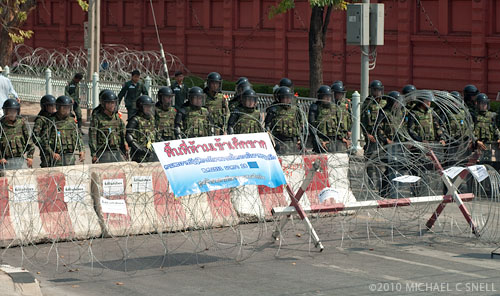
Toward the end of my time in Bangkok, I began to see a few more scenes like this one — streets blocked off and guarded by police. Still, only one tour stop was cancelled due to these blockades. In other parts of the city, life went on as usual. After I left, things began to heat up and violence erupted. Eventually, as I understand it, the protesters regrouped in one area, just a few blocks from where we had dinner at a rooftop restaurant just a few days earlier.

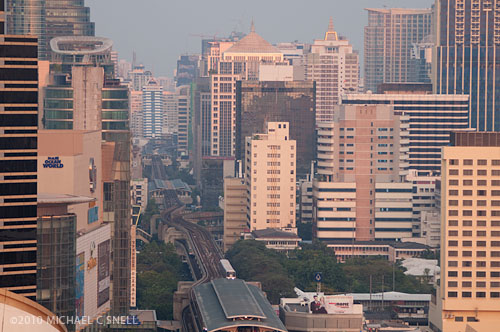
This is the view from that terrace toward where the protesters now have their camp. This area is approximately the intersection of the red lines on the map in this article posted on the BBC site. (The shot at the top of this post was taken from the same place on the same evening but is looking the other direction.)
A writer I have traveled with in the past, Kevin Revolinski, has been living in a borrowed condo not far from this part of Bangkok and has been posting some reports of the recent events on his blog. It’s odd to feel so connected to a situation happening half way around the world but the combination of having been there so recently and knowing the area somewhat, along with reading these reports of violence written by someone I know who is still there and whose voice I can hear in my head as I read the posts is all very disconcerting. I can’t claim to know exactly what’s going on or who’s firing live ammunition (police or terrorist snipers trying to elevate the tension?) but I hope for the best for the people of Bangkok and all of Thailand. It’s a beautiful country full of wonderful people — gracious and welcoming.
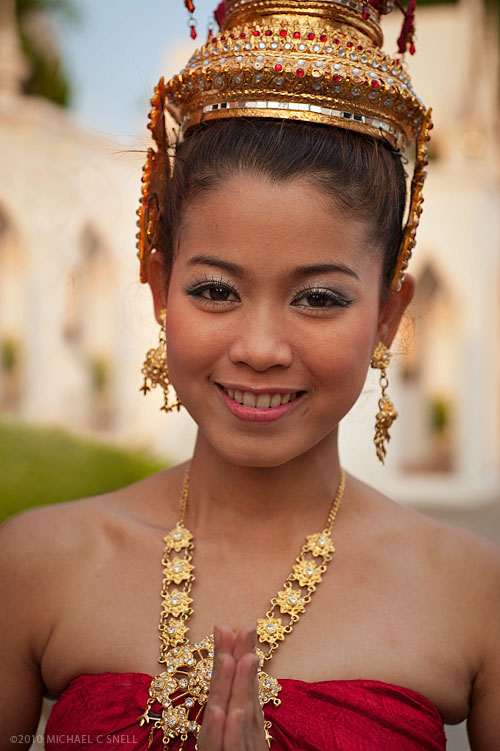
It is the warm people that I’ll remember and it is them, and the amazing places I visited, that I will continue to tell people about, encouraging them to visit for themselves in the future.

Wats of Chiang Mai

So much to show and so little time. I find myself in a familiar place — not caught up with images from one trip and, yet, leaving on another. I’ll be in Jamaica for the next few days so here’s one more Thailand post to tide you over while I’m away. Of course, I’ll post from the road when possible but you never know if the goddess of internet connections will smile upon you.

These are a few of the temples I wandered across on my last morning in Chiang Mai. Some small, some large, but they were everywhere. The one above had absolutely no signage in english to help me to identify it but, thankfully, Google Maps helped me out on my return. I was able to retrace my walk on the satellite image and find my temple, nicely labelled in english.

Now… off to pack… again…
Elephant Conservation Center

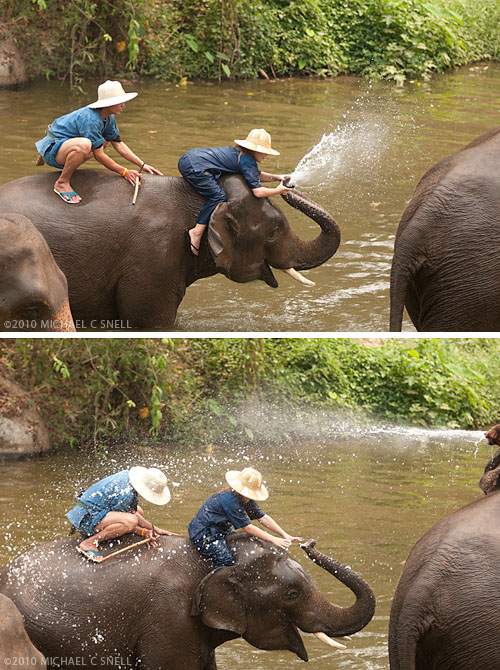
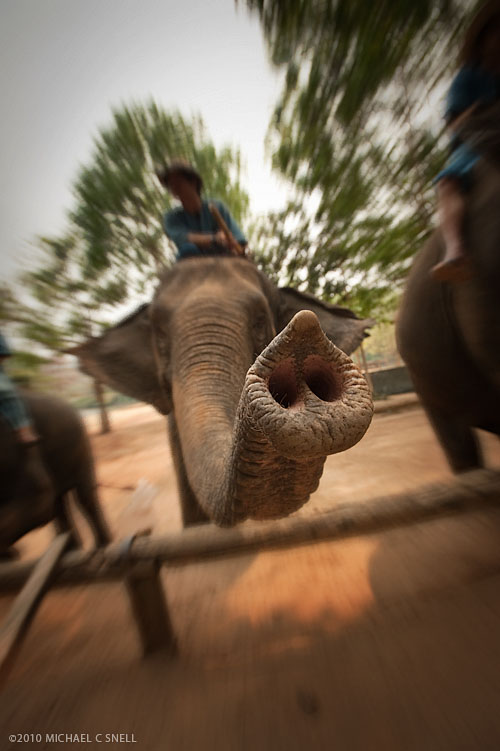
It’s happened to all of us. We take the family elephant down to the river to wash off the accumulated sludge of winter from her undercarriage and, next thing you know, a water fight breaks out. Afterall, you’re sitting on the world’s greatest water pistol, right?
Day three in Thailand and it’s a visit to the Elephant Conservation Center at Lampang.

Wat Chedi Luang, Chiang Mai, Thailand

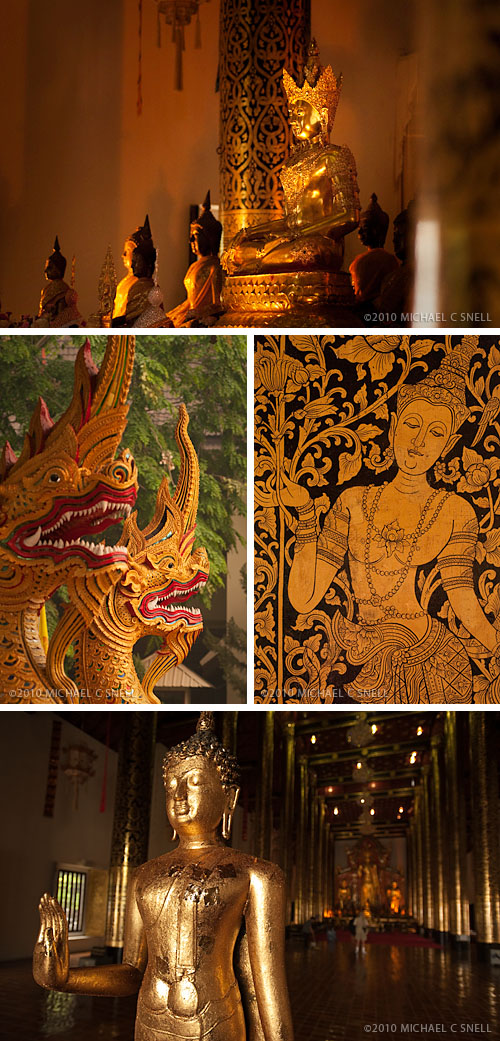
Wrapping up day two of my Thailand trip were visits to a few temples including Wat Chedi Luang. Images from its prayer hall appear above. There are many, many temples in Chiang Mai — I believe I heard the number put at 1038 which hardly seems possible. On my fourth and last day in Chiang Mai, I took a long morning walk through the old, walled city and found that there were temples hidden around nearly every corner. You wouldn’t know it driving through town but on foot these hidden gems are revealed. More on that walk in a few posts. I’ll try and stay somewhat chronological as I go through the images from this trip.
A visit to the hill tribes of Thailand

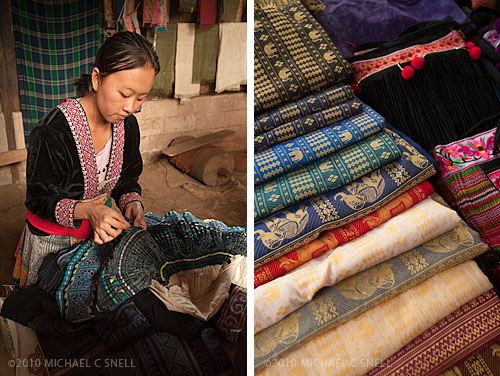
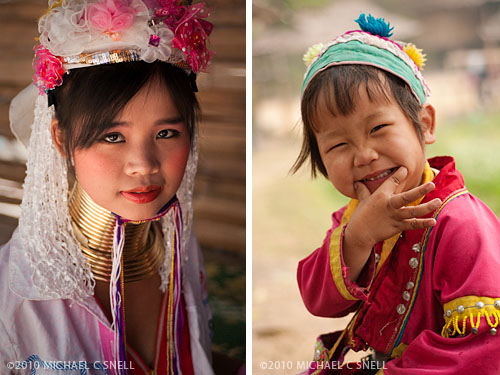
In the afternoon of my second day in Thailand, I visited some highland villages north of Chiang Mai. The people who live in this area migrated to Thailand over the last few centuries from China and Tibet. My first stop was a working village that was largely agricultural but had a couple of small stands where they sold their traditional woven fabrics to the occasional tourists that ventured up.

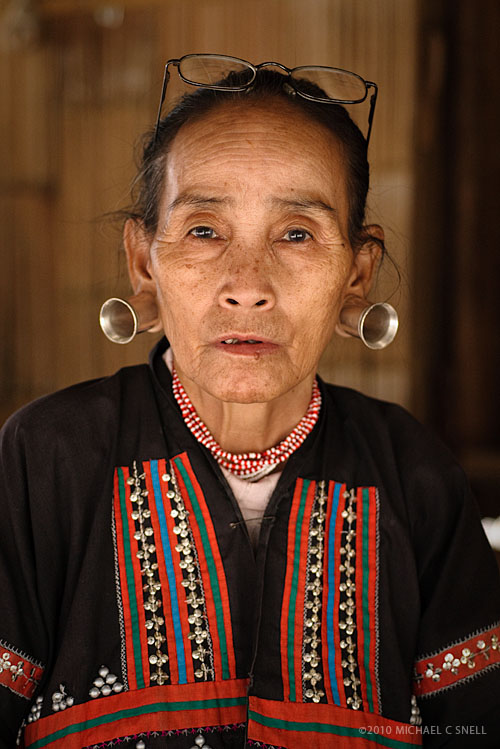
I posted a couple of other shots from this village in an earlier post. The shot at the top of this post and those that follow came from another village that is more of a tourist-centered, cultural village. This felt like much less of a real, working village and more like something that was created to show off the crafts of each of several tribes. Each grass-roofed “house” had someone weaving or sewing on the porch. Among the tribes represented were the Long Neck Karen, whose women are known for wearing the heavy brass rings on their necks.

One can argue the merits of this second type of village. As tourism grows in an area, these types of villages are ways to present local cultures to tourists in a way that is easily accessible to travelers (no need to venture high into the mountains to some remote village with no services, for instance). That also reduces the impact of tourism on the real, working villages where people want to just live their lives and maybe don’t want tour busses rolling through on the hour. On the other hand, you’re hardly seeing the real way of life of these people in such a controlled display. It’s a form of packaged tourism rather than a true experience. I don’t have an answer for what is right but I do hope that, whichever route is taken, it is good for the local people. Tourism may be key to their survival as their old ways of nomadic farming become nearly impossible with the onset of modern development on all sides. The world is changing and I think many cultures are desperate to find ways to assimilate while keeping something of their own cultural identities intact.
Chiang Mai: morning market

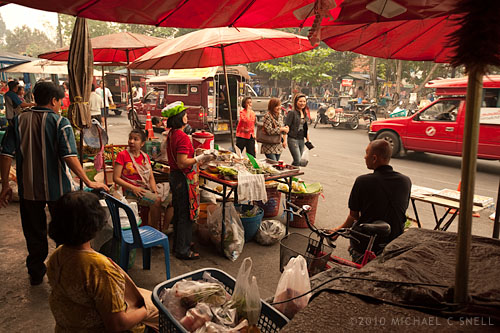
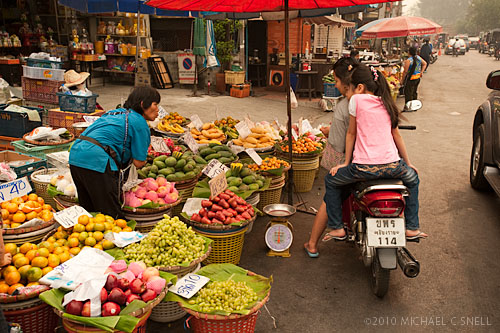
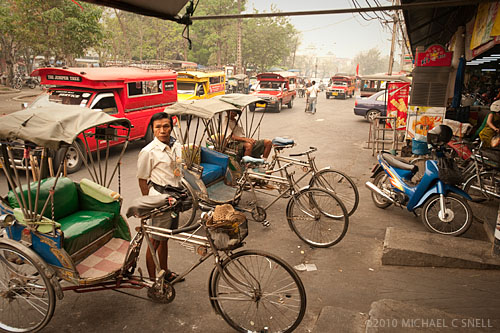
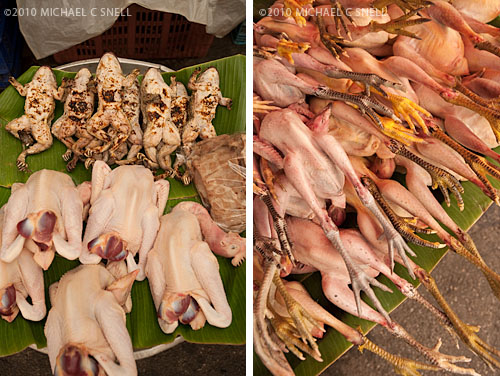
My second day in Thailand began with an early morning visit to the market. In addition to a vast indoor space where everything was sold from clothing to hot meals, there were a line of vendors along the street stretching for several blocks. This was true convenience shopping in that people could ride up on their scooter and do their shopping without ever getting off of their bike.
Smoke from the nearby agricultural burning still hung in the air lending a soft warm glow to the light.