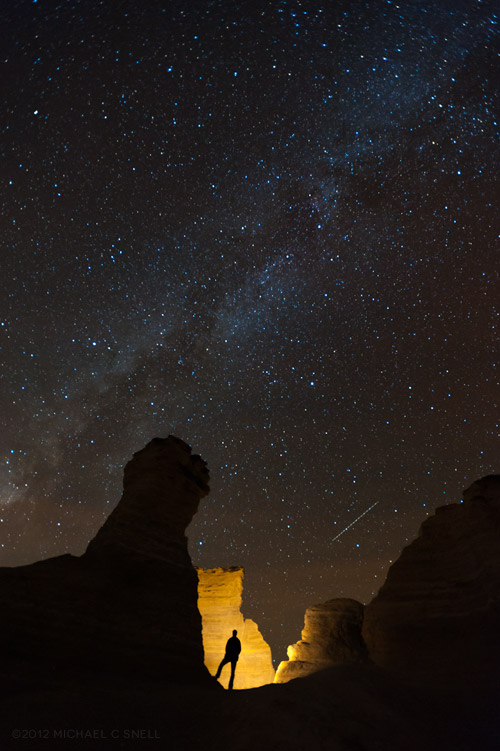
In yesterday’s post I promised to provide some insights into last Wednesday’s night shoot at Monument Rocks in Western Kansas. It’s a different animal, shooting in near total darkness, and takes some getting used to. I learned a lot last week and I look forward to my next opportunity to improve my process.
None of the images in this post have had huge adjustments made in post-processing. White balance was probably the biggest challenge — especially when getting into mixed light sources — but I’ve decided not to get into localized color changes and instead go with how the camera recorded the images.
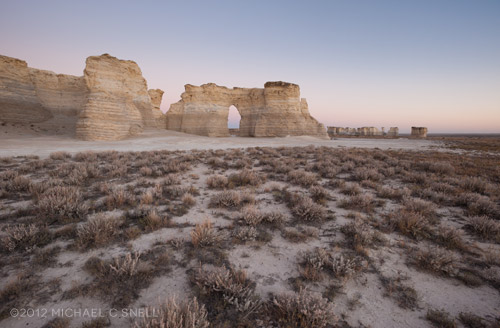
But first things first: if you’re not familiar with Monument Rocks, it’s an area of the high plains of Western Kansas that used to be the bottom of a vast ocean millions of years ago. Eons of erosion have left behind spires of chalk that stand up to 70 feet above the mostly flat surrounding landscape. According to Wikipedia, this was the first region to be designated a National Natural Landmark by the US Department of the Interior.
But why try to describe it when you have photos? Here’s what it looked like just after sunset last Wednesday:
The rocks are also remote enough that there wasn’t a lot of light noise from nearby towns to cause problems with our attempts at night photography. I think the nearest town is at least 20 miles away. We could see a few lights from surrounding farms and ranches, but they didn’t cause huge problems. The stars where clearly visible in the millions, but I do think that the color shifts that I observed in some of the shots may have come from artificial light bouncing around in dust that was being carried in the slight breeze. It was a far calmer night than I had ever experienced at Monument Rocks, but it has been an extremely dry year and the dust was very fine and easily made airborne.
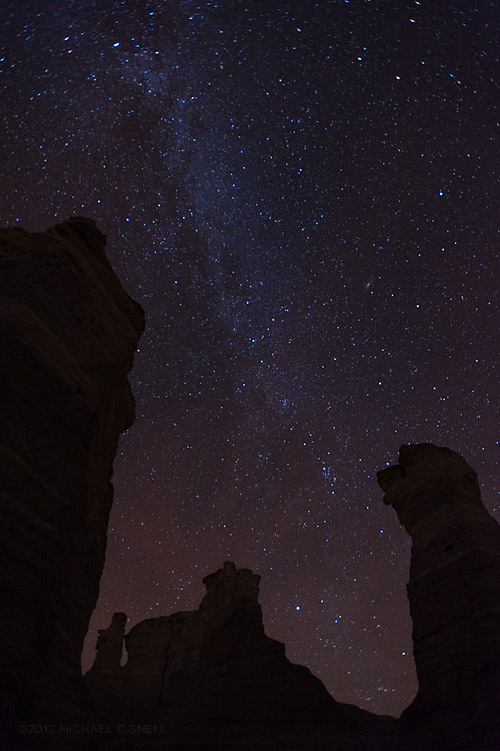
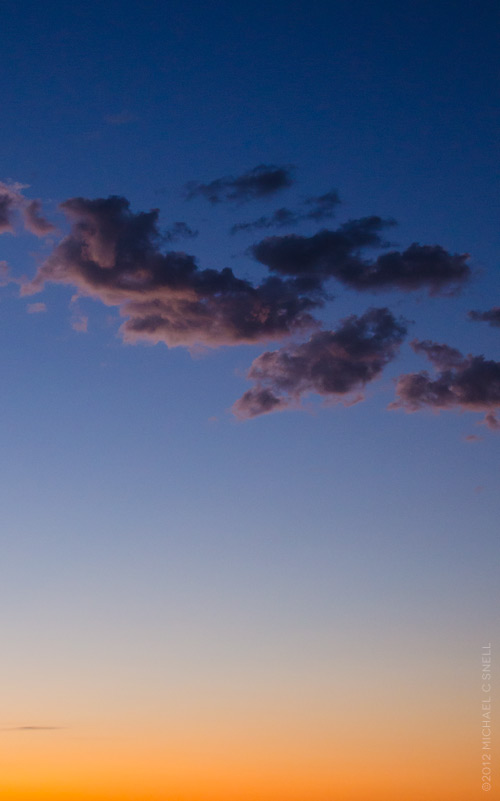
After the sun went down, it didn’t take long for stars to appear and be bright enough to photograph. In this shot, there is still a fair amount of ambient light in the sky and the rocks are still being lit slightly by the dying light of the sunset:
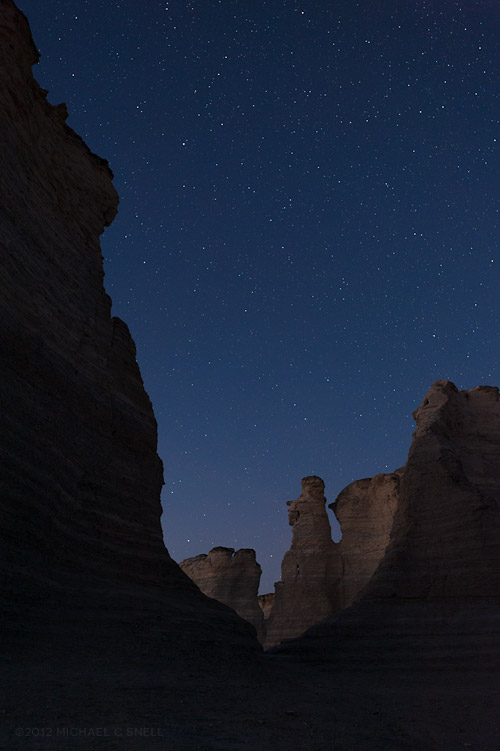
To the eye, it was fairly close to total darkness at this point but the camera could still draw quite a bit of light from the scene. I tried to keep all exposures shorter than 20 seconds, or 30 at the most, in order to keep the stars from streaking due to the earth’s rotation. Focusing was a bit of a trick since many modern auto-focus lenses don’t behave quite like old manual lenses did. On the old lenses, you could often just rack them all the way to infinity and you’d be fine, but with some earlier testing on my 17-35mm Nikkor that I used for these shots, I noticed that I had to pull it back a bit to get things sharp when focussing manually. I’d made a note of where the focus point needed to be on the lens markings and just used that once it was too dark to visually attain focus anymore.
As it got darker still, I started experimenting with adding some light painting. This was done with a variety of sources but the two I found that worked best were 1.) a small, hand-held flood that I picked up at a hardware store for less than $20 and 2.) an even smaller Maglite that I tend to keep in my camera bag to help me locate things in the dark on night shoots such as this. It was this small Maglite that was used in the shot at the top of this post. One of my fellow photographers stood in to give some scale to the scene and also used my Maglite to “paint” the distant rock during the exposure. The hardware store floodlight was used on the following shot:
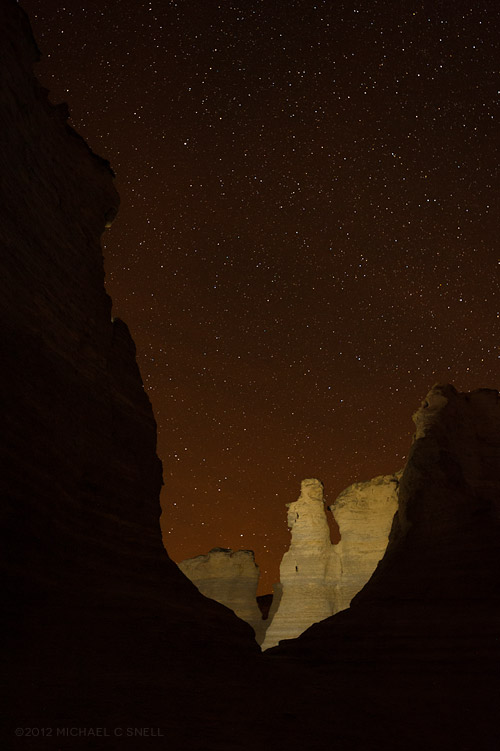
The light was far too bright when pointed directly at the rocks so I used the silhouetted rock in the foreground as a giant bounce card. I walked around the foreground rock and set the floodlight on the ground, propped but by a small rock, so that it pointed away from the rock I wanted lit. The beam hit the back of the rock that you see in silhouette here, and the light bounced back to illuminate the more distant spires. The redness of the sky is what I believe is coming from some light from surrounding towns and farms refracting in some airborne dust. My best guess anyway.
I found that when shooting with a 17mm lens (on a full-frame D700), 20 seconds was indeed about the limit of what an exposure could be before stars began to streak. Twenty seconds or less kept them more or less as pinpoints. To achieve this, I generally shot wide open at 2.8 and used ISOs to control the exposure. By the darkest point in the night I was shooting at ISO 1600. I was surprised to not have to go higher, but relieved that I didn’t need to deal with more noise from even higher ISOs. As it was, these shots required very little noise reduction in Lightroom.
The following night we shot more night skies, including one 15 minute star trail exposure. I’ll share some of those images in later posts.