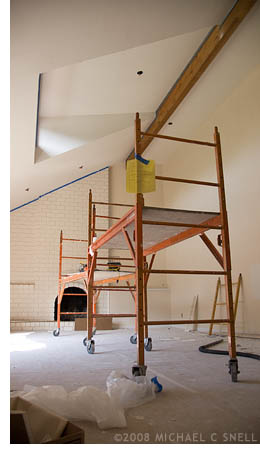
 Again, my apologies for the limited posts and all of the other ways that I’m neglecting my friends and family. Progress is moving along at the new house but it’s taking a lot of our time right now. Along with the work that we’re doing to ready the old house for the market and the “real work” that we have to fit in to pay for all of this, let’s just say it’s been busy. Real busy.
There is light at the end of the tunnel, though. We may be starting to move in by the first of August. Don’t worry, change of address cards will be in the mail shortly. Oh dang! I have to get those made, too!!!
Painting the outside of the old house today. Since the ladder has to rest inside the neighbor’s fence, let’s hope they keep the dog inside…
Bear with me. Normality (such as it is) will return soon. Oh — and I almost forgot. Yes, I am excited about the new Nikon D700. I barely caught the news of it in all this chaos but what I’ve seen so far looks great.

 More related links are available on
  Sounds right up my alley although I’m a little peaved that they are using a logo that’s very similar to one I designed in 1999 for a local redevelopment campaign (left). Oh well, they can make it up to me by offering me an all-expense-paid-plus-full-dayrate position on the next Lightroom Adventure. Seems only fair.
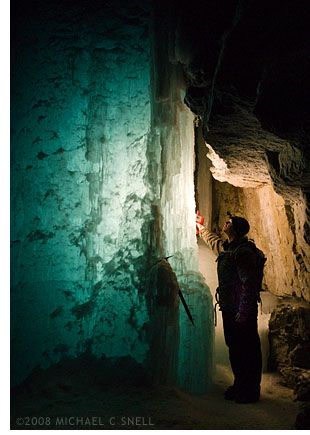 I had a great experience last night on the Maligne Canyon ice hike in Canada’s Jasper National Park. This is a trip you must make with a guide. Boots and ice spikes are provided — a necessity for the second half of the hike when you are literally walking on the frozen and sometimes slushy river. It’s a pretty good trek from the parking area to the ice falls and fairly disorienting in the dark with only an LED headlamp to show you the way. There are a few overlooks at the top of the falls that are accessible during the day on your own but the fun of the night trip begins when the guide leads you off of the path and down into the canyon. It’s similar to exploring a cave except you can see the stars between the high canyon walls and many of the formations are ice instead of stone. This is not a trip that can be made in the summer as the river prevents all access.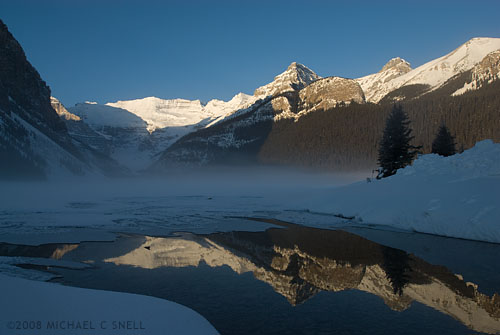
 Grabbed a few shots of Lake Louise this morning with some fog coming off of the ice. There was a patch of open water at the lake’s outlet that provided another nice opportunity for a reflection. The fog came up almost instantaneously and only remained for 15 minutes or so but it was beautiful while it lasted.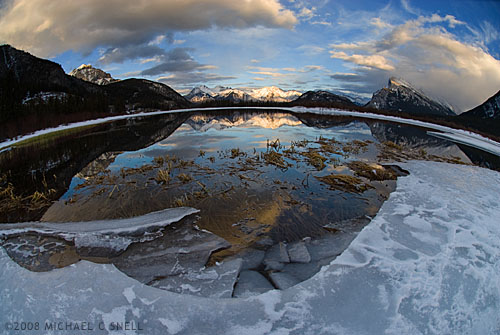
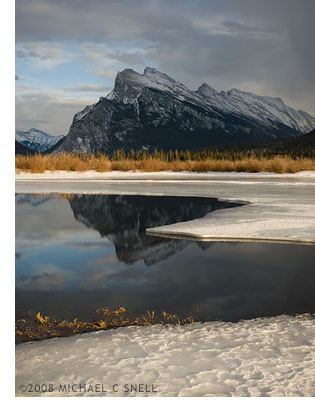 The spot was perfect as it allowed for several shooting opportunities. Nearby hot springs had kept this body of water open and the stillness made for perfect reflections of the nearby mountains — including Mount Rundle shown at the right. Ice around the edge of the lake provided a good surface to shoot from as well as some nice leading lines and foreground elements. in other areas patches of golden reeds broke the surface of the water giving some nice warm color and a very different look than shots that were dominated by the ice. In the end I was able to grab lots of different images that don’t all look like they were shot in the same place or on the same evening. A very versatile location. What a great way to end a day.