Category Archives: photography

The Giants and the Bigheads of San Fermin

140901sanfermin01_sotc

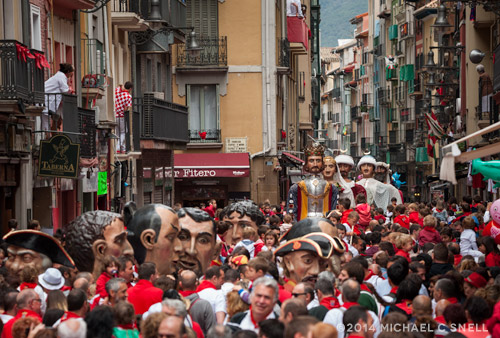
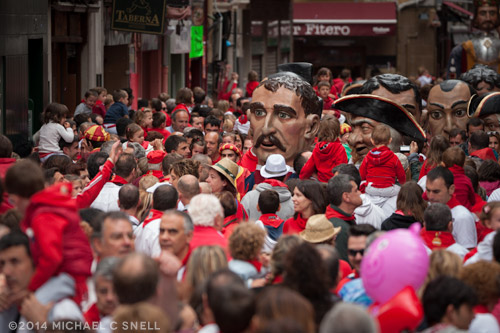
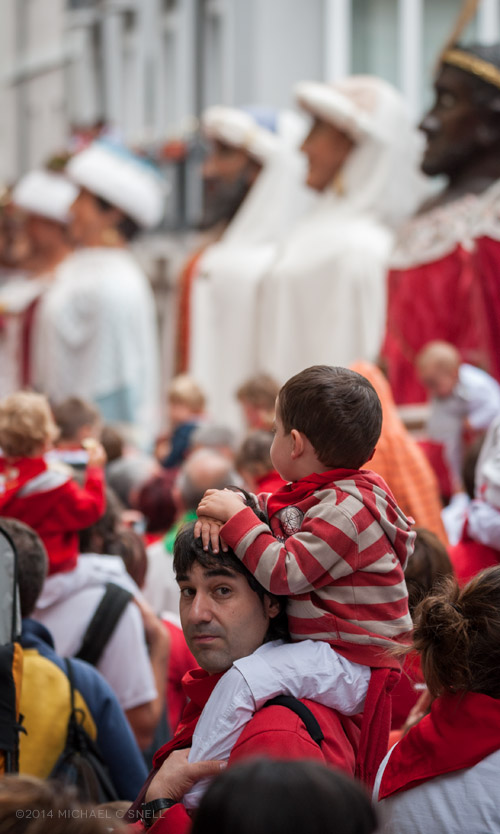
I mentioned in an earlier post how the Festival of San Fermin in Pamplona, Spain, is so much more than just the running of the bulls. One of my favorite parts of the festival is the visually stunning and family-friendly Comparsa of the Giants and Bigheads. The current Giant and Bighead characters date from around 1860, replacing older versions that had fallen into disrepair. Wherever they go, a crowd gathers. I saw them briefly on my first day in Pamplona, but the crowds were so tight it was difficult to find a position for good photographs. On my second day, I was lucky enough to run into them again during some free time and I managed much better.

140901sanfermin02_sotc

Coming upon the parade from behind, I could see where they would be going — which appeared to be a different route than they had taken the day before. This time they were heading down Estafeta Street — the same street I had scouted for my long telephoto shot of the running of the bulls. After getting a few shots of families enjoying the festivities from my initial vantage point, I set off to walk around a few blocks and be ready as the procession approached me closer to the bullfighting arena.

140901sanfermin03_sotc

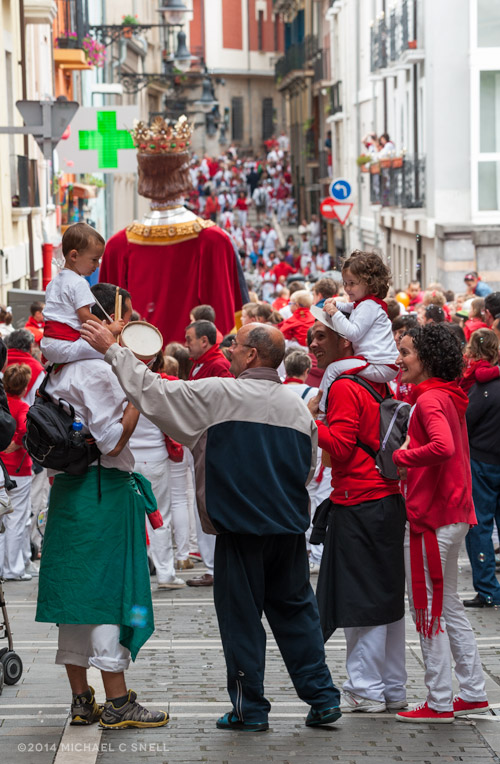
And they arrived — coming right down Estafeta following the same path that the bulls do each morning. The shot below shows the full procession with the Bigheads in the lead and the Giants following behind. The Bigheads interact with the people in the crowd as the Giants twirl and dance.

140901sanfermin05_sotc

140901sanfermin04_sotc

This last shot is the one I was really looking for and hoping to get. I love the compression from the long lens (this was my Tamron 150-600mm zoom, set to 450mm) and the way the shallow depth-of-field isolated the Giants by softly blurring the balconies in the background. As you can see by the myriad children in all of these photos, this really is a family event and the kids love it. Hey, I loved it!

140901sanfermin06_sotc

The running of the bulls, Pamplona, Spain

140815bulls07_sotc

I have photographed bovines in abundance this summer, but the pinnacle may have come in early July when I went to Pamplona, Spain, for the San Fermin Festival and the running of the bulls. The  spectacle of people running through these crowded streets alongside bulls that are being driven toward the bullring was made famous by Earnest Hemingway in his 1925 novel, “The Sun also Rises.” I read the book on the way to Pamplona and I have to say, I thought it was more about drinking and fishing than bulls, but I’m no literary scholar. The fact remains, because of Hemingway, everyone is now familiar with the running of the bulls in Pamplona. Which is a real shame, because I found other aspects of the San Fermin Festival to be at least, if not more, entertaining.

That said, when in Pamplona during San Fermin, you’ve got to see the running of the bulls, known locally as the encierro. And it is worth it. I was able to go three days in a row (the encierro is at 8 a.m. every morning from July 7-14) and would have happily gone again. As a photographer, it’s a difficult event to shoot in one try. The entire run takes just a few minutes and you can’t see the entire course from any one vantage  point so the action literally passes by you in seconds.

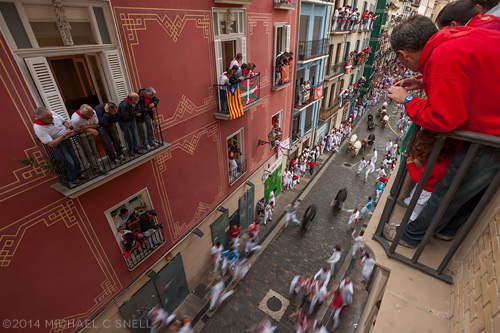
For my first encierro, I had a spot on a balcony of the City Hall. It was near the beginning of the run, as the bulls are coming up a hill and entering a public square to make a sharp left. Here was my view from that vantage point:
140815bulls01_sotc

Better yet, here’s a looping animation of several frames I fired off on that first day:
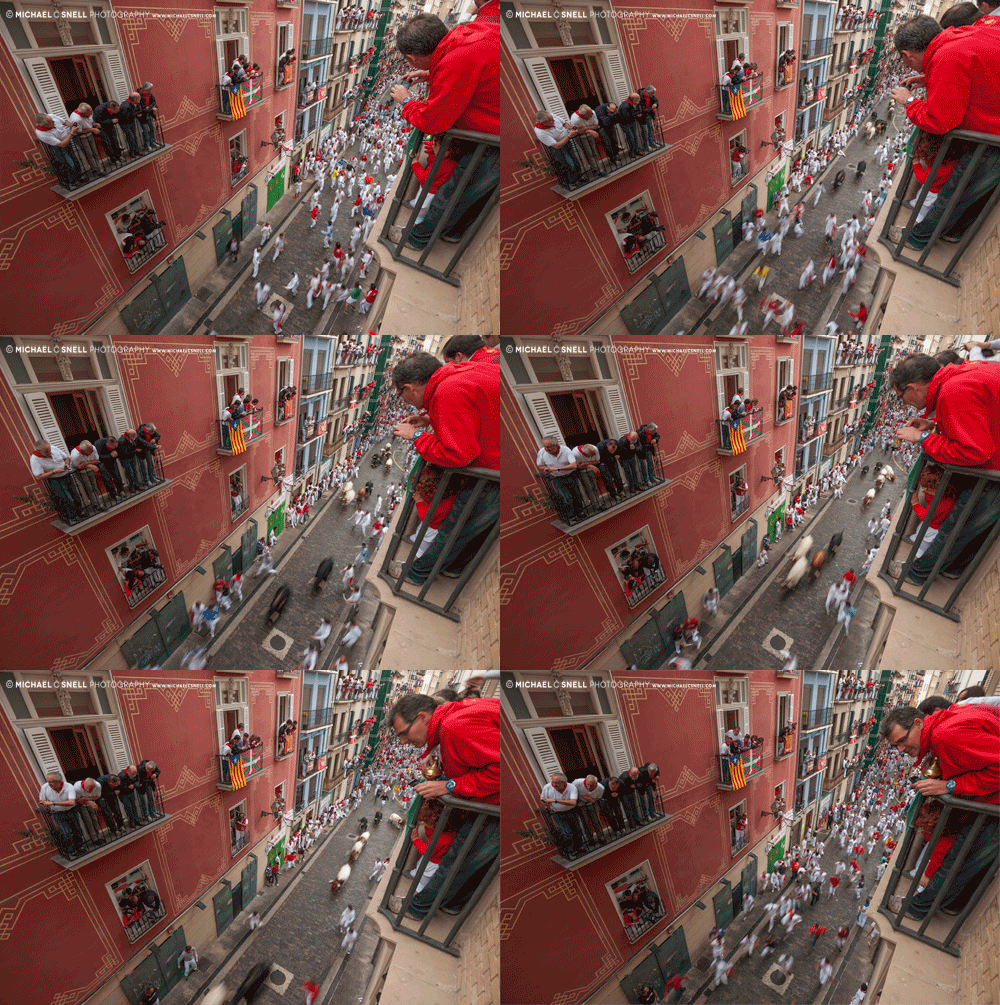
140815bullanim_sotc

That was a great start, but I was really looking forward to my second day, when I had a pass to be in the barricade at street level. This is a narrow space between the temporary fence that holds the general public back and the fence that separates you from the route itself. The only people allowed in this gap are credentialed journalists, police and emergency medical personnel. But, you can’t just stand in there. To photograph the event, you need to be straddling the fence itself so that you leave the space below the bottom rail open. That way if (when) runners fall, they can roll to safety without your feet being in the way.

Here’s a shot from that vantage point as the route was getting one final inspection:
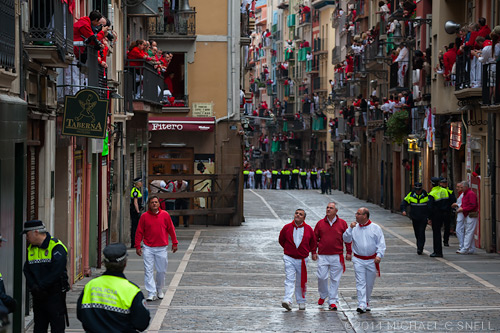
140815bulls04_sotc

A few moments later, the runners — and bulls — arrived:
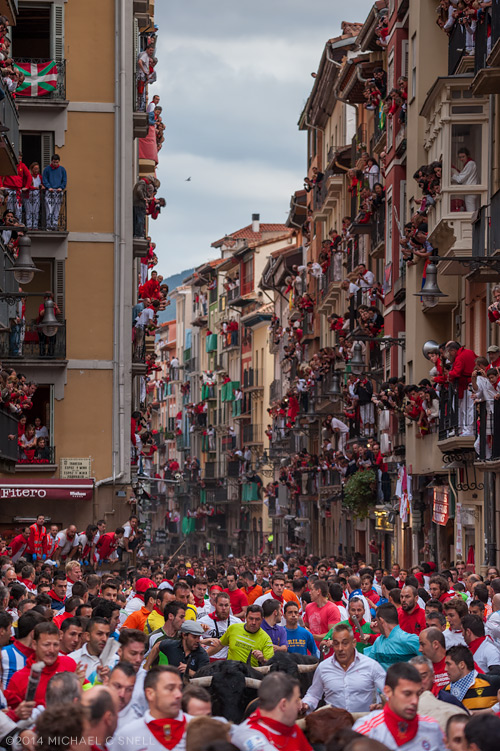
140815bulls02_sotc

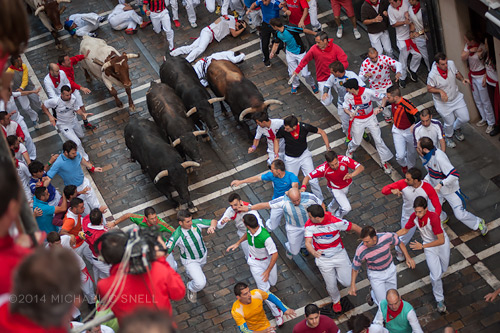
I love the telephoto compression that came from using my Tamron 150-600mm zoom here, but the runner’s bodies nearly obscure the bulls altogether. If was difficult to even tell if the bulls were in the frame through the viewfinder so I just continued to shoot and hoped for the best. Upon later inspection of the images, this one was among my favorite.

Once the bulls were too close for the telephoto, I had one last — quick — opportunity to grab a few wide-angle shots as they passed:
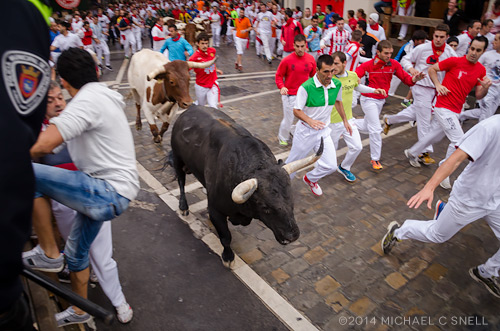
140815bulls03_sotc

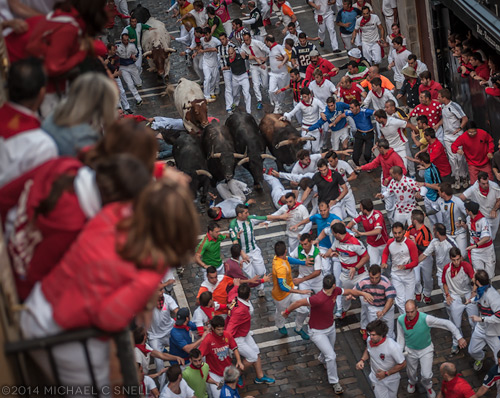
My third day and third encierro found me back on a balcony, this time one floor higher and on the street that makes for the longest straightaway during the run: Calle Estafeta:
140815bulls06_sotc

This view allowed me a little more time as you could track the bulls approaching and passing by. It also appeared to be a fairly chaotic spot on this particular day, with lots of runners falling, but no serious injuries. One last shot from the balcony as the bulls pass by:
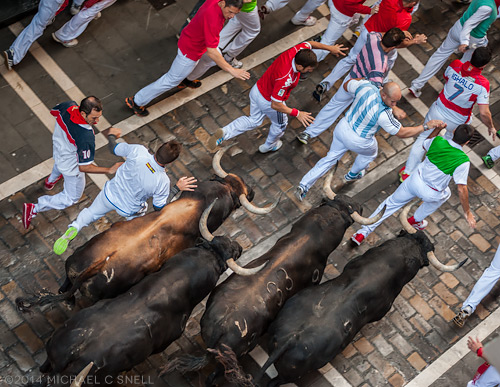
140815bulls08_sotc

I have a new found respect for the photographers that get those great shots that you see of this event. It’s certainly a skill that must be honed with experience in order to know where best to be and how best to handle each location. I enjoyed myself thoroughly, though, and would have gladly gone back for a fourth day.

In the following posts, I’ll feature more of the events that make up Pamplona’s San Fermin Festival. As I mentioned before, there was so much more than just the bulls. Stay tuned and I’ll show you what I mean.
Dodge City Days

140806dodge04_sotc

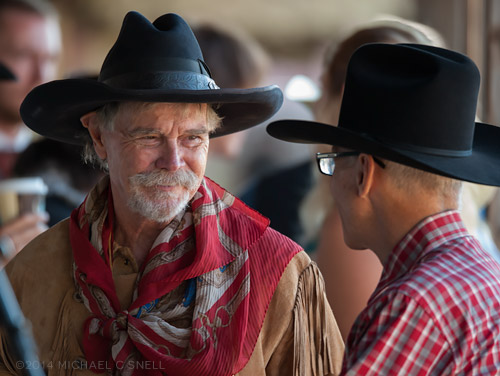
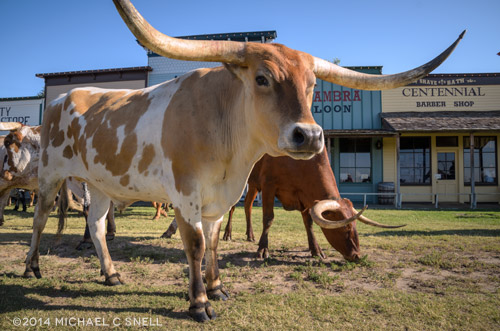
I had a great time covering Dodge City Days last weekend. The town of Dodge City, Kansas has a great history as a prominent old west cowtown and the setting for many an old west tale — some true, some not. I spent a fair amount of time here as a kid so it was great to return. I’ve actually done quite a bit of work in the area over the past few years but this time was more nostalgic as many of the Dodge City Days events were things I did here as a kid. Here are a few, random shots from this year’s Dodge City Days events:
140806dodge01_sotc

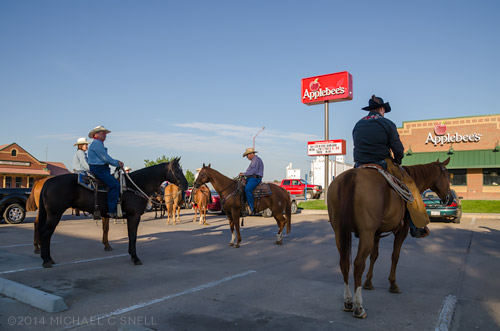
While not part of an actual “event,” this was the scene as riders were waiting to begin the world-record-attempting longhorn cattle drive down Wyatt Earp Boulevard. I loved the way the horses appeared to be “parked” at Applebees. Only in Dodge.

140806dodge06_sotc

Actors from the old television series “Gunsmoke” and “The Rifleman” were on hand to help celebrate Dodge City Days this year.

140806dodge07_sotc

140806dodge08_sotc

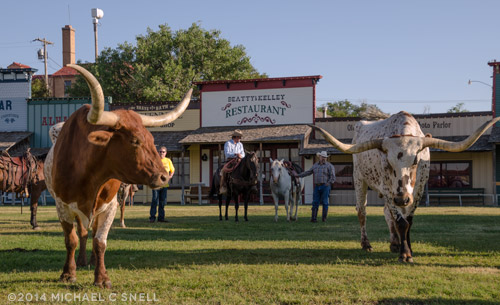
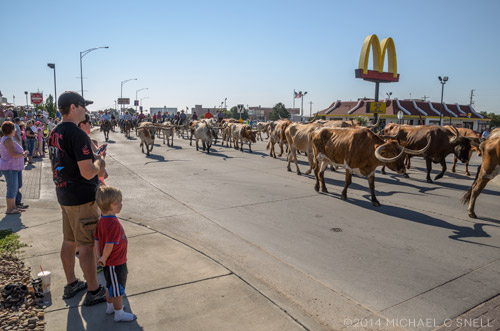
A tough route for the longhorns, as the cattle drive moved them past several fast-food burger places.

140806dodge10_sotc

140806dodge09_sotc

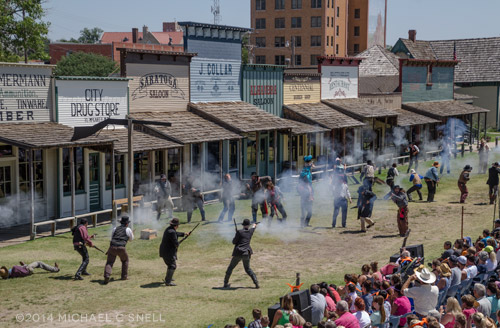
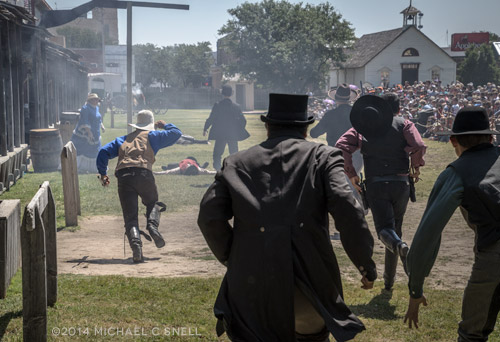
With the cattle moved off of Front Street, it’s just a matter of time before there’s trouble. Daily gunfights are re-enacted here for tourists. These during Dodge City Days were well-attended by both gunfighters and visitors.

140806rodeo04_sotc

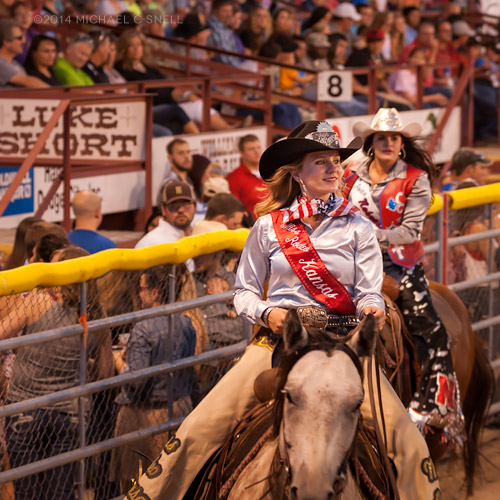
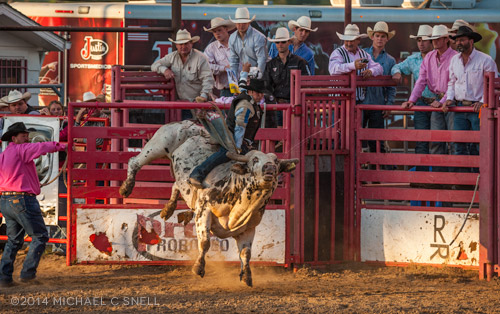
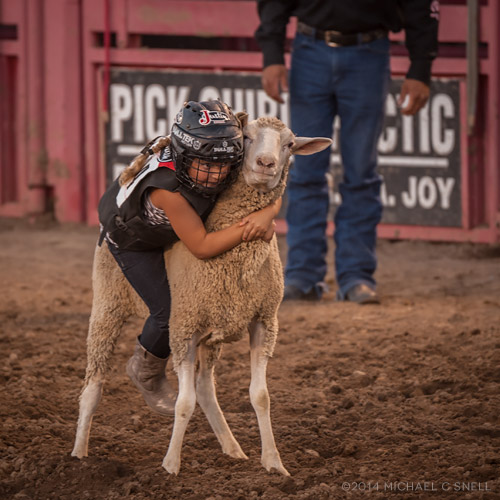
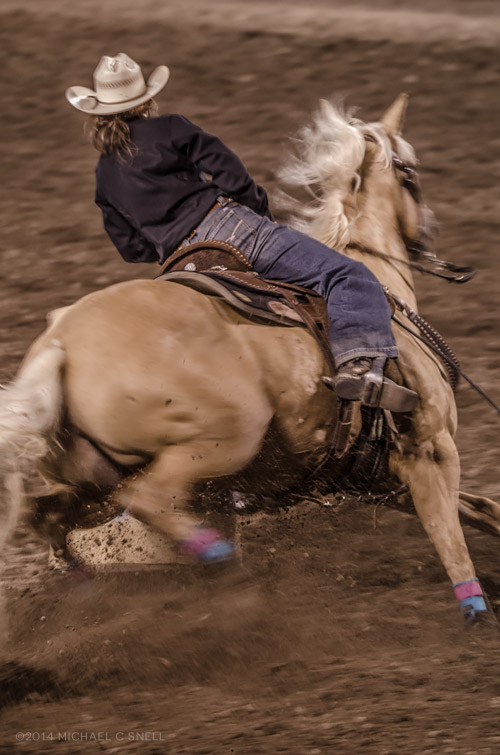
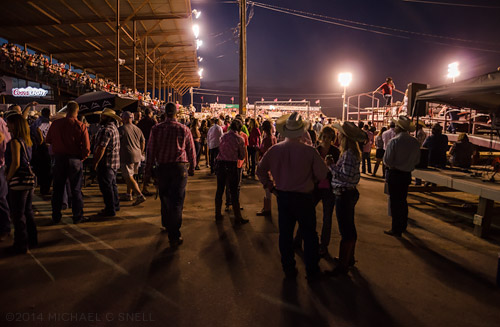
I ended both Friday and Saturday evenings at the Dodge City Round-Up Rodeo. I love shooting these events. The weather was great, and there was tons of action.

140806rodeo03_sotc

140806rodeo02_sotc

140806rodeo05_sotc

140806rodeo01_sotc

Granada, Spain

140618granada02_sotc

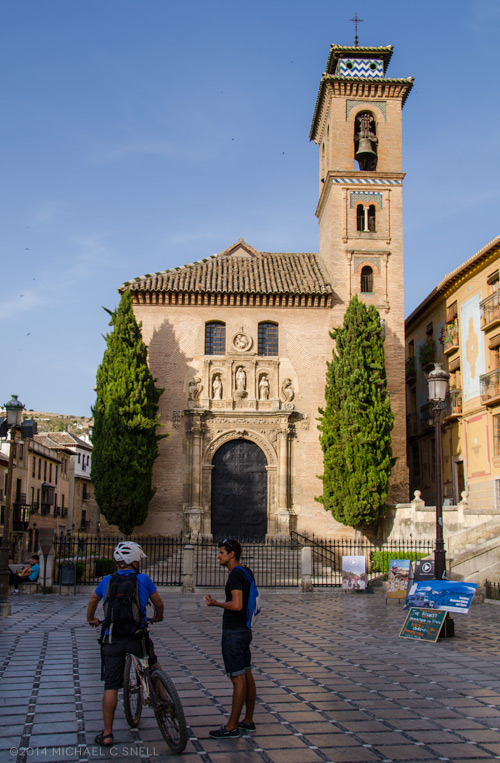
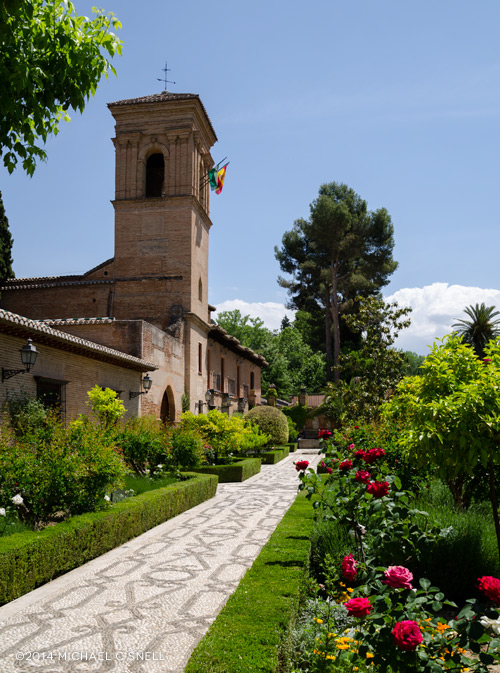
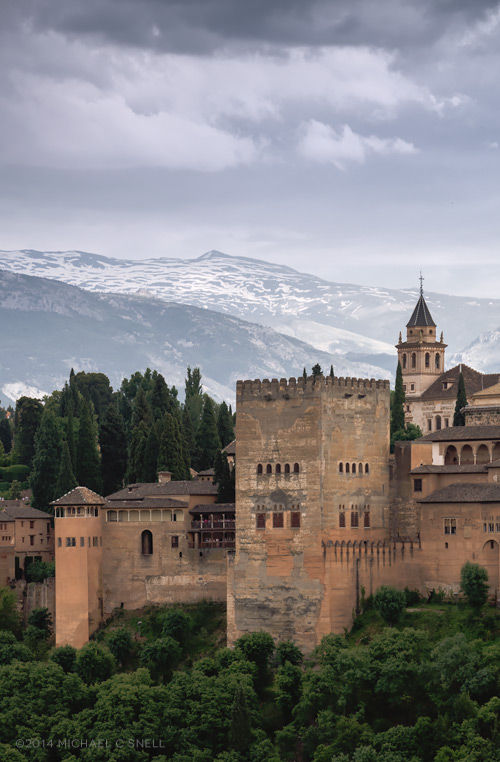
I’ve been going on and on for the last three posts about the Alhambra, but there’s really much more to see in Granada, Spain. In this post, I’ll share a few other random images from various spots around the rest of the old town. Above is the Church of Santa Ana just off of the Plaza Nueva. Next is the Parador de Granada — and amazing place to stay with an unbeatable location right in the midst of the Alhambra:

140618granada08_sotc

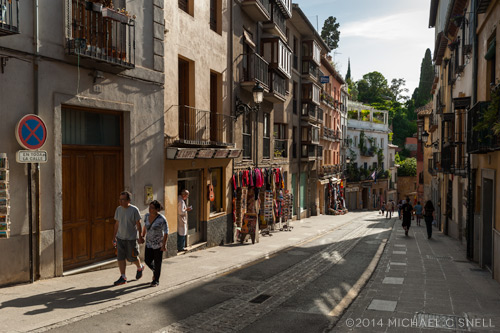
I got to know this next street well. It’s the transition between the pedestrian path down from the Alhambra  and the old town:

140618granada01_sotc

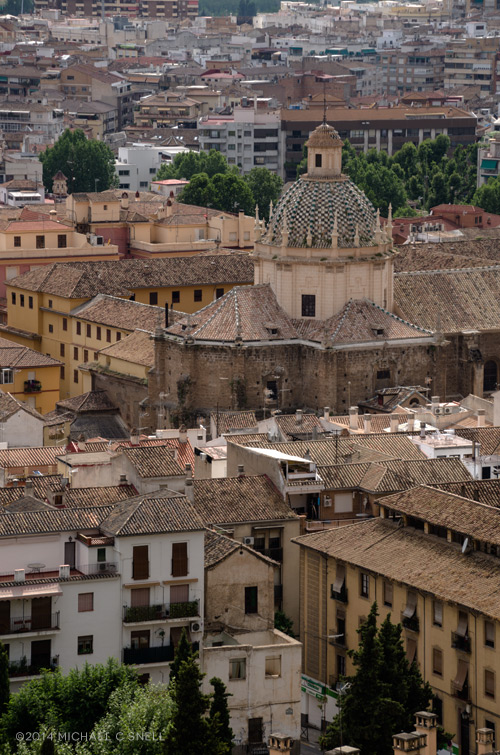
The dome of the Church of Santo Domingo:

140618granada04_sotc

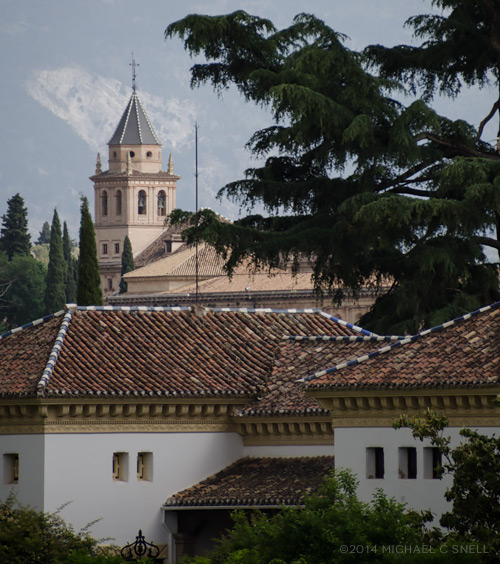
The spire of the Church of Santa Maria de la Encarnacion of the Alhambra:

140618granada05_sotc

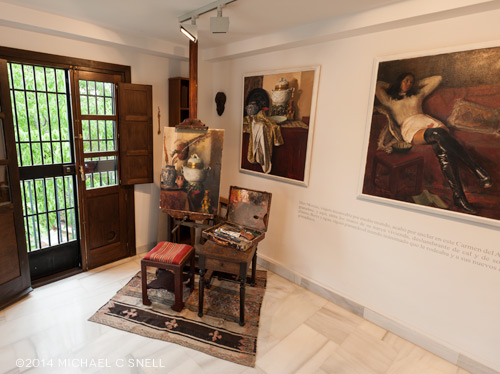
The studio of painter Max Moreau, now a museum:

140618granada06_sotc

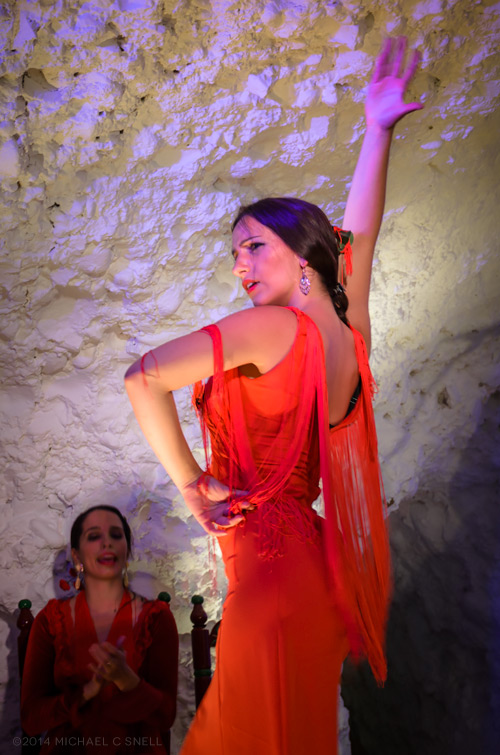
And no trip to Granada would be complete without a night of flamenco. This photo was taken at El Templo del Flamenco:

140618granada07_sotc

Alhambra exteriors

140617alhambra_sotc

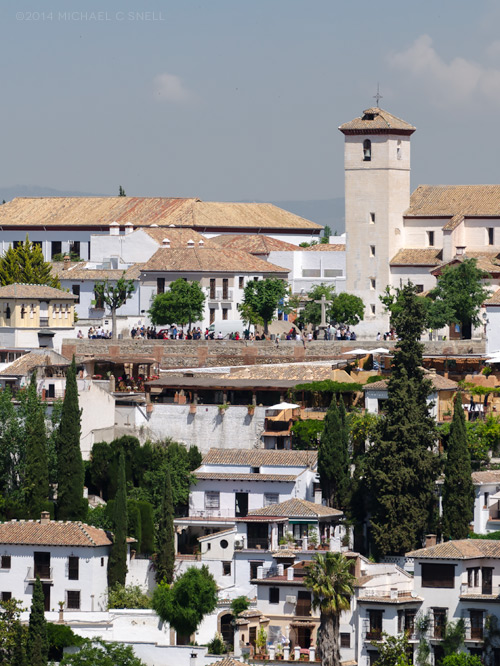
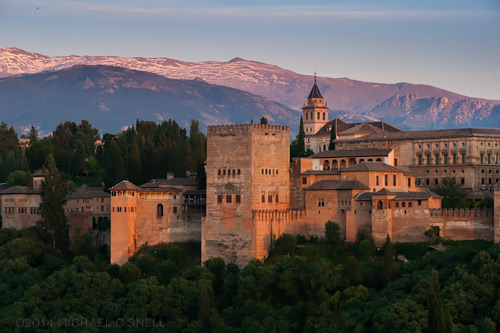
After two visits inside the Alhambra in Granada, Spain, it was time to get some exterior views. The Alhambra has a stunning setting on a hillside above the city with the Sierra Nevada mountains rising behind. Surprisingly, the view is blocked from many of the narrow streets of the Albaicin district, which is situated just across the valley. There are, however, a few spectacular public viewpoints. One of the best — and busiest — is the Plaza of St Nicholas. You can see it in the following photo, taken from a balcony on the Alhambra:

140617granada01_sotc

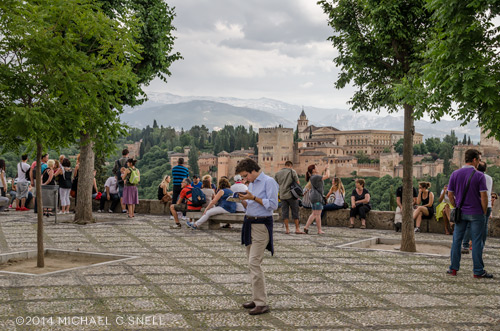
The white tower is the Church of St Nicholas and the plaza can be seen in front of it — where all of the people are gathering. It seems to always be a busy spot, but especially around sunset as I found out on a second visit a few days later. The first time I arrived on the plaza it was nearly noon and it was still fairly bustling.

140617alhambra02_sotc

The sun was high and there were dense clouds on this day, so when we returned to Granada after a few days of exploring the Tropical Coast, I took advantage of a couple of free hours to re-visit the plaza to catch sunset. The crowds were much thicker but I managed to stake out a spot with my tripod, right along the wall and I captured this view of last light:

140617alhambra03_sotc

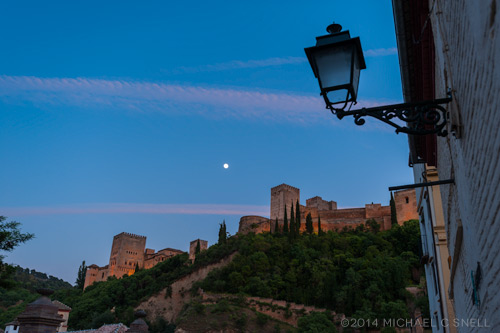
I’ll leave you with one more glimpse — the last that I had of the Alhambra as I made my way back down the narrow streets of the Albaicin on my way back to my hotel. I came to a small plaza with this view of the fortress palace just after the lights had come on and the sun was tinting the contrails pink. Not a bad way to say goodnight to an amazing piece of architecture, and history.

140617alhambra04_sotc

The Alhambra, Day 2

140614charles01_sotc

It’s always great to get a second chance to photograph a place. The first visit is about discovery and it’s sometimes overwhelming as you try and take everything in. The return visit is often more about details or things you just didn’t see the first time. Different light conditions and weather can also dramatically change how a place looks and feels.

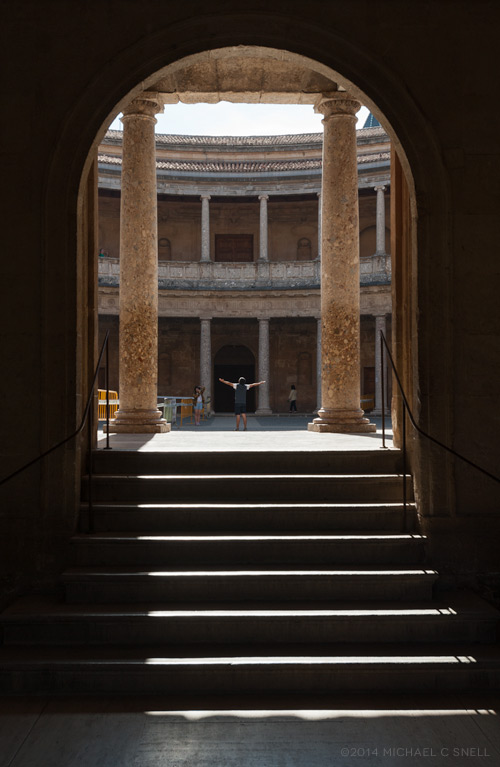
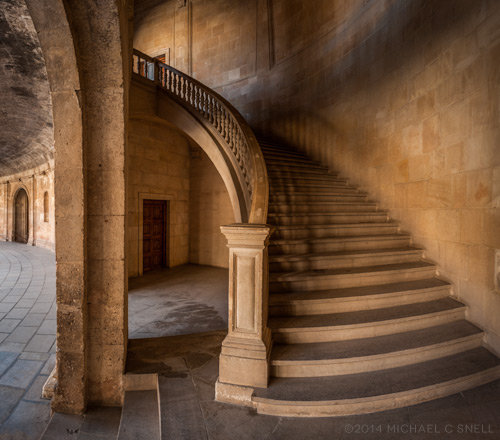
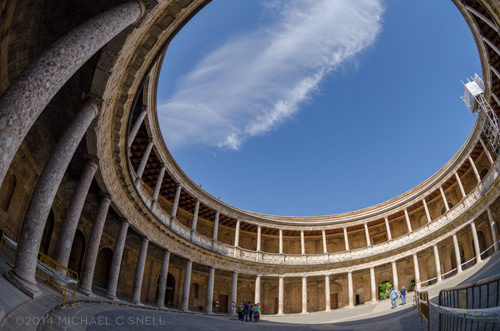
My second day in Granada, Spain, began with a return visit to the Alhambra. This time the first stop was the Palace of Charles V — a building I had bypassed entirely on my first visit. The main space is circular and ringed by a colonnade. Around the periphery are smaller rooms like this one with the staircase (This is actually three photos stitched together in Photoshop):

140614charles02_sotc

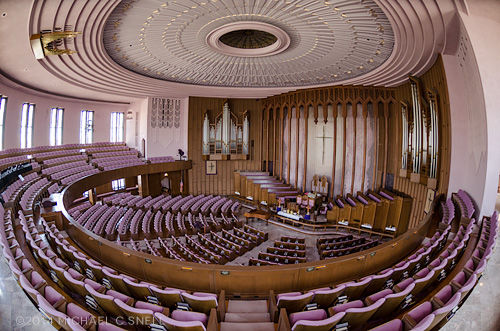
It was hard to get the main courtyard all in-frame and to show it full circle. I went to my rarely used fisheye for this shot and actually like the distortion it creates. I had used this lens in a circular Art Deco church in Tulsa in April, and realized that the distortion is less confusing in round spaces. One of those little tidbits I’ll file away for future shoots. You never know when you’ll find yourself in a round room, right?

140614charles03_sotc

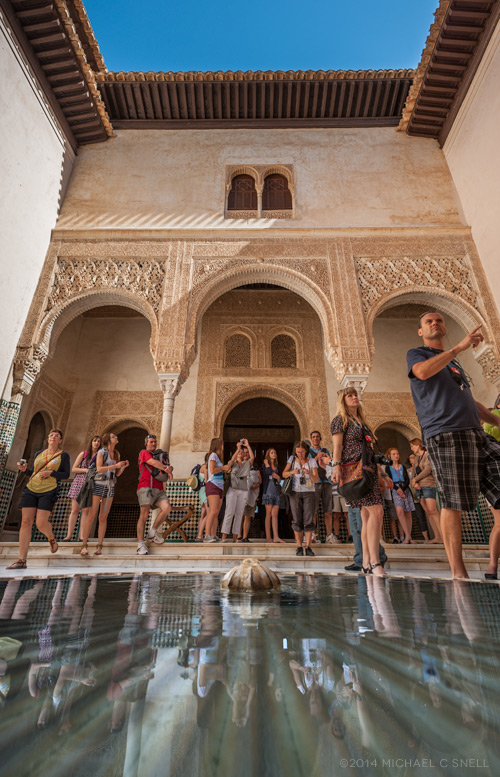
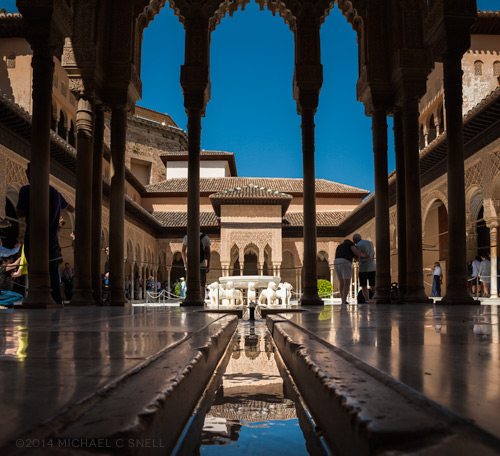
After the Palace of Charles V we followed much the same path on this visit as I had taken on Day 1. Here are just a few more shots of things I saw differently this second time around:

140614alhambra01_sotc

140614alhambra02_sotc

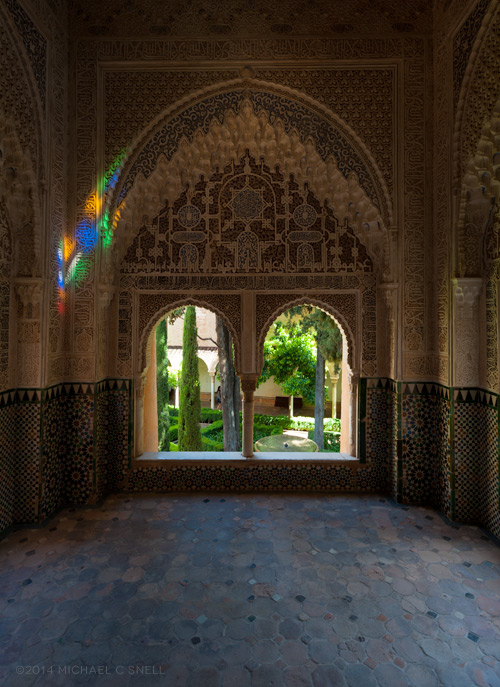
This next photo really shows the advantage of visiting at different times of day. I had photographed this room the afternoon before but the light was not coming through the stained glass as it did this following morning. The patches of colored light on the wall add an altogether different feel to the image and tells more of the story of what’s going on outside of the frame.

140614alhambra03_sotc

More Granada to come…

Kansas State Capitol

140415capitol04_sotc

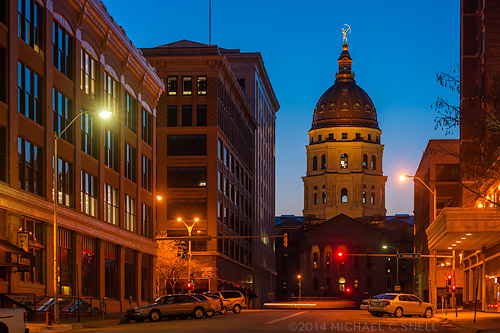
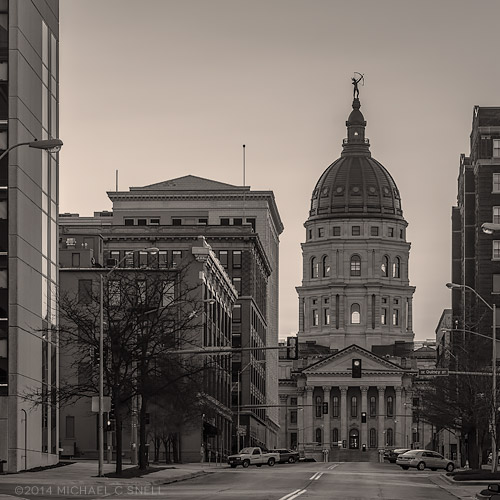
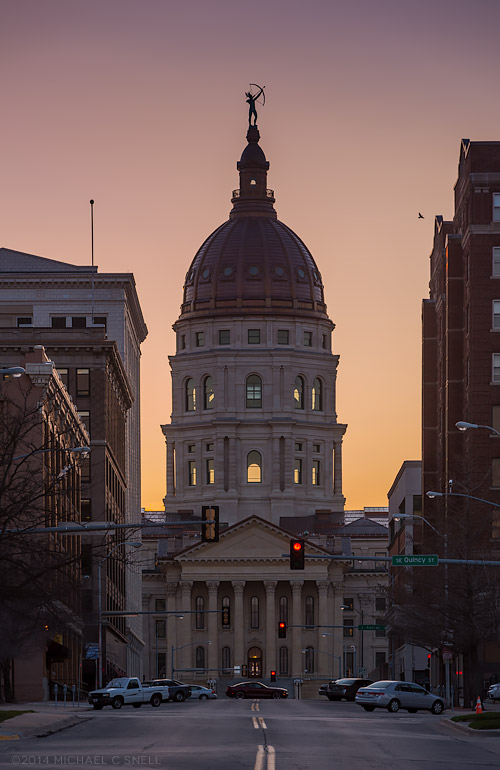
For five years I had an office just around the corner from the State Capitol in Topeka, Kansas. At the time we signed the lease on the place in 2003, I thought it would make for a great opportunity for me to build my library of Capitol photos. After all, I’d walk to work every day so I’d pass the building several times a week in all sorts of weather. What I didn’t realize was that the Capitol was about to undergo a long, long renovation. A renovation that would have it covered in scaffolding for the bulk of the time I officed downtown. When we moved to Lawrence six years ago, it was still impossible to get a clean shot of the most iconic building in Kansas. Only a few weeks ago did the work finish and the scaffolding and cranes came down. In the end, the copper on the dome had been replaced so the green patina is no more and the dome now has the dull sheen of a new-ish penny.

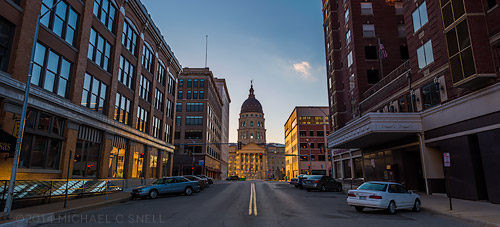
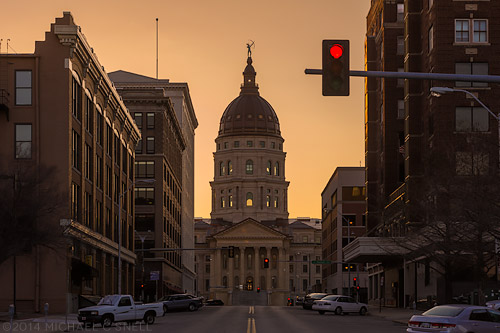
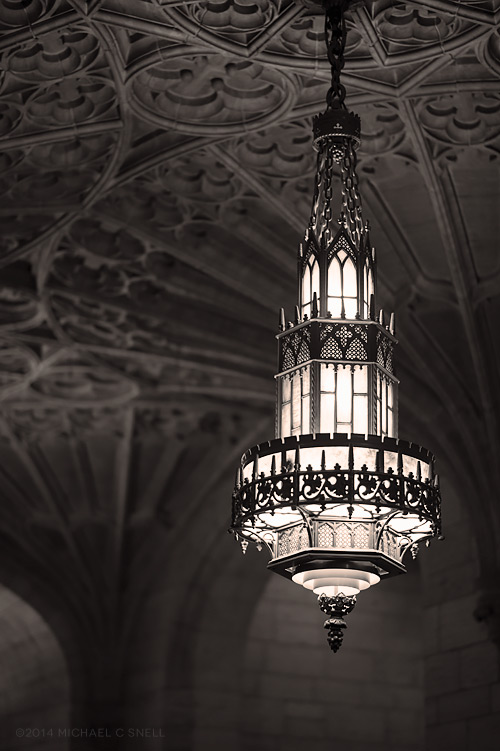
I photographed the interior a couple of weeks ago but with Spring finally arriving, I decided it was time to get back to updating my exterior photo files. Any photos of this building made prior to 2014 are now dated due to the new dome, so I’ll be continuing to revisit the Capitol many times in the coming year(s). Last night I got started by setting up shop on 9th Street — probably the best view of the Capitol if you want to see it in context to downtown. Until about 10 years ago, this was the one downtown intersection that still had historic buildings on all four corners. The northwest corner (in the distant right in this view) has since been redeveloped with a retail/parking structure, but this angle still remains one of the most “historic” views.

Here are a few more images made while waiting for the sun to set last night and experimenting with some different post-processing effects. All are from more or less the same position but shot with lenses of different focal lengths, each giving more or less prominence to the Capitol in relation to the other downtown buildings.

140415capitol02_sotc

140415capitol01_sotc

140415capitol03_sotc

140415capitol05_sotc

Balcony views

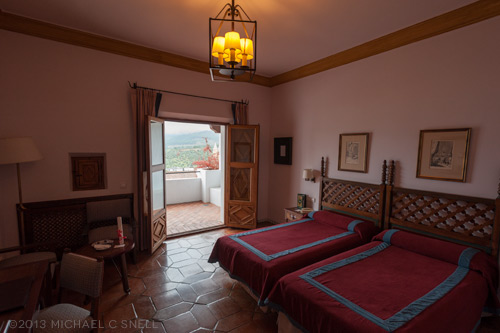
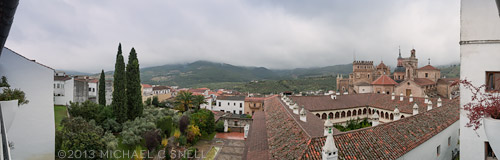
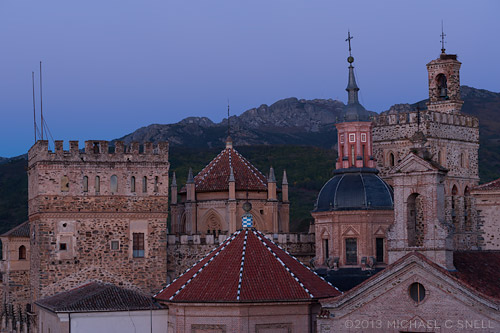
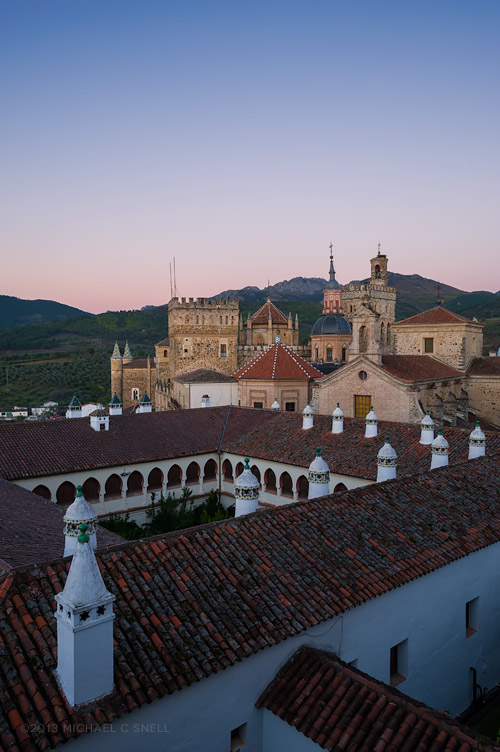
I thought I’d follow up on my last post with a few shots from my room at the Parador de Guadalupe. As I mentioned before, we stayed in Paradores most of our nights in Spain and they never disappointed. Each is unique architecturally, food/service was excellent, and you just couldn’t beat their locations. However, of all of them I encountered, I think I was most taken with the balcony view from my room in Guadalupe. I had very little time to spend in the room, but both sunset and sunrise found me out on the balcony, photographing that view. Sometimes you have to really work hard to find the right location — the perfect angle — and sometimes it’s just handed to you.

Here is a view of my room and a stitched panorama of the overall view from my balcony:

131226guad20_sotc

131226guad13_sotc

These were taken just after checking in and before taking a tour of the monastery, seen in the right of the panoramic image. By the time I got back to the room, the clouds were more defined and the sun was beginning to set, so out I went on my balcony:

131226guad05_sotc

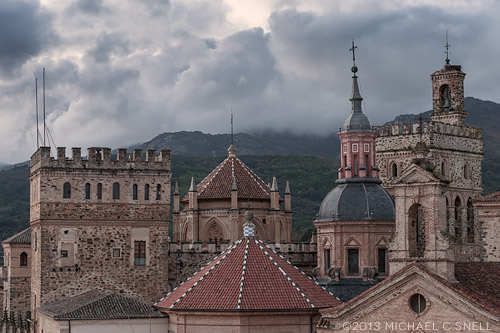
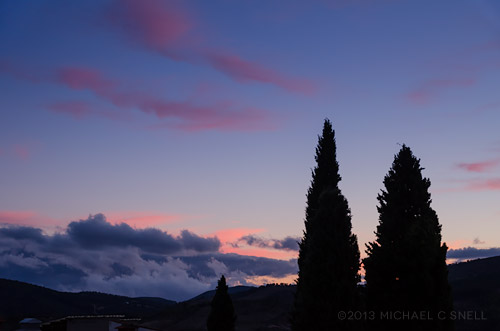
I settled on this view (above) with my full-frame Nikon D700 and locked it down on the tripod to get a series of shots as the light changed. I was hoping that, at some point, some exterior lighting might come on to contrast with the cobalt blue skies that I expected just after sunset. The sun was actually going down to the left of this scene so, while my one camera body was occupied with the monastery, I shot variations of the sunset itself with my D7000:

131226guad12_sotc

The D7000 shots were hand-held so I had to increase my ISO to achieve a faster shutter speed. I knew that would result in more noise, but I was less concerned about that in these shots than in my primary images that I was shooting with the D700.

131226guad10_sotc

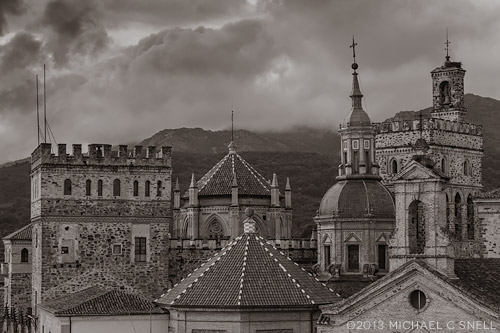
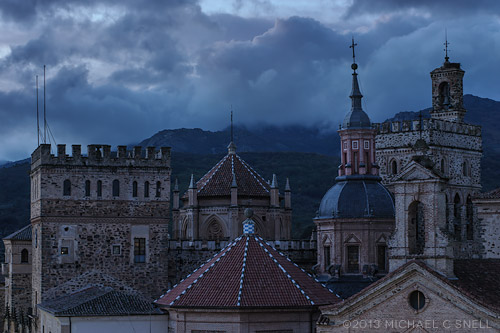
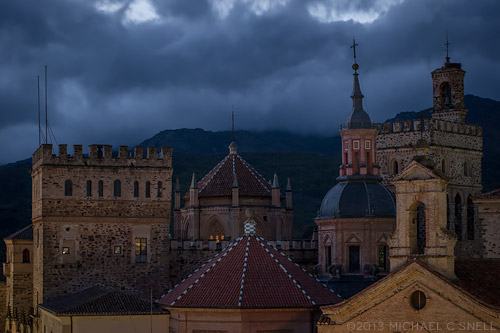
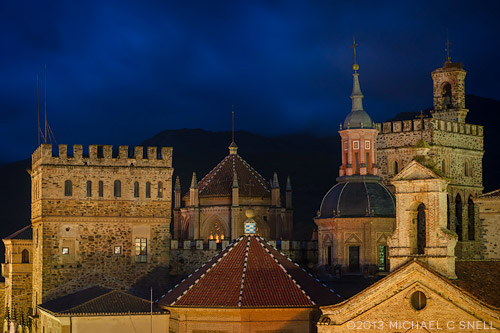
The coloration was less interesting at first, but the clouds were fairly dramatic. Converting some of these early shots to black and white (using Lightroom 5 and/or Photoshop CC) was a nice solution. The next series of images shows the gradual darkening of the sky and the subtle warm colors that began to emerge from the street lights that were bouncing back to illuminate the towers.

131226guad06_sotc

131226guad07_sotc

131226guad08_sotc

While there never were any floodlights or other exterior illumination on the monastery, the bounced street lights were enough to add quite a bit of warmth as the evening got darker. The shot above was taken well after dark and the intensity of the colors shown here was not visible to the eye. Only the long exposure was able to draw it out, softening the sky at the same time by the blur of the moving clouds. I was using 30-second exposures at this point.

The next morning I resumed my position for sunrise and caught a few pre-dawn images with a beautifully clear sky:

131226guad09_sotc

131226guad11_sotc

One last shot of the monastery just before sunrise with the main courtyard of the Parador seen in the foreground. Once the sun broke over the mountains, the light was actually a little too harsh for my taste and several of the towers were casting harsh shadows on one another. It was time to pack up the gear anyway before grabbing a quick breakfast and heading off to our next stop: Merida, Spain.

You can learn more about the Parador de Guadalupe on their website, which I notice has been redesigned just in the last couple of weeks. Lots of good info there if you’re planning a visit in Spain.