Author Archives: Michael

Google maps to the rescue for keywording

100619wat_sotc

I’ve been meaning to write this post for a long time. While finishing up the keywording of my Thailand files in the last couple of weeks, I ran across a good example of what I’ve been wanting to discuss, and that is: how I use Google Maps to help me identify my images.

Of course, taking notes on site is always the best practice. I carry a small notebook in my camera bag but, in truth, I tend to take most of my notes with the camera itself. Here’s an example: on my last day in Chiang Mai, I had a few hours in the morning to stroll the old city on my own and photograph the various Wats, Chedis and Prayer Halls. I had heard that Chiang Mai has over 1000 Wats so, suffice it to say, it’s important to keep track of which is which when it comes time to keyword and label for my stock agencies.

I set out from the hotel before dawn and headed for the original, walled city. Once inside the walls, I would pass a small temple complex nearly every half a block. While I had been driven through these streets regularly for three days, I never would have seen many of these buildings without being on foot. They are tucked away and need to be sought out.

When I would begin to shoot a temple site, I would first look for a sign with the name in english and photograph that first. This is my way of taking notes. The images can always be sorted by capture time and I’ll have an “opening title” for each location I visited. Hopefully it will even be spelled correctly, but, you never know.

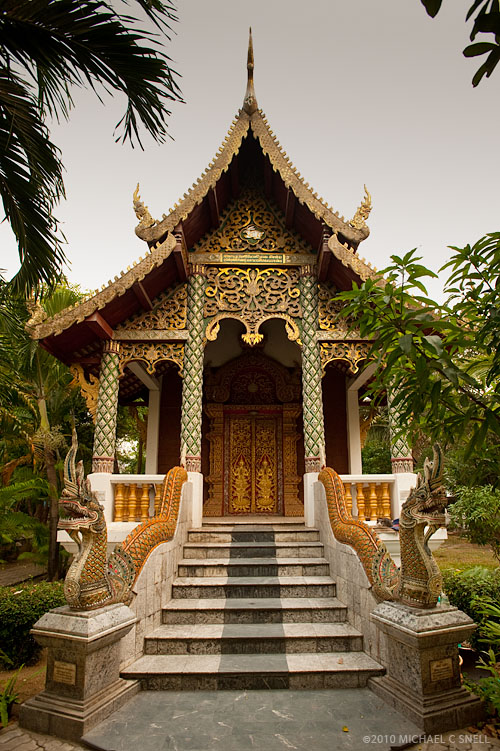
When I arrived at the Wat at the top of this post, I couldn’t find a sign in english anywhere. Nor was there anyone around that could tell me what it was save for a group of monks (who I opted not to bother), chanting inside this main building:
100620chedi_sotc

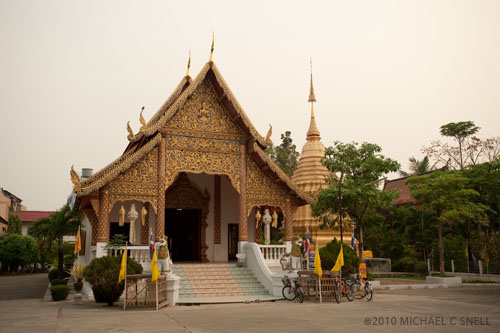
The site was a monastery comprised of a viharn (the building in the foreground), a chedi (the gold spire behind it) and a ubosot (the roof seen peeking over the trees in the back on the right). The english terms for these might be an assembly hall, a reliquary, and a prayer room or ordination hall. The ubosot, or prayer room, is what is pictured in the opening photo.

As it turned out, I never had the opportunity to speak with my local guide again and I continued on my way to Bangkok. Once back in the office at home, I could have tried to contact him by email but decided to do some detective work on my own first. This is where Google Maps comes in.

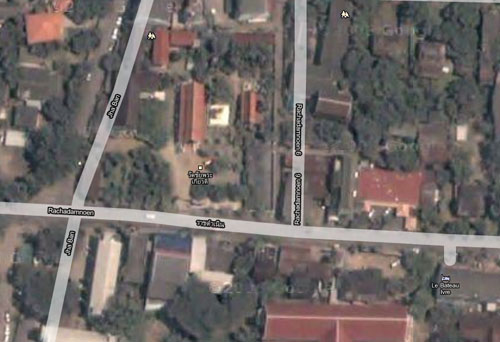
I knew the route that I had walked through the walled city, and I knew from signage, what the names were of the Wats on either side were. I zoomed in close in this area with Google Maps and switched to the satellite image view. There was my Wat:
100620map

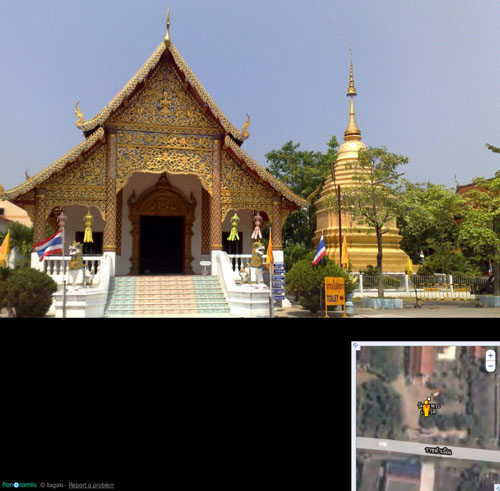
You can see the shiny gold chedi in between the two red-roofed buildings just above and to the left of center in this screen capture. There is a label, but it’s in Thai. I tried using an online translator but didn’t trust it so I tried using Google’s street level viewer in Google Maps. That’s the tool shaped like a little man. While the area had not been mapped for street level views, the tool did show several blue dots for the positions of still images that were on file for the site. Sure enough, by looking at some of these images, I was able to confirm that this was the Wat I was looking for and that it was named Wat Chai Phra Kiat, or Monastery of the Renowned Victory.
100620streetview

That’s the image that convinced me. Still, just to be safe, I Googled the name and found several other sites that confirmed it was what I was looking for and provided me with some alternate spellings.

The internet has been one of my most valuable tools for researching images and compiling keywords. I would hate to imagine the time it would take to track sites like this down through books, emails to local guides, etc. I still do my best to identify sites while I’m on location — there’s no substitute for that — but at least in situations like this, I can feel confident that I can come up with the information later when necessary.
The mother of all upgrades

It’s an exciting and scary week around here. I’ve been putting off upgrading my old G5 Mac tower for far too long. It was running fine but beginning to get a little tired. I could respect that. I get a little tired, too. But then Snow Leopard came along — running only on Intel-chipped machines — and I began to fall behind. Still no biggie. No real urgency. And that became my downfall.

Now we have an update from Adobe to the entire Creative Suite — CS5. A few days later, Lightroom 3. I held out until after the WWDC just in case Apple made any updates to the Mac line-up (something without a shiny screen maybe?) but, when there weren’t, I pulled the trigger and placed my order. Or should I say “orders”. Piles of boxes have started to arrive and the installation process has begun but I think I’m in for a multi-day process. Common sense has always told me to just update one thing at a time. Then, if something goes crazy, you know what is likely to blame. There will be no such common sense this time. New hardware and all new software. If there is a conflict, I’ll have one heck of a time figuring out where it is. Luckily, that doesn’t happen as much as in the old days. I also tend to stick with just the necessary software — not a lot of system modifiers, etc. that can lead to trouble. Call me overly cautious but I make my living with these Macs and I don’t care to spend my time trouble-shooting software conflicts when I can be billing hours.

With all of these updates there will be a slight shift in the focus of this blog. I plan on doing more technique and how-to posts, sharing what I learn about the new features in Photoshop CS5, Lightroom 3, Aperture, etc. We’ll see how it goes but this may be just the first phase of this new direction. Exciting times for sure.

Studio work

100604glass_sotc

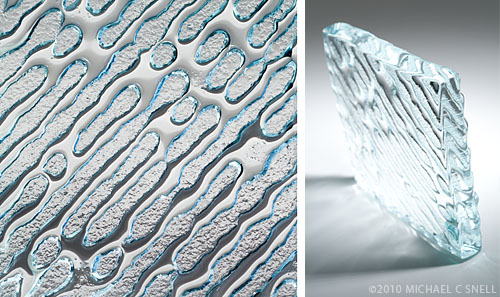
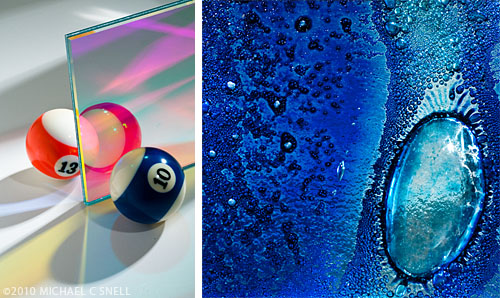
I’ve had fewer hours on the road lately but I’ve still been shooting fairly heavily. Instead of travel images, I’ve been working in the studio on some tabletop product shots. I could never be one of those catalog guys that does this stuff day in, day out, but I enjoy it as a break from field work. It stretches a different part of the brain.

When shooting travel, I work in a more documentary way. I shoot 99% available light and tend to work with what’s there. I don’t do a lot of posing or manipulating of objects in a shot, I look for the best angles given what I encounter. In short, I move myself and the camera rather than the subject for the most part. Given that my subjects are often architecture or landscapes, it’s really necessity that I be the moving element.

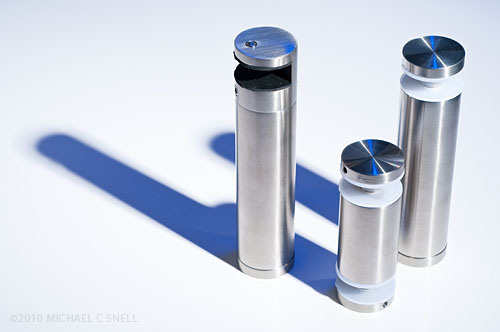
In the studio it’s different. I’m not working with available light, but typically a set of hot lights on stands. I can move them and alter their qualities with diffusers and gels in ways that I can’t affect the light in the field. There are a lot more decisions to be made in the studio due to these extra elements that are within my control. I choose backgrounds, positioning of elements, light, color, etc. Many of the shoots I’ve been doing over the last couple of weeks have involved glass and mirrored products so lighting and reflected light have been a real challenge. I’ve been having a lot of fun experimenting with these products and how different lighting can enhance them and show off their unique qualities.

100604glass2_sotc

I find the studio work experience useful in my travel work as well. Having control over lighting helps you to understand the qualities of light so that when you’re in the field, you better understand how to make use of the light you’re given. The light that you can’t control. The sun does move, it just doesn’t always go where you want it or as fast (or slow) as you wish. Clouds and haze can act as diffusers. The difference between the studio and the field photography is really how you choose to control the situation. In the studio, you can control it by acting: moving a light, adding another, etc. In the field, with the kind of travel photography I tend to do, it’s more about reacting: change your position due to sun position, wait for a cloud to pass (or move in front of the sun), warm a cloudy scene by adjusting white balance in-camera rather than gelling the light source, etc.

I’ll be back in the field soon enough. I have some local projects that I want to work on for myself and my stock files and travel is always on the horizon. In the meantime, I’ve been enjoying the air conditioning and the lack of need for bug spray.

100604hardware_sotc

One bloomin’ lupine

100525lupines_sotc

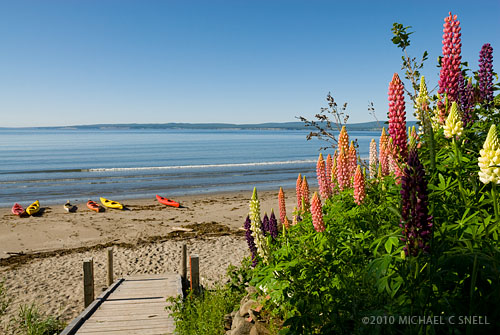
I took the shot above in July of 2007 on the Gaspe Peninsula on Canada’s eastern coast. The lupines were in full bloom and they were everywhere — planted in people’s lawns and growing wild in big patches like this one. I’ve wanted to grow lupines at home ever since but they may not appreciate our hot summers. Everyone in town that I’ve talked to about Lupines that has tried to grow them has had a tale of woe and disaster. Unfazed, I’m going ahead with my plan. Living my dream. Planting my lupines.

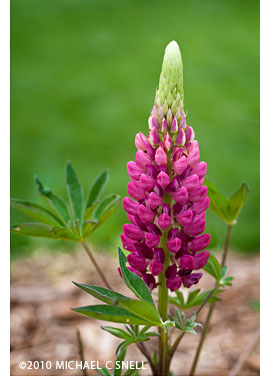
100525lupine_sotcInspired by the hillside of blooms in the photo, I chose a little lump of a hill in the yard not too far from the front door. In my mind it will be just like the scene in Canada — lush green and thick with blooms. I bought one largish potted lupine and six smaller ones at the local greenhouse. The largish pot had a good sized bud so I figured that if everything went south, I might at least get one bloom before the hillside returns to wasteland. Lo and behold, a couple of weeks later I have my bloom.
This may be all I get this year. Heck, it may be all I get ever. I’ve been chasing rabbits out of the patch nearly every morning and the dreaded heat has not even set in yet. My fingers are still crossed, though. If these survive, I’ll supplement my little hill with more next spring and keep at it until you’ll swear you’re in the Gaspe when you walk up to my front door (except there won’t be a vast sea of blue in the distance — but I could leave a couple of kayaks in the yard just for effect).

Ayutthaya, Thailand

100516ayutthaya2_sotc

After an ugly week in Bangkok, the protests have been dismantled and everyone seems to be waiting to see what happens next. This has been a tough time for Thailand. For a country that thrives on tourism, more tough times will likely be ahead. But this is a resilient region and hopefully the situation will remain calm and the tourists will return soon.

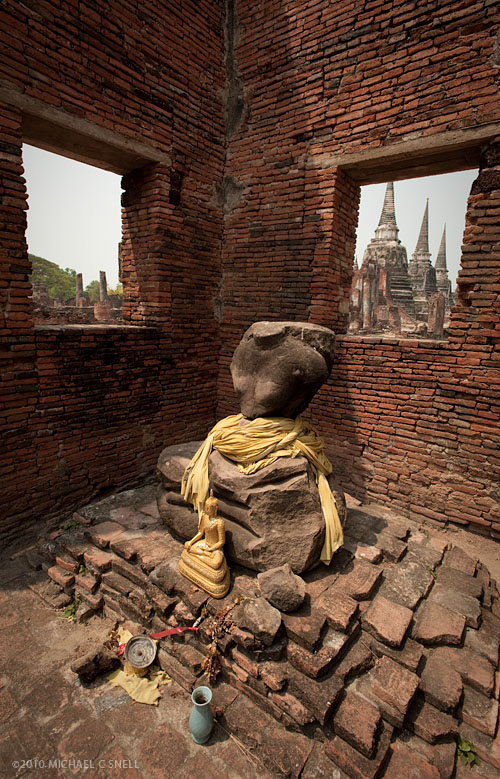
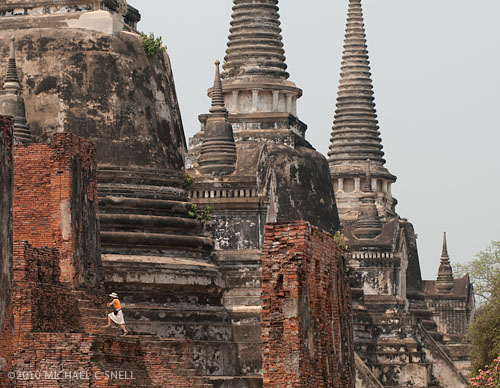
If and when you do find yourself in Bangkok, make sure you get to nearby Ayutthaya, a UNESCO World Heritage Site. The three chedis of Wat Phra Sri Sanphet are shown in both of the photos here. Ayutthaya was the second Siamese capital (founded in 1350) and the city was nearly burned to the ground in 1767 when the Burmese invaded — proof that this region has bounced back before. The remaining ruins are scattered on and around an island created by the confluence of three rivers — the Chao Phraya, the Lopburi and the Pa Sak — as seen on this map from Travelfish. I only visted three or four of these sites and could easily spend a week or more here continuing to explore.

100516ayutthaya_sotc

I’d seen photos of these ruins prior to visiting but still wasn’t prepared for their scale. The woman in the white skirt (above) gives you some idea of just how big these chedis — the bell-shaped towers — are. In this case, the three chedis were built to house the ashes of kings.

One day here was not nearly enough. While it would be hard to say what my favorite spot in Thailand was, this would certainly rank up there in terms of places I wish I could have spent more time. There is so much to see and I only scratched the surface.

Bangkok erupts

100515bangkok_sotc

The situation in Bangkok has ramped up again. Red Shirts maintain the protest they began over two months ago and the government’s patience is wearing thin. While I was there in March — oddly enough arriving on the same day as many of the Red Shirt protesters — things were quite peaceful and the protesters were scattered around various parts of the city. There was a sense of tension but, other than some traffic problems, the situation didn’t really affect one’s ability to go about their business in Bangkok.

100515police_sotc

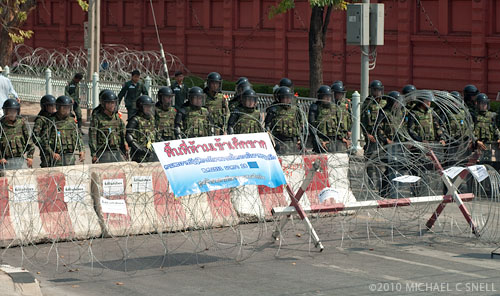
Toward the end of my time in Bangkok, I began to see a few more scenes like this one — streets blocked off and guarded by police. Still, only one tour stop was cancelled due to these blockades. In other parts of the city, life went on as usual. After I left, things began to heat up and violence erupted. Eventually, as I understand it, the protesters regrouped in one area, just a few blocks from where we had dinner at a rooftop restaurant just a few days earlier.

100515bangkok2_sotc

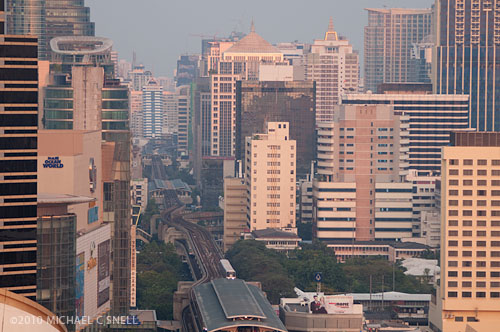
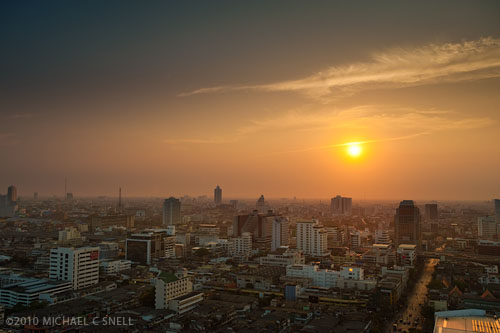
This is the view from that terrace toward where the protesters now have their camp. This area is approximately the intersection of the red lines on the map in this article posted on the BBC site. (The shot at the top of this post was taken from the same place on the same evening but is looking the other direction.)

A writer I have traveled with in the past, Kevin Revolinski, has been living in a borrowed condo not far from this part of Bangkok and has been posting some reports of the recent events on his blog. It’s odd to feel so connected to a situation happening half way around the world but the combination of having been there so recently and knowing the area somewhat, along with reading these reports of violence written by someone I know who is still there and whose voice I can hear in my head as I read the posts is all very disconcerting. I can’t claim to know exactly what’s going on or who’s firing live ammunition (police or terrorist snipers trying to elevate the tension?) but I hope for the best for the people of Bangkok and all of Thailand. It’s a beautiful country full of wonderful people — gracious and welcoming.

It is the warm people that I’ll remember and it is them, and the amazing places I visited, that I will continue to tell people about, encouraging them to visit for themselves in the future.

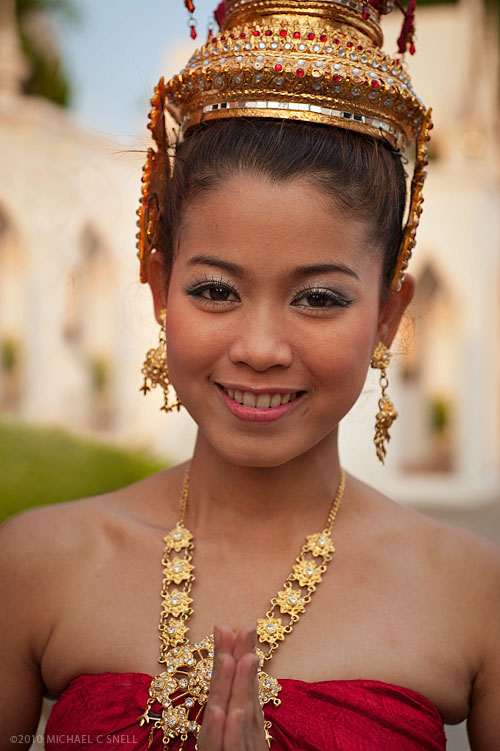
100515thaigirl_sotc

Googling myself

From time to time I make a point of googling around to see if I spot any unlicensed photo uses or even licensed uses that I just hadn’t seen reported yet. This time I turned up something even more interesting:

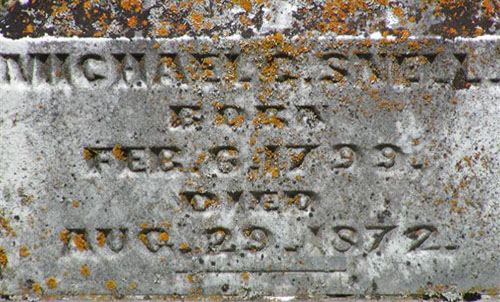
100510headstone

I found this photo, provided by a Sharon McClure, on a Ripley County, Indiana geneaology site. You can learn so much by googling yourself. In this case, I’ve learned that, not only will I die in 1872, but I will also invent a time machine. Or at least own one… or borrow one for a day. Why I’ll visit 19th century Ripley County is a still a mystery. I guess I’ll just have to wait for those details to unfold.

I also did find a couple of interesting photo uses. My shot of the lighthouse in Grand Haven, Michigan turned up on the CNBC site, and this one from Kalamazoo appears on Forbes.com. Congrats to Grand Haven/Holland for being named one of America’s happiest cities and to Kalamazoo for being named one of the best cities for doing business. And thanks for providing me a little business along the way.

Now, off to start googling for time machine plans…

Back from Jamaica

100429raft_sotc

After a brief delay due to a missed flight and re-routing through Pennsylvania, I am home once more. Sorry for not posting from the road but internet access was not always available to me, nor was there much time to even offload cards. I arrived home with nearly all of my shots still in-camera rather than on my portable hard drives. But as they say in Jamaica, “no problem, mon”.

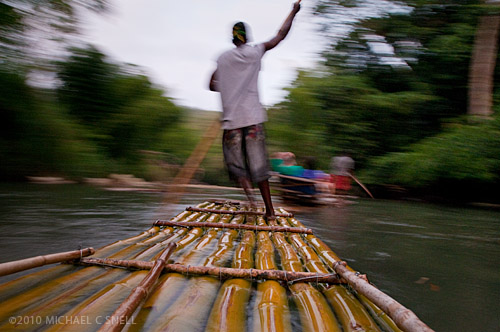
The shot from the river raft above was a fun one. At the beginning of the run, I was shooting “normally” — trying to keep everything crisp and sharp, raising the ISO along the way to compensate for the setting sun and diminishing light. It was somewhat overcast and nearly sunset by this time and I gave in to the inevitability that I was going to change my game.

Embrace the darkness. Embrace the blur.

Rather than increasing ISO further and dealing with noise in post-processing, I held steady at ISO 800 and began shooting intentionally for some motion blur. At first I panned with passing rafts to isolate their pilots (captains?) and get dreamily blurred foliage behind. After several passes with that technique, I turned my attention to the pilot of my own raft. I steadied the camera on a bamboo cross-support of the raft and fired away. This particular shot is at f/5.6 — to give myself a wee bit of depth-of-field in case the focus was off — and half a second. By using the raft itself as a kind of tripod, I could maintain sharpness on it while the world swam past. I was amazed at the amount of detail and color that the sensor could capture in those dark conditions. More than you could see with the naked eye.

I nearly filled a card shooting in this way because I knew the ratio of keepers would be extremely low. But, what the heck, if I got one good one, I’d be happy. As it turns out, I have several. Had I been shooting film, I would certainly have been more conservative and I probably would have missed some real keepers.

Wats of Chiang Mai

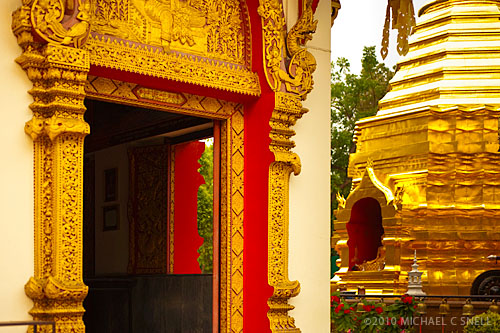
100416watdoor_sotc

So much to show and so little time. I find myself in a familiar place — not caught up with images from one trip and, yet, leaving on another. I’ll be in Jamaica for the next few days so here’s one more Thailand post to tide you over while I’m away. Of course, I’ll post from the road when possible but you never know if the goddess of internet connections will smile upon you.

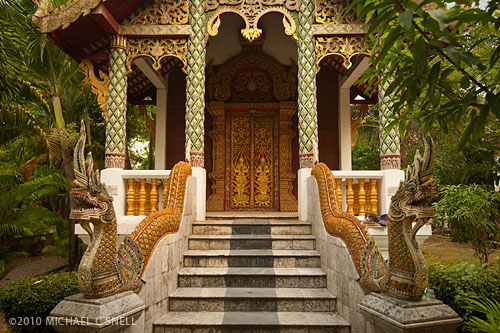
100416steps_sotc

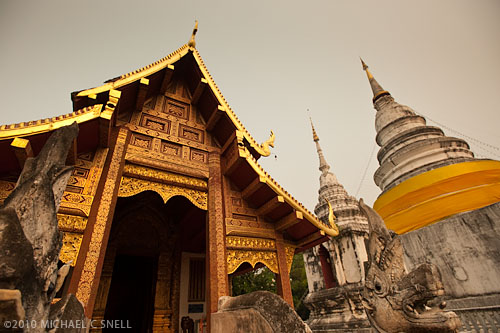
These are a few of the temples I wandered across on my last morning in Chiang Mai. Some small, some large, but they were everywhere. The one above had absolutely no signage in english to help me to identify it but, thankfully, Google Maps helped me out on my return. I was able to retrace my walk on the satellite image and find my temple, nicely labelled in english.

100416singh_sotc

Now… off to pack… again…