Category Archives: technique

Studio work

100604glass_sotc

I’ve had fewer hours on the road lately but I’ve still been shooting fairly heavily. Instead of travel images, I’ve been working in the studio on some tabletop product shots. I could never be one of those catalog guys that does this stuff day in, day out, but I enjoy it as a break from field work. It stretches a different part of the brain.

When shooting travel, I work in a more documentary way. I shoot 99% available light and tend to work with what’s there. I don’t do a lot of posing or manipulating of objects in a shot, I look for the best angles given what I encounter. In short, I move myself and the camera rather than the subject for the most part. Given that my subjects are often architecture or landscapes, it’s really necessity that I be the moving element.

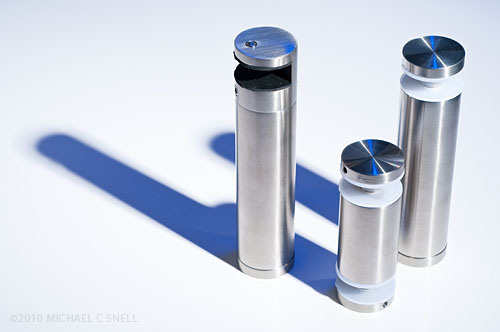
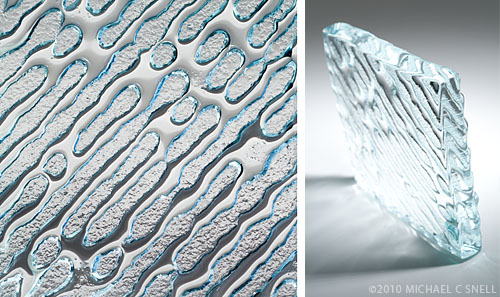
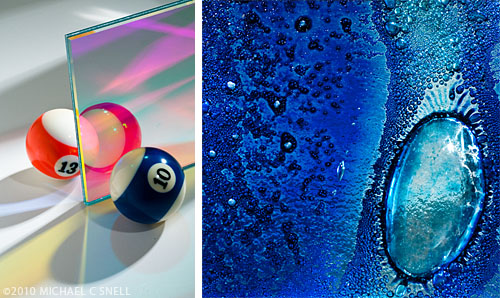
In the studio it’s different. I’m not working with available light, but typically a set of hot lights on stands. I can move them and alter their qualities with diffusers and gels in ways that I can’t affect the light in the field. There are a lot more decisions to be made in the studio due to these extra elements that are within my control. I choose backgrounds, positioning of elements, light, color, etc. Many of the shoots I’ve been doing over the last couple of weeks have involved glass and mirrored products so lighting and reflected light have been a real challenge. I’ve been having a lot of fun experimenting with these products and how different lighting can enhance them and show off their unique qualities.

100604glass2_sotc

I find the studio work experience useful in my travel work as well. Having control over lighting helps you to understand the qualities of light so that when you’re in the field, you better understand how to make use of the light you’re given. The light that you can’t control. The sun does move, it just doesn’t always go where you want it or as fast (or slow) as you wish. Clouds and haze can act as diffusers. The difference between the studio and the field photography is really how you choose to control the situation. In the studio, you can control it by acting: moving a light, adding another, etc. In the field, with the kind of travel photography I tend to do, it’s more about reacting: change your position due to sun position, wait for a cloud to pass (or move in front of the sun), warm a cloudy scene by adjusting white balance in-camera rather than gelling the light source, etc.

I’ll be back in the field soon enough. I have some local projects that I want to work on for myself and my stock files and travel is always on the horizon. In the meantime, I’ve been enjoying the air conditioning and the lack of need for bug spray.

100604hardware_sotc

Back from Jamaica

100429raft_sotc

After a brief delay due to a missed flight and re-routing through Pennsylvania, I am home once more. Sorry for not posting from the road but internet access was not always available to me, nor was there much time to even offload cards. I arrived home with nearly all of my shots still in-camera rather than on my portable hard drives. But as they say in Jamaica, “no problem, mon”.

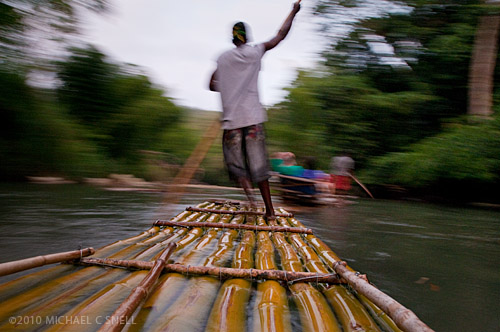
The shot from the river raft above was a fun one. At the beginning of the run, I was shooting “normally” — trying to keep everything crisp and sharp, raising the ISO along the way to compensate for the setting sun and diminishing light. It was somewhat overcast and nearly sunset by this time and I gave in to the inevitability that I was going to change my game.

Embrace the darkness. Embrace the blur.

Rather than increasing ISO further and dealing with noise in post-processing, I held steady at ISO 800 and began shooting intentionally for some motion blur. At first I panned with passing rafts to isolate their pilots (captains?) and get dreamily blurred foliage behind. After several passes with that technique, I turned my attention to the pilot of my own raft. I steadied the camera on a bamboo cross-support of the raft and fired away. This particular shot is at f/5.6 — to give myself a wee bit of depth-of-field in case the focus was off — and half a second. By using the raft itself as a kind of tripod, I could maintain sharpness on it while the world swam past. I was amazed at the amount of detail and color that the sensor could capture in those dark conditions. More than you could see with the naked eye.

I nearly filled a card shooting in this way because I knew the ratio of keepers would be extremely low. But, what the heck, if I got one good one, I’d be happy. As it turns out, I have several. Had I been shooting film, I would certainly have been more conservative and I probably would have missed some real keepers.

Traffic at the night market

100409nightmarket_sotc

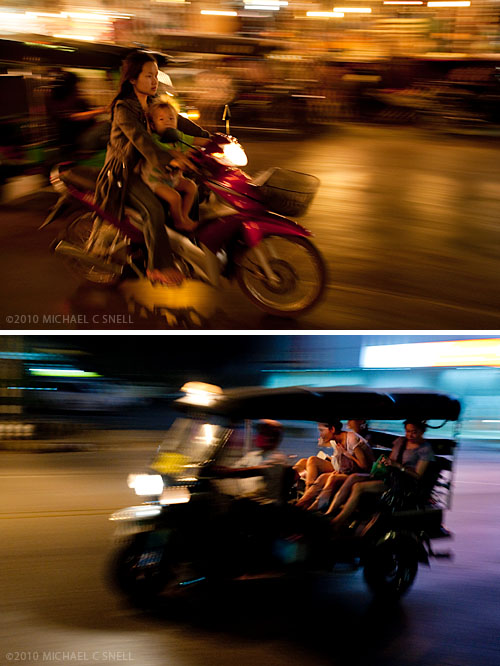
I ended day one in Thailand at the night market in Chiang Mai. The market itself was fairly touristy — lots of t-shirts and trinkets — but the local traffic was colorful enough for me. I enjoy places where a large percentage of the traffic is on fewer than four wheels and Thailand is full of scooters, motorcycles and tuktuks. It’s a hobby of mine to lock the shutter speed at 1/15th of a second and pan with these commuters in the evening to turn the background into a chaos of color. Obviously not every shot will be great but you end up with a few and I’m not paying for film and processing anymore so what’s it really matter? Chalk up another win for digital — it frees you to experiment and from failure comes the occasional wild success. As with the lottery, you don’t win if you don’t play.

I haven’t mentioned much about the Red Shirt protests in Bangkok. They began around March 12th and I arrived on the 15th. During my two weeks in Thailand — about half of that spent in Bangkok — the protests remained quite peaceful. You would see the occasional street blocked off or a group of riot police at a checkpoint but you could easily go about your day without any problems. On only one day did a tour get cancelled due to street closures and traffic problems due to the protests. When I flew out of Bangkok on the 28th, there were signs of enhanced security near the airport but things remained peaceful.

That has unfortunately changed in the last couple of days. While I had been having to check the news on BBC’s Asia-Pacific page, the Bangkok protests have now appeared on the front page of CNN’s site. The situation has worsened with at least 20 dead now and hundreds more wounded. It’s hard as an outsider to fully understand the state of affairs or to know from half way around the world what the current condition is or why things went south. I can only hope that we’ve seen the worst and that soon Thailand can move beyond the violence. It’s a beautiful country with amazingly kind people that deserve to live in peace.

Of course, photographers have been on scene throughout. The Boston Globe’s Big Picture ran a series of images from the “unrest” on April 9th. I’ve also been following the coverage of Bangkok-based photographer Gavin Gough on his blog (search it for “red shirt” and you’ll see several entries). I think you’ll find from these image galleries that things are not entirely black and white. They never are.

Back in the office

100406lightroom_sotc

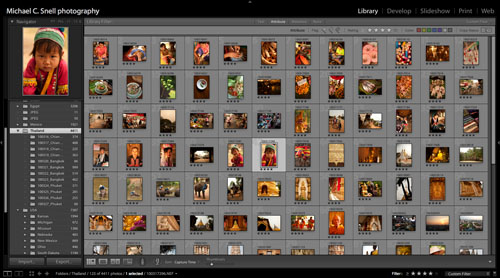
I’ve been back from Thailand for a week now but I’m still in the thick of organizing and processing my images from the trip. I’ve ended up with about 5000 “keeper” shots after purging the really bad stuff. Those images have all been renamed and filed with the most basic location information included in their description fields (city, province, country, continent). I’ve also added rough star-ratings but they will undoubtedly change as I begin the actual post-processing. That’s where I currently stand — I’m ready to begin making color corrections and other adjustments to get these images ready for submission to stock agencies and publishers. I’ll also need to keyword everything. Normally I would wait until after making corrections to keyword but I’ll probably jump back and forth between editing and keywording this time so that I don’t end up with a mind-numbingly long keywording task at the end.

Not all 5000 images will be distributed. There are lots of near duplicates as well as bracketed shots for HDR and sequences destined to become stitched panoramas. There are also lots of shots that I take for reference like signs that show the name and spelling of a place. This isn’t the most glamorous part of being a travel photographer but it’s necessary. Taking the photos is just the beginning. Getting them into the market and in the hands of photo buyers is crucial if you want to make a living.

Air travel strategy

100310exitrow_sotc
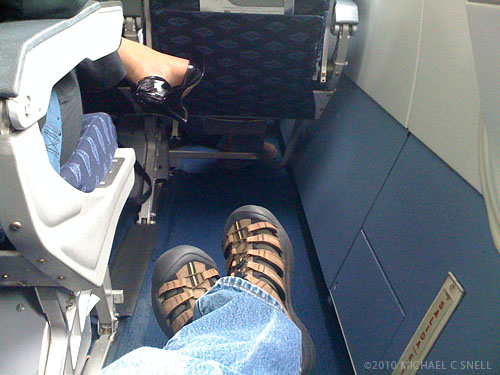
Sometimes that little bit of extra leg room makes all the difference.

My travel schedule is just about to shift into high gear. I leave for Thailand in a few hours with a short stop in Dubai along the way. I’ve been busily making preparations for weeks: getting photography permits, researching locations, etc., etc. But it’s the air travel that will define a large portion of this trip. In just over two weeks, I’ll have a dozen flights. Everything has been booked and a few days ago I logged in to the airline websites to check my seat assignments.

This is where the real strategy begins. I have a couple of long, overnight flights — around 13 hours each — and seating decisions can make the difference between arriving rested or arriving cramped and in a sleep-deprived haze. Being able to make seat selections online is great. Airlines’ sites are getting better and there are sites like SeatGuru that give all kinds of information by airline and plane type regarding location of power outlets, seats with extra legroom, less under-seat storage, etc. It’s great. Almost too great because now your seat assignment is your decision and not something you have to leave up to the fates and the person behind the gate counter.

So back to those long flights. Here’s the conundrum: window seat (where you can lean on the side of the plane to sleep but you’re trapped by your seat mate if you need to get up), aisle seat (where you have elbow room on one side and easy access to move around whenever you want but you have to constantly let your seat mate out), or the dreaded middle seats (where you can be pinned in on each side by your fellow flyers — no space and no freedom of movement).

Then you have to think about the other empty seats. Do you take a window seat in a two-seat row in hopes that no one will take the seat next to you so that you can spread out a little? Or do you take the bigger risk of going for an empty 5-seat center section? You run the risk of other seats filling after you book and being stuck shoulder to shoulder but — if you can pull it off — you can flip up all the armrests and practically have a bed to sleep in (albeit a bed with seatbelt buckles that like to find the small of your back in the middle of the night). This is the holy grail of economy class long distance flight but it doesn’t come easy. Others will spot you in-flight and you may need to protect your turf. After all, who are YOU to get 5 seats all to yourself? Feigning a drooling sleep will ward them off for a while but beware when you sit up to eat or make a bathroom run. It’s every man for himself.

I’ve gone with a hybrid strategy. Traveling to Thailand, I’ll stop in Dubai for two nights so I’ll arrive in Dubai in the evening and can get a good night’s sleep. Arriving in Bangkok two evenings later, I’ll get another good night’s sleep. Since sleeping on the plane won’t be so critical, I’m going for a window seat in a two seat row — currently there’s an empty seat beside me. Hopefully I’ll get to spread out a little and maybe I’ll be able to get a shot or two of the palm islands upon approach to Dubai (I made sure I wasn’t seated over the wing).

Flying home, I’ll have about 27 hours of nearly-continuous flying time in four legs with brief connections. I’ll want to sleep on this one so I’m taking a gamble on a 5-seat center section. I took the aisle so that, if it fills up, I’ll still have elbow room on one side but maybe I’ll get lucky and get the whole row. That would be pretty sweet.

Copying a Daguerreotype

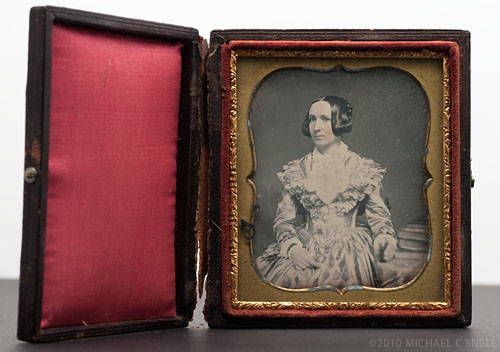
100225family1_sotc

I had thought about a catchy title for this post like “shooting dead relatives” but decided that it might get me some strange Google hits.

Winter grinds on in these parts and I haven’t had any travel for the last few months. Instead I’ve been getting caught up on indoor work that includes updating my files with stock agencies, organizing the chaos that developed over the course of the last year in my office and doing lots of tabletop studio shoots. I don’t do a lot of studio work but I do have a few clients that need the occasional product shot. This past couple of weeks I’ve been shooting a lot of architectural glass and mirror samples. While I had the small studio area set up for this, I decided to copy some old family photos.

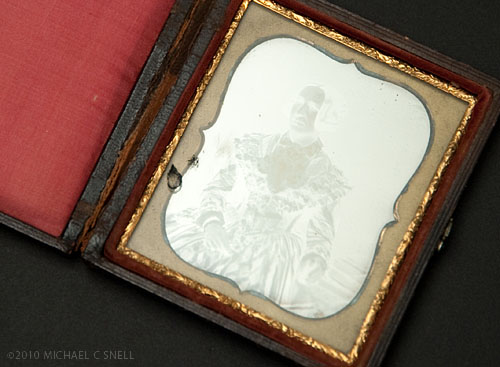
Some of these photos appear to be daguerrotypes. These images are tricky to photograph because they have a mirror-like surface and at most viewing angles they actually appear as a negative — almost like an etched piece of silver.

100226family2_sotc

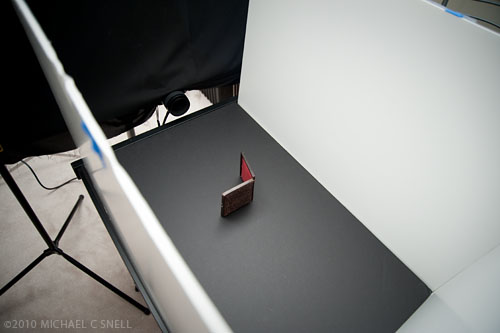
To see the image properly, you have to look straight-on so that something dark is reflected on the surface. Reflections of any other kind would be a big problem when re-photographing these portraits so I built a box out of foam core. The bottom was a piece of black foam core so that it doesn’t reflect onto the lower portion of the daguerrotype. The sides and back were white to bounce as much light around as possible and I draped a piece of thin foam packing material over the top to soften and distribute the light that came into the box. That light came from two hot lights that I had shooting up at the ceiling and bouncing down into the box.

100226studio_sotc

To eliminate reflection from the surface of the image, I draped a piece of matte black cloth from a background stand across the front of the box. Think of the box as a puppet theater and the black cloth is the front curtain. I could stick the lens of my camera through the curtain and let the cloth drape over the lens to block any reflection from the markings on the camera itself. I used my Nikon D300 and a Nikkor 60mm macro lens to be able to get the close focus that I needed.

The system worked pretty well but there is some pitting in the surface of the glass covering the portraits that was accentuated in the copies. For the tighter shots that I made, where the frames are cropped out, I’ll need to do some significant spotting in Photoshop. I like the wider shots warts-and-all, though. The wear on the cases and the pitting of the glass show the age of these images which were likely made between 1840 and 1860.

Decade in review: 2005

100116fire_sotc

Continuing my review of the the past decade…

2005 was a year of assignments throughout the Midwest for me. I like to take driving trips when it makes sense. I enjoy driving and like to be able to arrive at a place gradually, to know what is between here and there, and to have some sense of distance. When you fly, you get dropped into a new place with no bearings. You don’t have a sense of scale for how far you’ve traveled. You don’t know how the landscape unraveled between here and there. And, for me at least, it’s more difficult to get a feel for directions. If I drove in from the east, then I arrive knowing east from west, north from south. When arriving by air, I need to depend more on maps and make a conscious effort to pay attention to sun angles, etc. Obviously, flying is often necessary, either for speed, efficiency, or to just plain get somewhere that you can’t drive to.
100116band_sotc

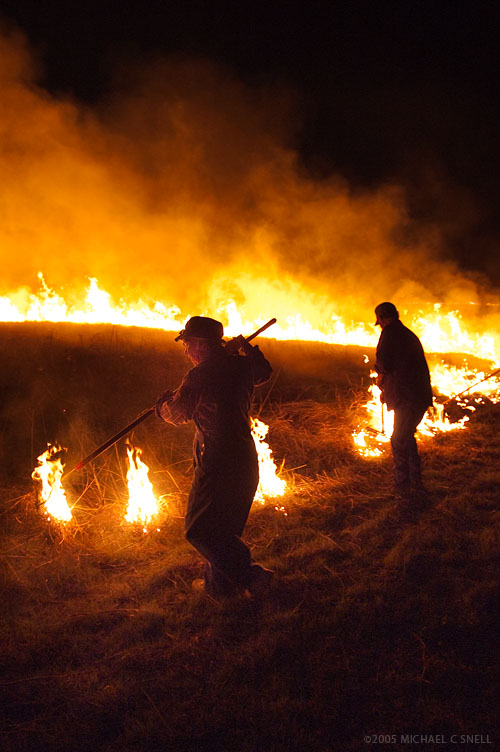
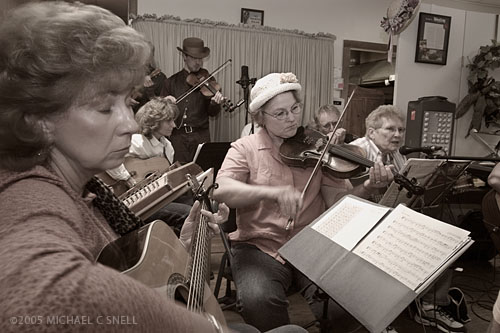
The first two shots in this post are from a prairie burn and related festival that I shot in the spring of 2005. I live near some of the largest remaining sections of tallgrass prairie in North America. Ranchers who graze cattle on this land have learned that a controlled burn in the spring will help new grass grow that will better fatten their livestock. These burns are often done at night while winds are low and it’s an amazing experience when driving across the prairie to see lines of fire in the distance and smell the sweet scent of burning grass.

Other assignments required far more driving than this one did. 2005 seems to have been the Year of the Roundup. In magazine-speak, a roundup is a story that bundles several locations together by theme. You’ve seen them: Best Places to See Fall Color in the Great Lakes, Children’s Museums of the Midwest, Ten Places You Can Still Find a Real Soda Fountain. That sort of thing. For several years we would shoot an annual story on the Best Christmas Shopping in Kansas City, St. Louis, Chicago, Indianapolis and Des Moines.

These are difficult trips to make work financially. A roundup may not pay more than a story on a single destination but, if the publication doesn’t pay expenses, you can see where the costs would add up when you need to visit several cities over several days. I’ve always tried to combine as many assignments or stock opportunities into each trip as possible. I’ll let art directors I work with often know where I’m going to be to see if they have something else in the area that I can tag on or I’ll look for iconic or unusual scenes in the area that I can use in my stock files. It works but it requires a lot of planning and a lot of driving.

I’m located about as close to the center of the US as you can get but in 2004 and 2005 I drove to both coasts in addition to several trips to the Great Lakes region and various other places around the Midwest and Western US. In 2004, we drove to Portland, Maine for an MTWA meeting, took the ferry to Yarmouth, Nova Scotia, drove up across the Gaspe to the St. Lawrence and then back home through Quebec, Montreal and Toronto.
100116mtns_sotc

In 2005 we drove to the west coast for a different reason. We had decided to take a serious look at relocating. We’d lived in the same house for nearly 20 years and had outgrown it when we both began working from home in the late 90s. In 2003 we leased office space downtown to have some more room. It worked for awhile but we realized we were more efficient when we had a home office. We decided to look for some place large enough to accommodate our home and office and we decided that, if we were moving, maybe we should make a big move.

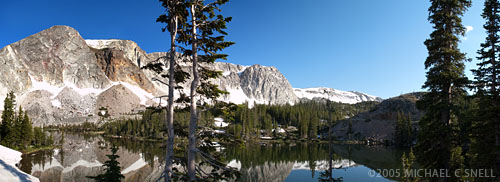
We made a list of things we would want from a new home and a cool, but not cold climate was high on the list. From our travels, we decided that the Pacific Northwest was our best option. We researched towns and put together a driving circuit that would take us through several places that we thought had great potential, mostly along the Oregon and Washington coasts. We threw in some towns in Wyoming and Idaho for the trips out and back as well. The panorama above was taken near our first stop: Laramie, Wyoming.
100116porta_sotc

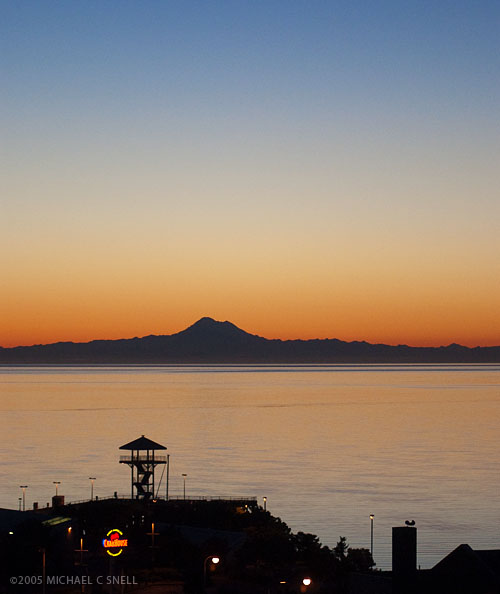
Port Angeles, Washington, was high on our list based on the experiences we’d had there on a previous trip in 1997. What we learned by our second visit to this town — and actually from this entire experiment — was that you need to look at a town completely differently if you are planning on visiting as a tourist or moving there permanently. The things we loved about Port Angeles were quickly overshadowed by things that now seemed unworkable for us in terms of a home. In general, all of the places we looked at had much higher property values than what we currently had in Kansas (this was before the real estate bubble burst but we could see that coming and didn’t want to get caught up in it). We liked the smaller coastal towns but were concerned about being further from international airports and having mountain roads between us and larger cities.

In the end, we decided to move just 30 miles east of our old home to Lawrence, Kansas. It’s a university town so it has a lot of diversity and a vibrant arts community. It’s 30 minutes closer to our international airport in Kansas City. And it’s incredibly affordable compared to the west coast. You can get a 3000 sq. ft. house here for what a double-wide might cost you on the west coast. It has worked out great for us and we’re very happy with our choice.
Decade in review: 2001

100102acoma_sotc

Continuing my review of the the past decade…

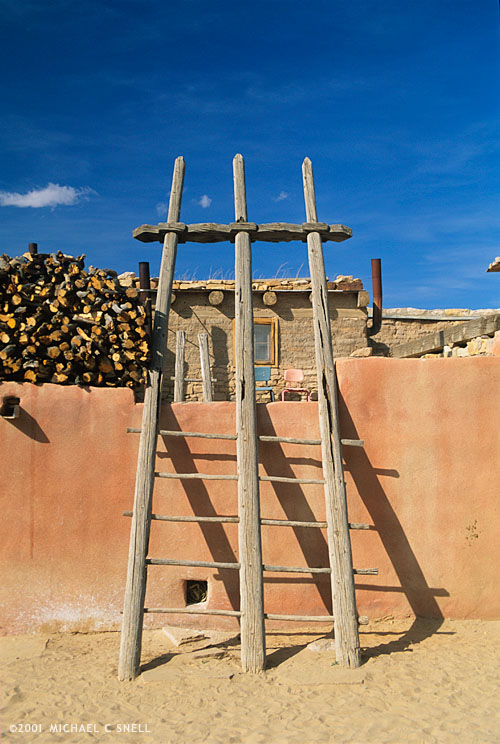
2001 slipped past me with no international travel. I’d had another Canadian trip in late 2000 and would go to the Yucatan peninsula in Mexico in early 2002, but the 12 month period that was 2001 was all US travel. The shots on this page came from a fall trip to New Mexico. The one at the top of the post is from Acoma Pueblo and has long been a favorite of mine. I went back to Acoma last year and it was very different. A large interpretation center has been built and many of the buildings on the mesa had been spruced up. Most of these ladders had been freshly painted white and the timeless feeling that I had loved from my first visit had eroded away a little. I’m glad I’d had the opportunity to see “Sky City” in 2001 while it was still a little more rustic.

I also remember another fall shoot in 2001, in the Great Lakes area just after 9/11. It was during the time that all of the flights were grounded and it struck me as I photographed Lake Michigan from the beach near Charlevoix that there were no contrails crossing the sky from planes coming out of O’Hare. A noticeable difference from previous trips to that spot.

On my return home from that Michigan trip, I stopped and shot a little in Pella, Iowa. One image in particular that I remember making may have been the last 4×5 transparency that I shot. It was a twilight scene in a new mixed-use development that had just been built downtown. The buildings were all designed to reflect the Dutch style (Pella has a big tulip festival every year) with a canal flowing through the courtyard. I was using my Tachihara field 4×5, correcting for perspective distortion with its bellows.

The fact that I can’t come up with a digital version of that shot to post here goes to show how much has changed in the last 8 years. I have the transparency, but I no longer have a way of scanning large format film here in the office. I used to use a backlit flatbed scanner — which didn’t give very good results — or I would send images out for commercial scans. This particular image was never scanned for my stock files so it languishes in the “dead film” cabinet. The following year would pretty much see the end of my use of film and everything would change.

Petroglyphs, Santa Fe County, New Mexico, USA

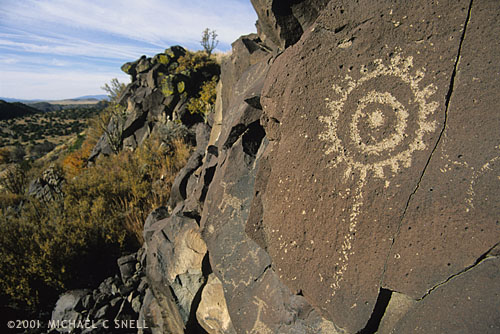
Here’s another New Mexico shot — some petroglyphs near Santa Fe. The New Mexico light was always a great fit for film. I shot a lot of Velvia at that time, along with some Provia when I didn’t want the saturation to be quite so strong. It’s funny, I loved that super-saturated look that I would get with Velvia, but when I try and mimic the look using digital techniques, it looks artificial to me. Obviously, it was artificial on film, too. But somehow it was easier to accept film altering a scene than doing it purposefully in digital. The film choice was purposeful, too, but it seemed somehow more honest than cranking the saturation slider in Photoshop. As time moves forward, I’m becoming more adventurous with pushing reality digitally, though. Something we’ll probably see over the next few posts.

Looking through these images from 9 and 10 years ago is making me realize that, at that time, I was really more of a landscape photographer. My mentors at the time were landscape shooters and it was a gradual transition for me to go from landscape to what I now consider “travel” which is a broader description that can include architecture, interiors, action, people and even food. I’m now shooting fewer pristine landscapes and am incorporating a lot more of the man-made world. It’s a reflection of both what interests me and what is needed in the marketplace.

The winter of limited progress

091213website_sotc

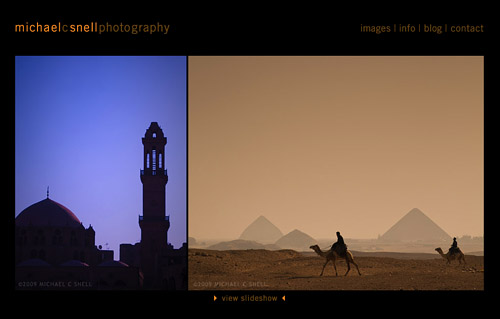
I’ve made a long overdue update to my website by changing the home page photo to a couple from my Feb ’09 Egypt trip. It’s something I’ve always intended to do on a monthly basis at least. This time it went for over a year.

This winter I made plans to make lots of updates to the site, this blog, and especially to my other Shade of the Cottonwood site. I usually have a lull in travel over the holidays and winter months so I thought it would be a good catch-up period.

Well… that was the plan. Reality often bears little resemblance to my plans and, so far, this winter is no exception. It is becoming one of those “one step forward, two steps back” periods. When I returned from Mexico in October, I planned to get through the processing of images from that trip and then I’d be free to dig into my “winter projects”. Then the cat fell from the balcony and broke his leg resulting in 8 weeks of heavily supervised recovery. While hanging out with him in his cushy rehab pad (actually Sally’s sewing room) we noticed the carpet was damp. After some exploration, it was discovered that the hot water heater was leaking and, although there is a floor drain less than three feet away it’s apparently uphill from the water heater. Plumber called, new water heater installed and now we are in the middle of the carpet drying process — pulling the carpet and pad up, fans everywhere, etc.

I won’t go on with my entire list of distractions (and there are a lot more), but you get the picture. Today I decided to ignore everything else (except the cat duties, of course) and make a dent in the web site updates. Much progress has been made but it will be a while before you begin to see it online. Hopefully not too long.

To help me get down to work, I used up some remaining credits I had in the iTunes store and added Ceu’s “Cangote” EP and Minipop’s “A New Hope” album to my library. I find it really helpful to crank up some new tunes when working at the desk. It’s a trick I use when post-processing a shoot, too. I usually buy some local music while I’m on the road and then I listen to it while processing the images. Listening to Chinese pop while processing Shanghai images or a Desert Beat compilation while going through an Egypt take keeps me connected to the place. Plus, music makes a great souvenir that’s easy to pack.

Working the sunset, part 3

091018surf_sotc

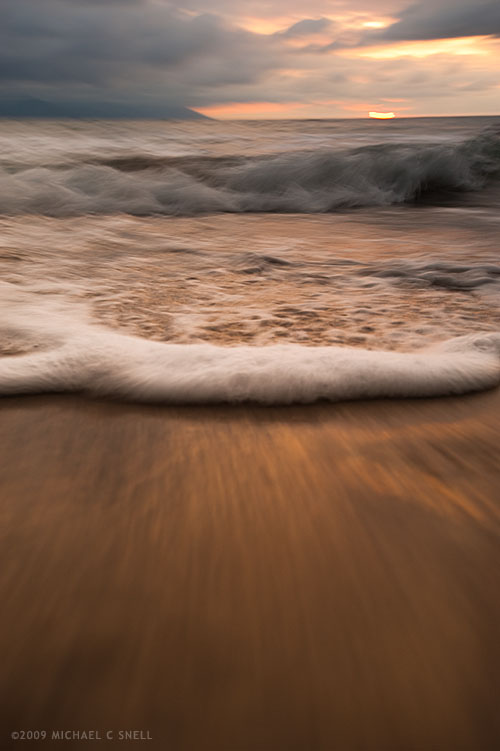
One more from my Puerto Vallarta beach session. I was beginning to feel like I was shooting greeting cards — sunset over ocean surf, footprints in the sand, etc. — so I decided to play a little. Call it a game of “don’t drop your camera in the water”. As the waves would pull back from the beach, I would follow them out. Then, as they came rolling back in, I would hold the D700 down almost to the sand and run backward in front of the waves firing off exposures all the way. I wanted to capture some motion and convey the feeling of the waves coming in. I experimented with several shutter speeds — this was f/6.3 at 1/13th of a second. Strong sharpening in Photoshop helped bring out some interesting texture in the distant wave. Technically, I doubt there is much that’s “right” about this photo but I do feel that it captures the moment better than a static shot. At least that part of the moment that I was shooting for. In the end, whether it’s a success is up to the viewer.