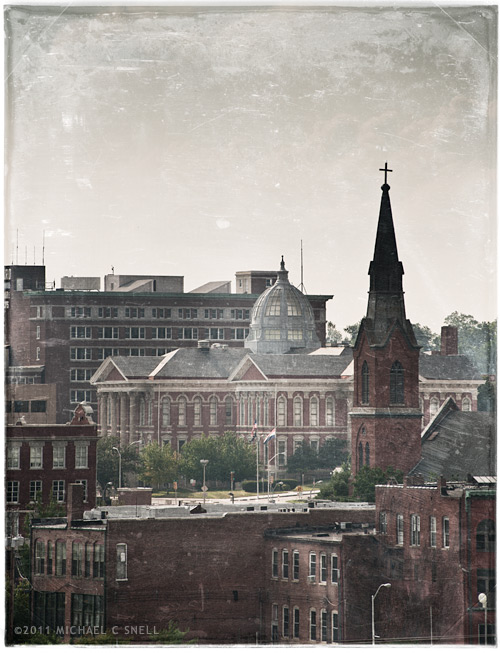
Here’s a shot from yesterday’s quick trip to St Joe. Something about the original image felt like it was from a different time so I applied some old glass-plate textures to take it further in that direction.
Here’s a shot from yesterday’s quick trip to St Joe. Something about the original image felt like it was from a different time so I applied some old glass-plate textures to take it further in that direction.
After a tough few weeks, I’m returning to a somewhat normal schedule. Some would argue whether I ever operate on a “normal” schedule, but at least things are becoming more normal by my own warped standards. One part of what I like to think of passing as a routine is my morning walk. They’ve been few and far between lately, but the weather — and life — has been cooperating recently and I’m trying to reawaken the habit.
I sometimes build additional purpose into these walks by taking a camera along to experiment with a new lens or technique. On this particular recent walk, I limited myself to my Lensbaby Composer and my D700. The shot at the top of this post was created by swinging the camera downward during a .6 second exposure. I wanted to abstract the scene of grass and tree trunks to its essence and I’m pretty happy with the result. It took more than one try, but this is actually pretty close to what I was looking for.
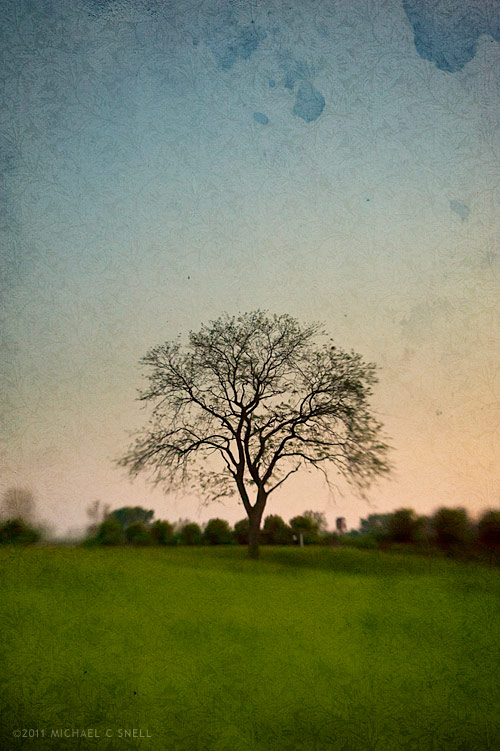
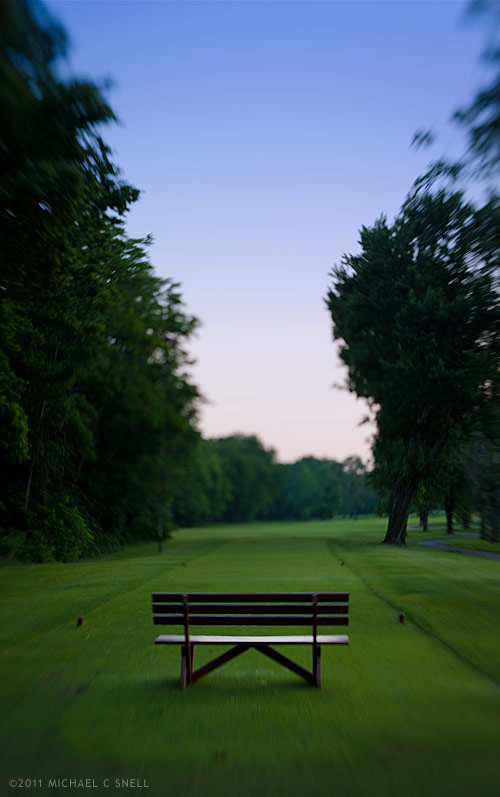
The shot of the tree was pretty straightforward until I applied some textures in post using Photoshop CS5. And here’s one more Lensbaby shot that sums up the serenity of a pre-dawn stroll:
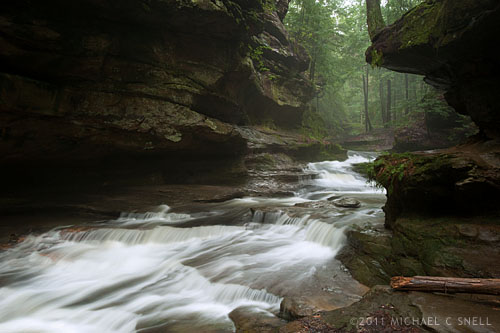
I’m back from a week of shooting in the Midwest — mostly Ohio and Indiana. It’s always bothered me, that name “Midwest”. I live very near the center of the U.S. and the Midwest is east of me. Seems like “Midwest” ought to be Utah — halfway between the center and the west coast. Shouldn’t Ohio be “Mideast”? But I digress…
Most of the work I was doing on this trip was on assignment and, unfortunately, I can’t share it prior to publication. I did squeeze in a quick trip to Hocking Hills State Park for my own stock, however. I’d visited before about a year and a half ago, but lack of water made for no waterfalls to shoot. This time was much different. Parts of the park were closed due to flooding but the parts that were open were stunning. I got absolutely soaked by the on-and-off rain, but enjoyed the heck out of it. I know I’ve just come from Fiji — many people’s dream location — but it’s really these dark, misty, craggy, rocky places that I love the most. I’m not sure what that says about me.
I should also mention that I found two pieces of equipment essential for the Hocking Hills shoot. First, a tripod was an absolute must. Without long exposures, the water didn’t have nearly as much movement or mood. The other thing that aided in the long exposures was my 8 stop neutral density filter. It adds no color to the scene (thus the name “neutral”) but it cuts the light down so that I can get much longer exposures than even my lowest ISO and smallest aperture will allow. NDs and polarizers are the only filters I carry any more because they both have abilities that I can’t mimic later in Photoshop or Lightroom. When I reeeally want to cut the light down — say, for a long exposure in full daylight to show clouds streaking across the sky — I’ll stack up all of my NDs and polarizers to the point that it’s hard to see anything through the viewfinder.
More from this shoot and Fiji in the coming days.
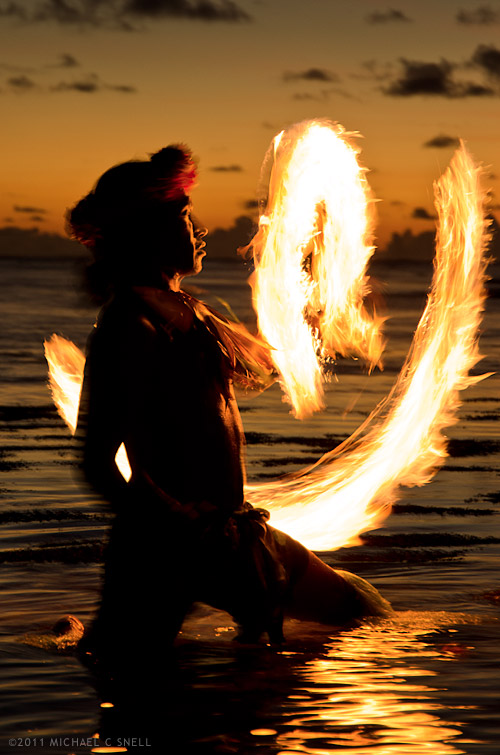
The coming week is going to be busy and there’s a good chance that I won’t have an opportunity to post anything so I’ll leave you with a fun shot today, just in case you end up having to stare at it all week. This one’s from an evening spent photographing fire dancers on the beach in Fiji. Not really an evening as much as a few minutes. There’s a brief period when the sky is dark enough but not too dark to balance with the fire and the light being cast by the fire. It’s fast and exhilarating — made more so by the bits of flaming material that occasionally gets flung in your direction. These guys and gals were amazing and put on quite a show.
For those of you interested in technical stuff, this was f/5.3 at 1/6th of a second. It was shot at 6:28. The entire shoot lasting from 6:17 until 6:37. 400 shots in 20 minutes (I’m glad I wasn’t having to change film). There are plenty more fun ones from this series which I’ll share in the coming weeks.
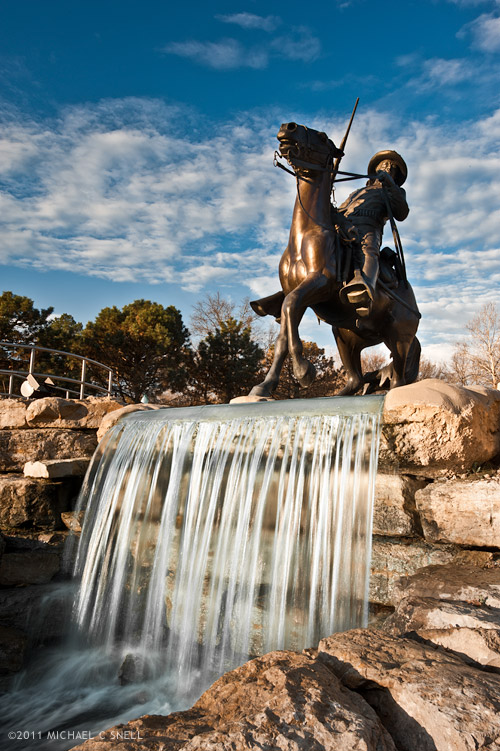
Adjusting this photo from Saturday’s NE Kansas excursion was a little more work than it needed to be. This is the Buffalo Soldier Memorial at Fort Leavenworth and apparently someone thinks the water looks better dyed an unnatural blue/green color. That, or it’s been this way since St. Patty’s day. Maybe there is some other perfectly reasonable explanation for the water’s color, but it looked really, really strange in the falls below the sculpture. You can see for yourself in the un-fixed horizontal version below:
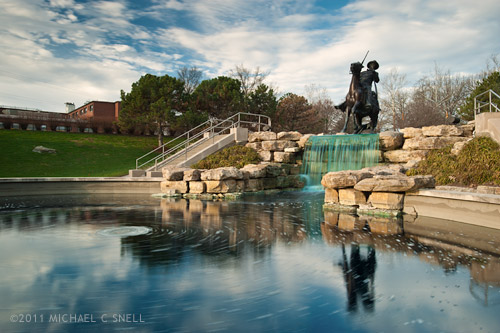
Note to all fountain owners — green water doesn’t look better! In Lightroom, I had to go through a whole process of selectively desaturating the aqua range of the color spectrum and painting in with the adjustment brush a combination of increased contrast and desaturation until things were looking somewhat natural again. Whew.
By the way, I was also putting a new camera bag through its paces on Saturday. For my upcoming Fiji trip in just a few days, I picked up a new Think Tank Sling-O-Matic. Here’s a photo of it from their site:
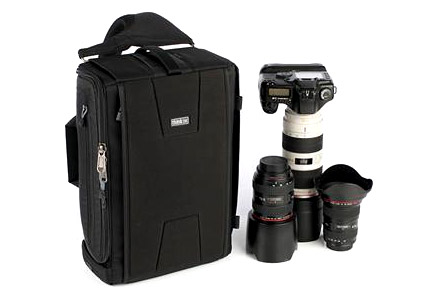
I had originally planned on getting the smaller Sling-O-Matic 10 but it wasn’t in stock locally and upon seeing the size of the 20, thought it might better fit my gear. This bag is slightly smaller than my Think Tank Airport Ultralight and is a sling-bag instead of a full backpack. While I’ll miss the distribution of the weight across both shoulders, I welcome the ability to swing the bag around to access lenses without taking the bag off.
The bag worked great on Sunday and I look forward to seeing how it does on a longer trip. My Ultralight fit nearly every overhead compartment I encountered although it was a bit tight in some. This one should slide right in, but the laptop will have to be carried separately in its own sleeve. There is a side pocket that will take the laptop on the Sling, but an inch or so sticks out and I’d be a little nervous that it might work its way out while out of my view on my back (the way the pockets work is that they’re top-opening when you sling the bag ’round front, but are side-opening when worn on the back).
I’ll report back after the Sling has logged a few air miles.

In my last post I talked a little about how the things that you leave out of an image can change the impression given to the viewer. Here’s an example of going the opposite direction. I first made the shot of the RSA office tower in Mobile, AL, that appears on the left. It’s a clean shot. Simple. Nothing extra. But there is no context. The building could be anywhere from Mobile to Moose Jaw. I took a few steps to the side and took the right-hand shot, framed by some palm fronds. Now the viewer has a little extra information. Climate. You’re somewhere warm and tropical and more of your senses are engaged.
I’m not saying either of these is a great shot — I’m just trying to give an example of how including one extra element can sometimes provide a lot more information to those viewing your photos. While I agree that it’s generally best to edit a scene as much as possible and include only those critical elements in your frame, don’t go too far and eliminate something that can add a little context.
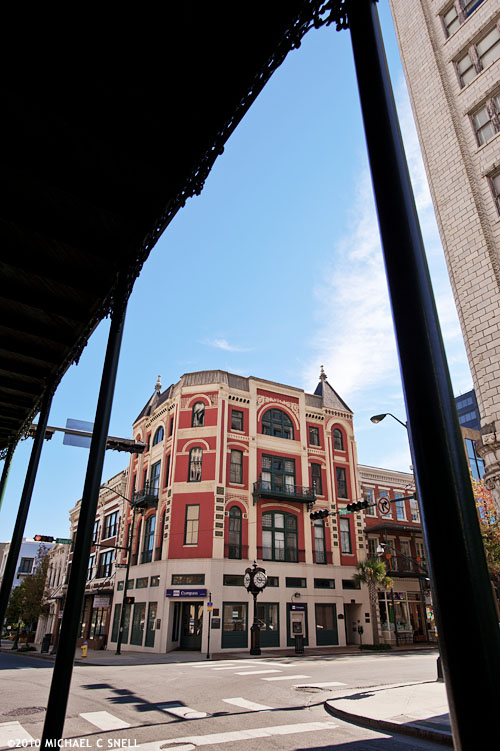
Reality and truth are concepts often discussed when it comes to photography these days. With the rise of Photoshop, people question what’s real — or perhaps they don’t question it enough. When I’m shooting for editorial use, I try to be “truthful” and show the “reality” of the place I’m photographing, but that doesn’t mean that some interpretation doesn’t creep into the images. In fact, it’s often my intention to boil an image down to focus on one single concept rather than to convey an entire, complicated reality.
There are often many truths and many ways of expressing them. Take these shots of downtown Mobile, Alabama. The one above gives the impression that the city is historic and shares much of the character that one thinks of when one thinks of New Orleans – brick buildings and ornate cast iron balconies. I would say that this is true of Mobile and it’s an accurate representation.
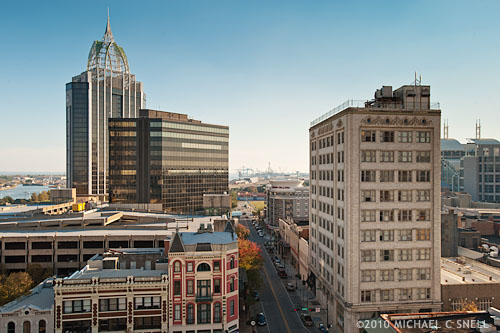
Then there’s this shot taken of the same block but from a higher vantage point. The same brick building can be seen in the lower foreground but this time it is minimized by the office towers looming above. Now Mobile appears to be a progressive city, a growing urban center.
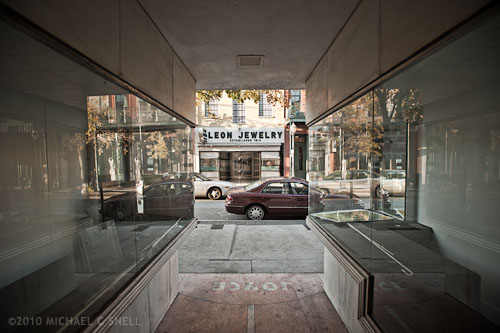
Taken just a few blocks away, this photo shows yet another side of Mobile — one of a city that is struggling. Empty storefronts are emphasized by the camera viewpoint being moved back inside a shop entrance with vacant display windows. The vibrant shopping area that actually flanks this particular shop is hidden from view, giving the impression that this is a neighborhood in decline.
None of these images have been manipulated in Photoshop to give a false impression. The three sides of this city are conveyed simply by camera position and the choices made in composition. Is one shot more real than the others? I feel that they all represent my reaction to the city I was exploring. They do, however, contain my own personal point of view and reactions. Put a dozen photographers in Mobile for a day and you’ll have a dozen different perspectives. Maybe a dozen different truths?
I talked a little bit yesterday about how to best handle less than ideal weather situations. My day in Passau was white-skied and a tad dreary. I actually like that kind of weather and think some great shots can be made when there’s a little more “atmosphere” than usual. Unfortunately, from a business sense, my likes are trumped by what sells. I’ll still shoot for myself and make the shots available to publishers, but they’ll typically take those dramatic sunsets or clear blue skies over this:
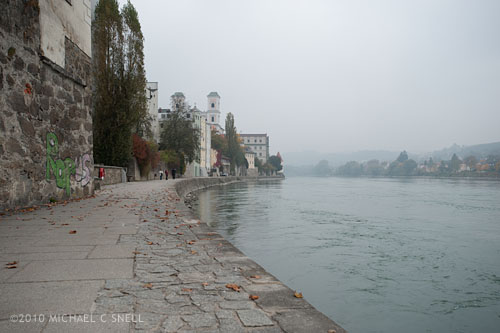
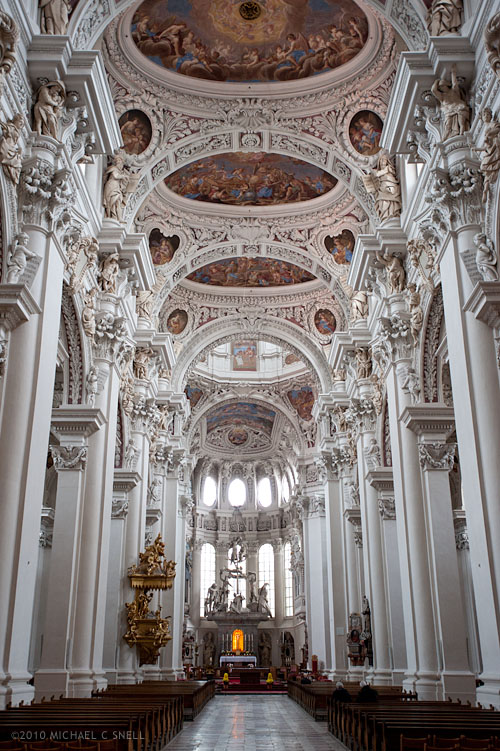
That’s the Passau I saw last month. Beautiful city, actually. And I had a great time wandering its streets finding incredible vantage point after more incredible vantage point. But… reality sets in and you need to make some photos that will sell, too. Heading inside is one option as seen by the church interior at the top of this post. The softened light from the overcast skies didn’t give those dramatic shafts of light that you might sometimes see streaming through the windows but — with an interior as bright and white as this one — you don’t really need them. The soft light did a great job of modeling all of the ornate features and did so with lower contrast than direct sun would have.
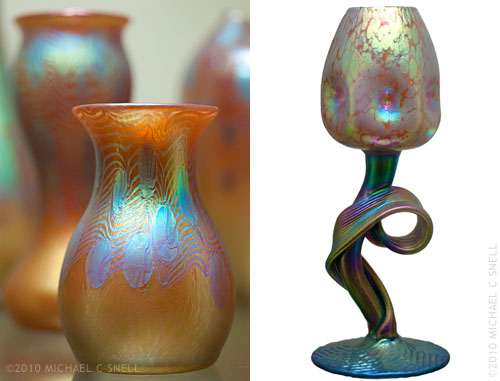
Passau also has a great glass museum. We’re talking about a rambling, multi-story maze of room after room of extraordinary glass. You can seriously get lost in there, but you won’t mind much because there’s good stuff around every corner. The lighting doesn’t look too sympathetic to photography at first. There are all different color temperatures from pink to blue to green. Happily, the auto white balance on my Nikon was able to clean that right up without a second thought from me. I just popped on the 60mm Micro lens and went crazy. Most of the glass was behind glass, but limiting depth of field and blocking the background with my own body allowed me to deal with most reflections. Some of these shots will make nice cutouts (like the one on the right) for those guidebooks that want a little detail shot to break up a long block of copy.
All in all, not bad for a rainy day’s work.
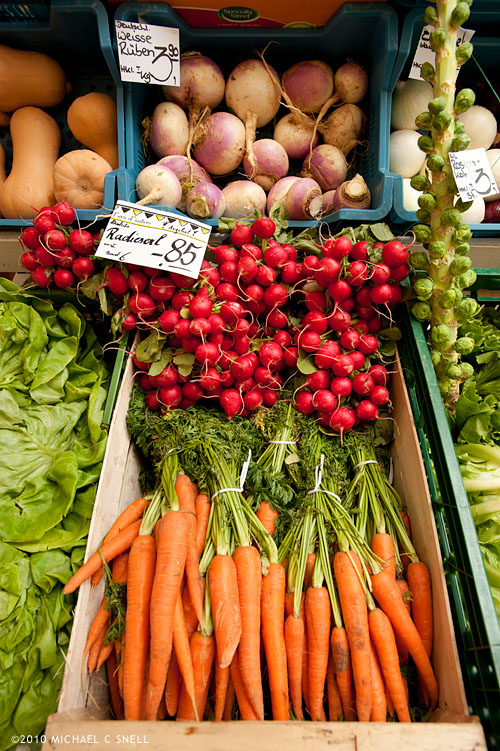
Nearing the end of my trip to Germany last month, I found myself in the town of Passau on a less than perfect day. It was cold and grey and overcast. The light was nice and soft, however, and you just had to pick your subjects appropriately. This produce stand, for instance. The colors were so saturated and the lack of direct sunlight kept the contrast from being too great.
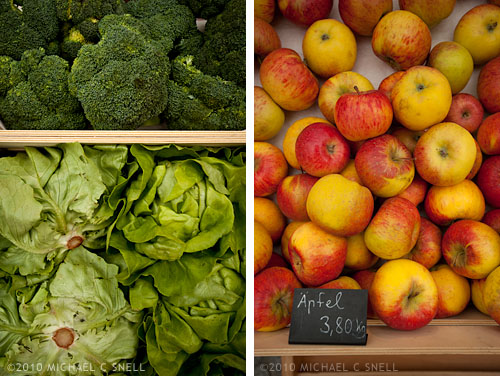
I also found the light to be nice for some of the tight alleyways where I could shoot and not show any sky. Again, the contrast of direct sun would have made these areas very difficult to capture but the clouds helped keep that contrast down. The town is also famous for its glass museum which was another comfy place to shoot on a chilly day. The lesson is: make the most of your situation. There’s always some way to make the weather work to your advantage.
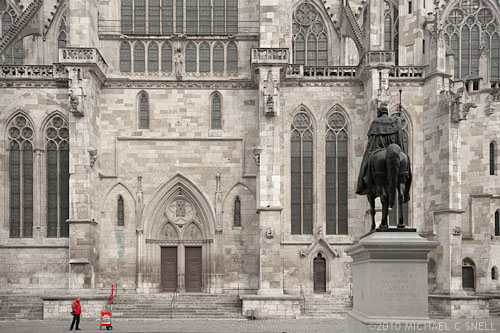
I’d love to see this shot run as a double-page spread one day. At a large size it’s chock-full of detail and nearly entirely monochromatic except for the tiny red-coated figure in the lower left. Not only does he give a little splash of color, but he makes it apparent just how large the cathedral in Regensburg, Germany, really is. Often with something huge like this the impulse is to get it all in frame, but that can actually make it look quite small in the final image. Cropping in and using just a portion of the church so that it bleeds off on all sides emphasizes that it’s so big it won’t even fit in the shot. Even so, without that lone figure in the corner the effect would not be nearly as strong. (And thank you, sir, for wearing your red coat that day!)