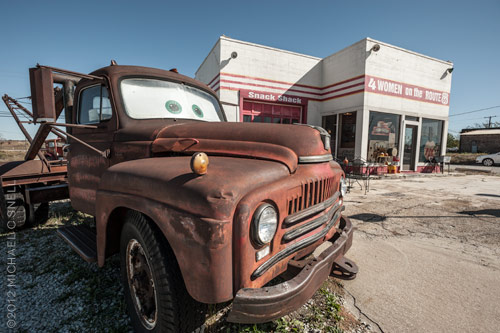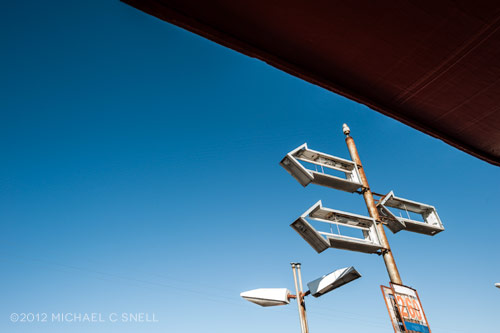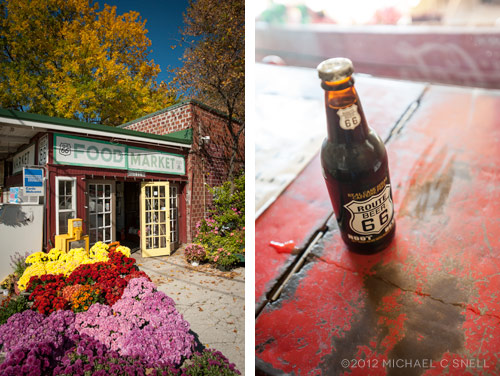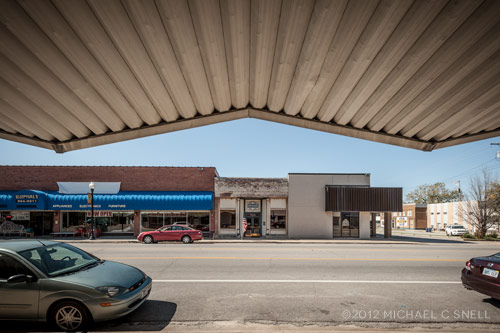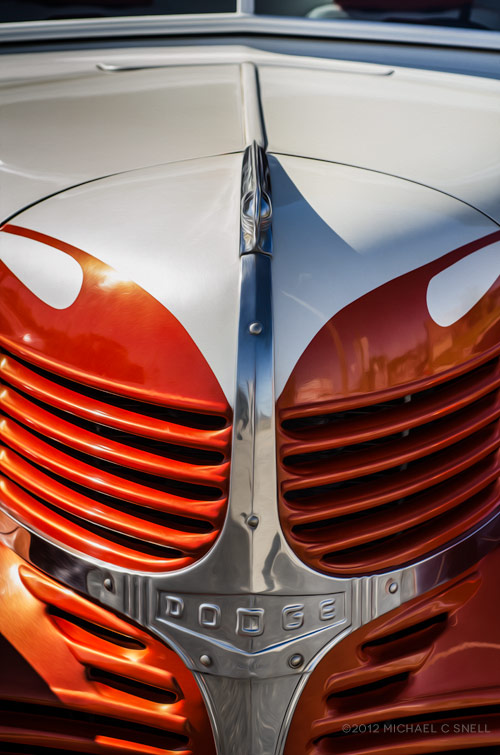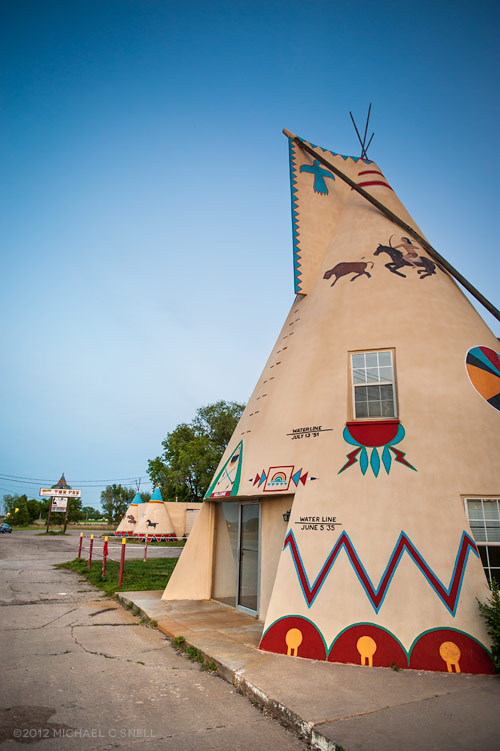
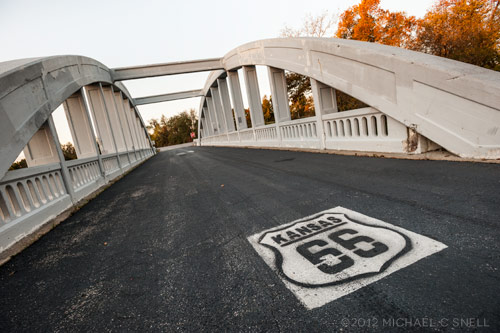
I spent a few days on the road with my friends at Gizmo Pictures last week. That’s always a recipe for a great time and this was no different. The shots in this post are all from Kansas’ section of Route 66. We only have about 13 miles of the Mother Road in our state but you can get your kicks on them none-the-less.
Category Archives: architecture
Greensburg, KS, revisited
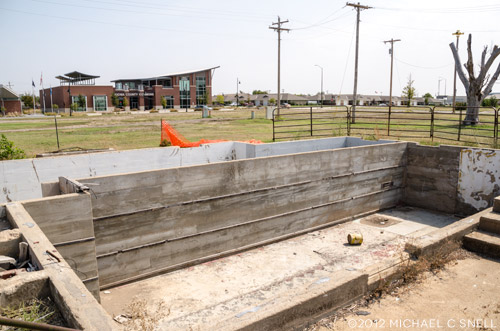
Greensburg, Kansas, was nearly wiped out by a tornado in 2007. Something like 95% of its buildings were destroyed. I used to travel through Greensburg frequently in the 80s and 90s and remember it as a beautiful community with the typical mix of old brick shops downtown and early nineteenth century clapboard houses filling its surrounding neighborhoods. But I remember it most for having what seemed like more than its fair share of shade trees. It was always a truly welcoming place on the prairies of western Kansas. Most people knew it as being home to the World’s Largest Hand Dug Well and, to be honest, most of the images I have in my files from Greensburg are of the staircases leading down to the bottom of that well. I wish now that I would have recorded more of the rest of the town.
It was quite a while after the tornado before I went back to Greensburg and, even then, I just drove through. I didn’t want to just gawk at the destruction and it was a hard thing to come to grips with, seeing a community that you knew for your whole life, now replaced by an open field that you barely recognized.
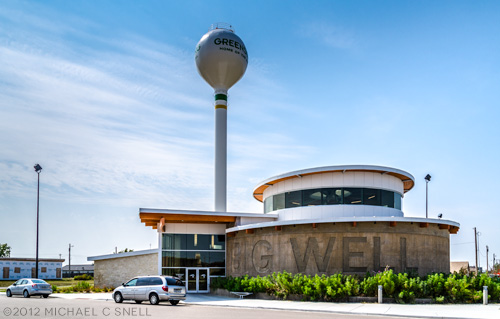
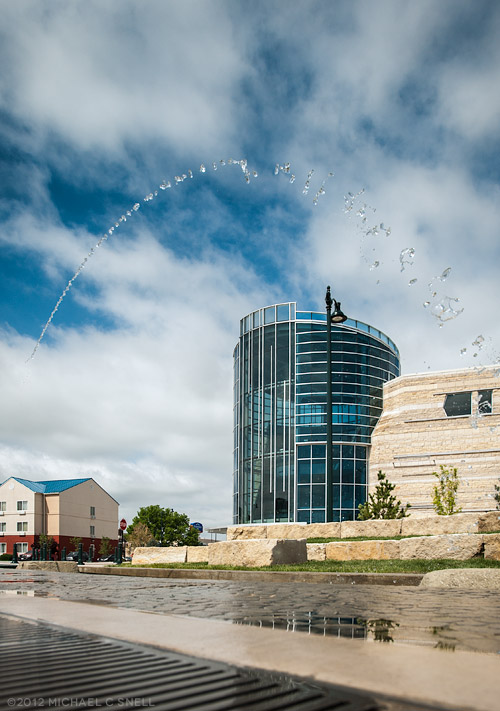
A recent shoot in Dodge City had me driving through Greensburg on the way to my next stop in Wichita. This time I decided to take a little time to see how the community is rebuilding. Of course the first landmark I looked for was the Big Well, which was always easy to find as it was located just beneath the city water tower. The water tower and the museum that sat behind the well (still seen on the Wikipedia page) were both destroyed but a new water tower has replaced the old metal one and a vastly larger and more modern museum has actually been built over the well this time as seen above. As I was running short on time on this visit, I saved the trip down into the well for next time, but I understand the old zig-zagging stairs have been replaced with a circular system that hugs the outer wall of the stone-lined well. If you’re having trouble imagining a well with room for a staircase, we’re talking about a hole 32 feet in diameter and over 100 feet deep.
There are still a few damaged trees standing and plenty of sidewalks leading to nowhere, foundations with no homes. But I have to give a great deal of credit to the people of Greensburg and their philosophy about rebuilding. They took a disaster and found an opportunity within it. The townspeople have decided to rebuild better than before, and greener than before. You notice the wind turbines long before you even get to town, then the solar panels. Greensburg now boasts more LEED certified buildings per capita than any city in the world. They have become a testing ground for all kinds of energy-conserving and alternative energy technologies.
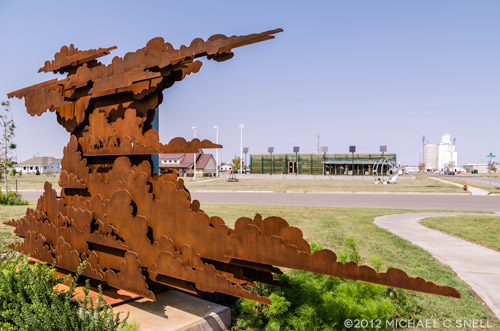
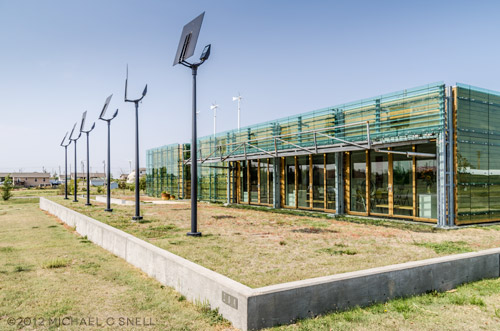
It’s nice to see public art being among the first things to return to Greensburg as well. This glass-skinned building is the 5.4.7 Arts Center, the first building in Kansas to receive a LEED Platinum rating.
For me, it’s still a bit painful to walk the streets of Greensburg. In my mind’s eye I’m still seeing what was. But that’s not fair to the efforts of the people who have put such energy into bringing this community back. They have made great strides and I look forward to many future visits to see how they are progressing. The hopes and dreams of these folks are now plainly visible in the new buildings and the new trees and gardens being planted.
Fountain shoot, behind the scenes
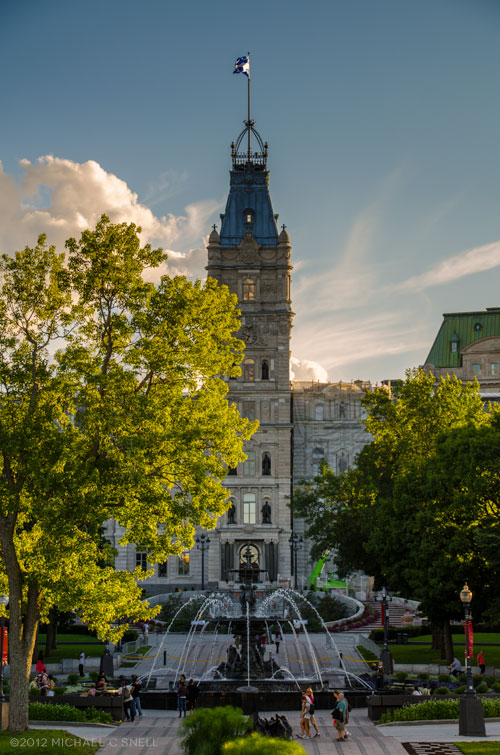
On my last trip to Quebec City in 2007, I never had an opportunity to get a good shot of the Fontaine de Tourny, located in front of the Parliament Building. The fountain was brand new at that time — if you can call something new that was built in France in 1855, put in storage in 1960, and relocated to Quebec in 2007. You can find the whole story here.
Anyway, it’s one of those shots that I felt should be in my files because the fountain has such a great story and it is rapidly becoming yet another landmark of this already beautiful city. So… when I went back to Quebec last month, this fountain was high on my shot list.
I captured the above photo on my next-to-last day in town but it’s not the one I originally had in mind. I really wanted a shot that made the fountain the hero and included the Parliament Building as context. I also wanted to shoot at twilight to get the most impact from the color in the scene.
Early on my first free evening in Quebec I set out with my D700 and a tripod and began scouting out my angle. Things are rarely perfect and this day would be no different. It was cloudy, first of all. Not puffy, dramatic clouds but heavy, overall grey clouds that pretty much made for a dead sky. Grey sky, black fountain, stone building. Not a lot of color so far. Still, you never know what will happen and twilight can be magical in any weather. Secondly, I found that half of the Parliament Building was covered in scaffolding and there was a big, lime-green crane right in front. Scaffolding had been everywhere on this visit — even the most prominent element of the Quebec skyline, the Fairmont Le Chateau Frontenac, was getting a new copper roof. The Parliament Building I could work with, though. It just took a little finesse to hide of the bulk of the scaffolding behind trees and hopefully the green crane would disappear as night fell.
Here’s my initial exposure at 7:29 with the composition pretty much established:
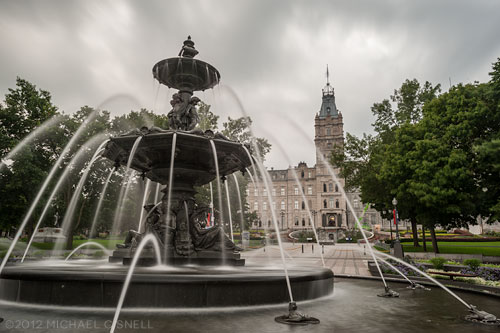
A little grey overall but it was early yet and I knew from experience that even grey skies can go cobalt blue for a few, short minutes at twilight. Patience.
A couple of other details for you photographers: I wanted not only the fountain’s water to blur but also the clouds, which were moving fairly quickly. To achieve this before darkness, I stacked my ND filter and my polarizer to cut down as much light as possible. I stopped down mostly around f/11 or f/16 because I find this lens (my Nikkor 17-35mm) to be sharper in that range than it is all the way down to f/22. That first shot was 5 seconds at f/16.
Here’s a shot from a bit later in the evening around 7:48 — 30 seconds at f/22 (I accepted the loss of sharpness for more blur on this one):
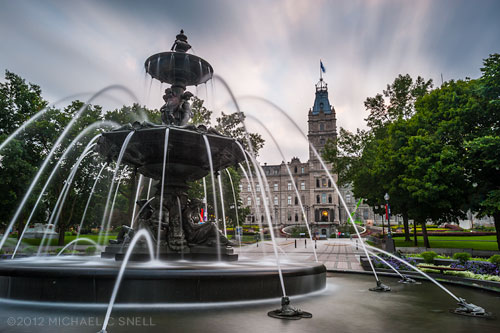
You can start to see the cloud effect in this one. I kept firing a shot off every few minutes, whether it looked like anything had changed or not. I tried some shots with traffic blurring in the background, while on other shots I tried to avoid any cars at all by taking advantage of the nearby traffic signals.
Right around the time of that last shot, this guy shows up:
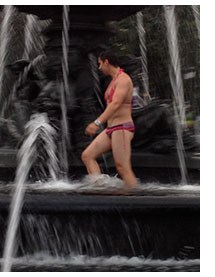
I have no explanation. A group of guys had wandered up with “protest” signs in French, so I had no idea what they said. Then this guy then strips down to his… bikini (mankini?)… and proceeds to strut around in the fountain while all of his buddies video-taped him. Okay, to be honest, I shot some video on my iPhone as well. What are you supposed to do when something like this happens?!? His friends seem thrilled with his performance and were shouting and cheering and egging him on.
Huh. Luckily he didn’t stay around long enough to ruin any of my long exposures during the fleeting prime light.
This is the kind of thing that could easily distract the amateur photographer. But, as a consummate professional (ahem!), I took it all in stride. I shot my little video to share with friends later, and returned my thoughts to the task at hand. There would be time to ponder this moment later. Strange as it may seem, this isn’t the craziest thing I’ve encountered on a shoot.
I’m starting to get a little color in the sky at this point and there are even occasional cloud breaks and patches of blue. Happily most of the breaks occurred right about sunset time, giving some really nice color for just a brief period of time:
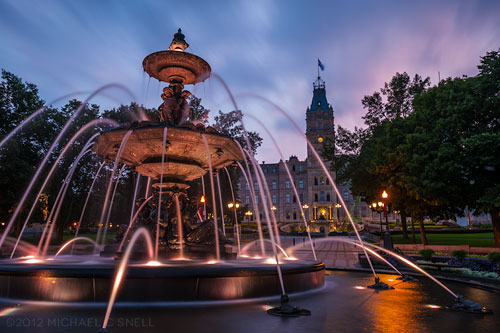
That’s about 8:03, 13 seconds at f/11. The fountain lights were coming on just as the sky was getting nice. I’m liking the balance here. But there’s still more to come. Little by little more lights come on. I notice the floodlights on the front of the parliament building come on extremely green at first but, after they “warm up” a bit, they gradually become a more pleasing tungsten-like color. A good reminder to not pack up too early but to wait and see what happens with time.
During all of this time I played with different apertures and color balances. The latter is mostly just to experiment in-camera. I can easily change the white balance later in Lightroom but it’s interesting to see the changes it makes in such a mixed bag of color temperatures while on location. I tend to like a fluorescent balance on the camera’s screen but I do still tweak it considerably later in Lightroom. Here’s where I was at by 8:24 (30 seconds at f/8):
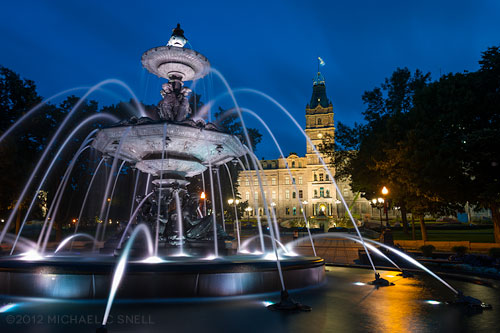
This is closest to the shot that I had pre-imagined, but I now actually like some of the earlier shots better. Even with the cloudy sky, I knew I had a good shot at getting that cobalt blue color after sunset (which contrasts nicely with the warm artificial light on the building), but the earlier pinks and purples in the sky were an unexpected treat.
In the end, that’s about an hour of actual shoot-time but it yielded quite an array of looks. Some of the early, grey shots might make really dramatic black and whites, while I have three or four pretty different twilight looks that might each appeal to different buyers when these get into the stock libraries.
Not bad for an evening’s work.
Old Quebec
I’ve been back in the office for a week now after spending some time working on stories and generating stock images in eastern Canada and Maine. It’s a region that I can go back to again and again without ever tiring of photographing it. This time I went “old school” by leaving all of my images on the CF and SD cards until returning home. It was almost like shooting film again when you wouldn’t get your images back from the lab for days or even weeks after a shoot. Of course, I had the advantage this time of being able to check shots on the camera’s screen to make sure I was getting what I thought I was getting but, once the cards were swapped out for fresh ones, I didn’t see the images again until I was back in the office and had them imported into Lightroom.
I don’t want to continue to work this way. I much prefer backing up to multiple portable drives while on the road just in case something gets lost or corrupted. But this is the way we always worked with film, wasn’t it? You never had back-ups until you had dupes made at the lab much later. With all the worry about image back-up these days I marvel at how we would ship rolls and rolls of film to the lab, crossing our fingers that there would be no problems in development and wondering if the package would make it back home safely.
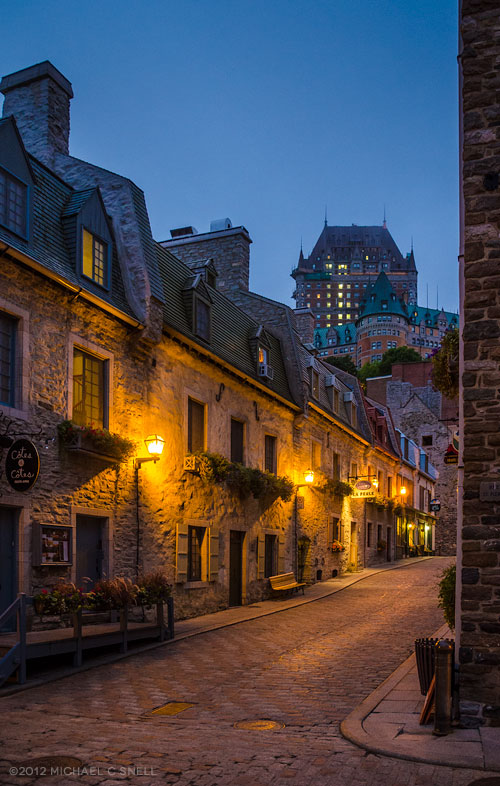
Anyway, I digress. This past week has been a little bit of a reminder of those wonderful days when the film would come back from the lab and I’d pour over everything with a loupe on the lightbox, finally seeing what I’d managed to capture. Not having downloaded any of these images onto the laptop while traveling, I didn’t know what I really had until the first pass reviewing them in Lightroom this week. And the images didn’t disappoint. I’ll share more as I continue to fit the post-processing in around other work but, for now, just this one from the Lower Town of Old Quebec City with the Fairmont Le Chateau Frontenac standing tall in the background.
More to come…
New Orleans revisited
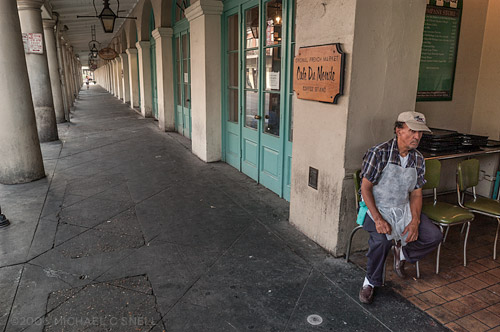
Now that I’m running both Lightroom 4 and Photoshop CS6 (if only in beta), I’m going through old files to see what the new software can do for some images that I never quite felt were finished. Back in the days of the darkroom, it was a good idea to work a print and then set it aside for a time before coming back to it, reassessing, and trying some new ideas. That’s basically the way I treat digital files as well. I process them almost immediately after capturing them, but I like to come back later to take a fresh approach. These files from New Orleans are from 2006, less than a year after Katrina hit. We made the visit with a group of journalists at the invitation of the tourism bureau to help get the word out that the main tourist areas were largely unaffected and open for business. The impact in tourism numbers was very evident, however, in the quiet streets and restaurants.
In reprocessing these images, I tried to focus on that quiet feeling of a nearly abandoned city. The texture of New Orleans also comes through. It’s an old city by American standards and after all that it had been through it seemed to be feeling its age. I look forward to my next trip there, to see what has changed in six years.
Tee Pee Junction
Abandoned places
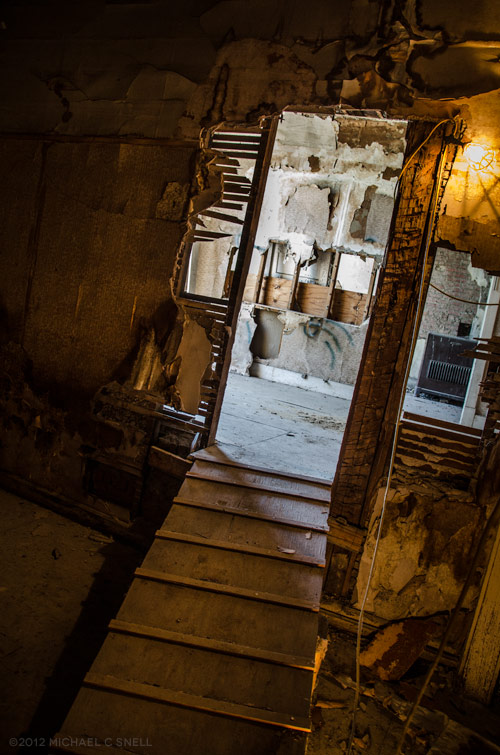
Call me weird, but there are few things I enjoy more than rooting around in abandoned buildings. The layers of history and questions that arise from strange additions and alterations — it’s fascinating. Earlier this week I got a quick peek at the building above. But this isn’t just any old, decaying building. It’s believed that this is the very second-floor room (it was originally one big open room with no dividing walls) where forty elected delegates from the Kansas Territory gathered to write the Free State Constitution in October of 1855. In fact, it may be the first permanent building constructed in Topeka, Kansas.
This was a quick scouting trip and I hope to return soon to further document the building in this condition — basically abandoned since the 1940s — and throughout its proposed restoration. More to come…
Flint Hills Discovery Center
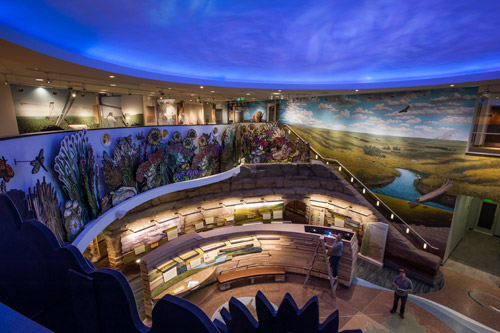
As members of the media, we were given a sneak peak of the new Flint Hills Discovery Center in Manhattan, Kansas on Thursday morning. The area’s tallgrass prairies are often taken for granted so this is a welcome addition to the scenic byway, Tallgrass Prairie National Preserve and scenic overlooks that have brought more understanding of this vast natural resource over the past few years. The Flint Hills have long been a favorite region of mine and many other Kansans, and now it’s great to have a place to point people to where they can learn more about what makes them so unique and special.

Above: Techs fine-tuning the ceiling projectors in the lobby of the new Flint Hills Discovery Center.
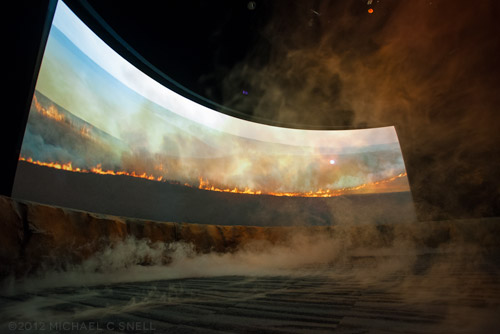
The opening of the Flint Hills Discovery Center is set for April 14th. While you’re there, be sure to check out the film in triple-wide high definition. The addition of breezes and fog put you right in the hills during the Spring burning scenes:
Roaming the rooftops
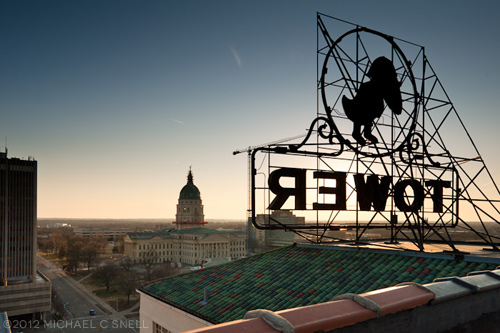
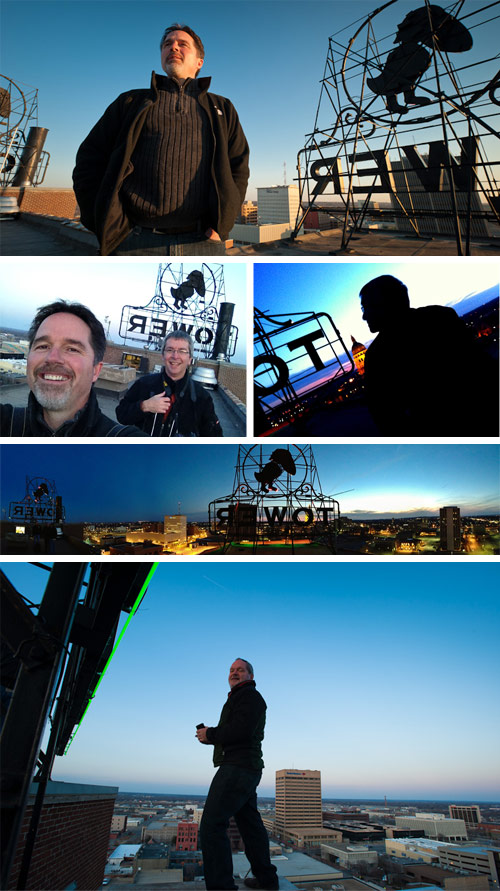
If there’s one thing I love, it’s getting access to a new vantage point and finding a new angle on a familiar photo subject. Having lived in Topeka, Kansas, for a much of my life, there are a lot of familiar subjects around but not that many new angles. So when my friend Doug Stremel mentioned that he and fellow Gizmo guy, Jeff Carson, were heading up to the top of the old Jayhawk Tower Hotel building the other night, I made sure I got myself invited along.
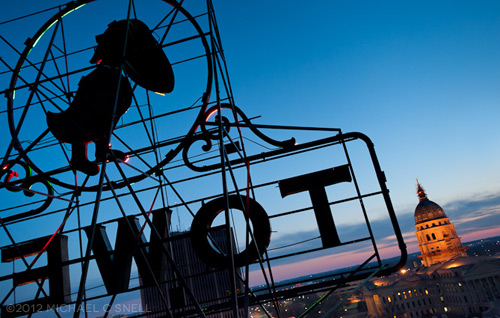
I grew up seeing those neon Jayhawks glowing over downtown Topeka. Next to the Capitol building itself, the twin birds might be most recognizable elements of the Topeka skyline. I’ve been in the building many times — way back when it was a hotel and more recently after its conversion to offices — but I’d never been on the roof before.
All-in-all, it was a great night. It’s always fun to hang around with Doug and Jeff but this was a particularly special evening. Thanks to them for letting me tag along and I hope to shoot with you both again soon. Or just drink beer. I’m pretty flexible. Thanks, too, to the folks at the Jayhawk Tower for letting us on their roof.
Here are a few behind-the-scenes shots — some are mine, others are courtesy of Jeff and Doug, the Gizmo guys:
Lightroom 4 beta in the real world
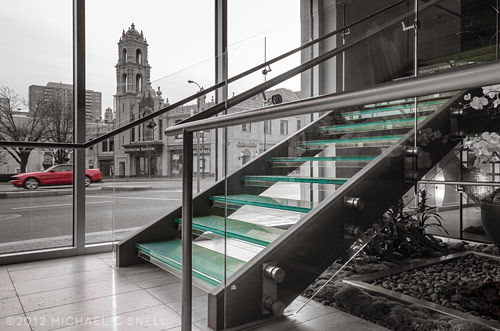
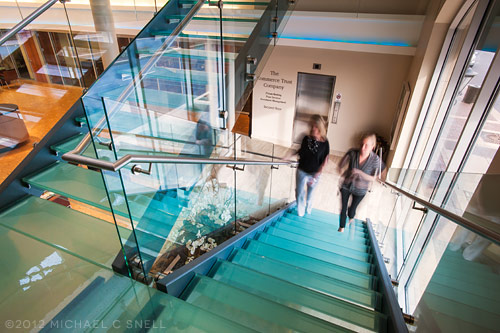
I had an architectural interior shoot this week that provided me the perfect opportunity to put the Lightroom 4 beta through its paces in a real-world situation. Much as I would love to move my entire collection over to LR4 right now, it is still only in beta. The prudent thing is to wait until the official release and, in the meantime, just test some duplicated files that don’t risk anything if there is a problem. But this was an isolated shoot that I could easily break out of my catalog and wouldn’t cause any real harm — even if I ended up having to reprocess it entirely at some point down the road.
As I’ve mentioned before, there is some relearning to be done between LR3 and LR4. There were a few times that I found myself moving the black slider to the right, expecting my blacks to get darker and momentarily being surprised to see them get lighter. When I think about it rationally, though, it does make more sense having all the main develop sliders zeroed out at their centers so that they all react the same way when moved right or left. After an hour or so, it was all feeling very natural and I imagine I’ll be messing up in reverse when I go back to Lightroom 3 now.
A few things really stood out to me in this experiment. First, Lightroom 4 beta just seems to handle major adjustments much better than previous versions. I was able to pull highlights back much further than it seemed I could before, and the result looked more natural. The situation I was shooting in was extremely contrasty. It was a fairly dimly lit interior and outside there was a thin layer of clouds that gave the sky that intense white that is always difficult to hold. Because of this, I was shooting 3 to 5 images bracketed, thinking that I’d most likely have to use some HDR techniques to keep detail in both the sky and the darker areas of the interior. As it turned out, I was able to manipulate the middle image of the bracket alone — in every case — using only Lightroom’s exposure, highlights and shadows sliders. I never had to resort to using the under- and over-exposed versions to make an HDR image.
Another feature of the Lightroom 4 beta that I found extremely useful was the ability to adjust the white balance of graduated and spot adjustments. Take the photo above — the left side was a darkish, tungsten-lit interior that was very warm. The light coming in through the windows at the right was very cold due to the cloud cover. The result was an image that shifted drastically from warm tones on the left to much cooler tones on the right. By adding a graduated adjustment on the right that had a warmer white balance, I was easily able to even the scene out.
I’m already totally invested in this new version of Lightroom and am eagerly looking forward to its full release. The new processing engine alone is worth the cost of an upgrade to me and the new features will be a fantastic bonus.