Category Archives: technique

Shooting tethered

130323robot_sotc

It’s snowing outside so I’m playing indoors today.

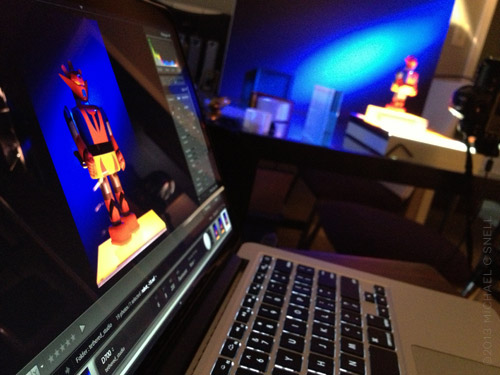
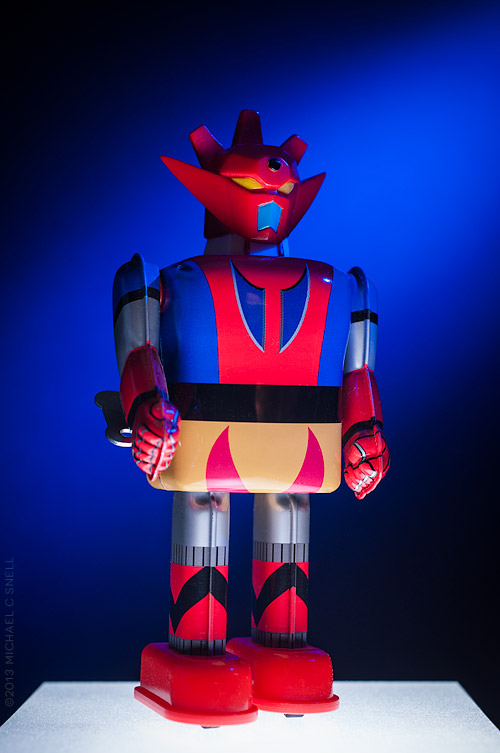
I’ve been setting up my new 13″ Retina MacBook Pro and ran across an article about shooting tethered in Lightroom 4. I thought I’d give it a try, even though I only do a small amount of studio photography compared to field work. For some reason I always thought that tethering would be a lot more involved than it turned out to be. In fact, all I needed was a USB cable to connect my Nikon D700 to my MacBook. Turn on the camera and open Lightroom and, under the “file” menu, you can initiate tethering. Lightroom found the camera automatically and in no time I had a little toolbar added to my Lightroom interface that showed my camera settings: shutter speed, aperture, white balance, etc. Here’s a glimpse of the setup:

130323robot2_sotc


The Lightroom toolbar has a shutter button so you can fire the camera from the laptop. Hit the button and the camera makes an exposure that is immediately transferred to the laptop and opened for review right there in Lightroom.

I know. Lots of photographers have been doing this for years and it’s nothing new, but it was a revelation how easy it was to set for a first-time user like me. I’m reminded of the first time I realized that my Nikon had a built-in intervalometer for shooting time-lapses. More and more often, features that used to be costly added expenses are now built into modern gear, although sometimes they’re not heavily promoted. It pays to noodle around a bit every now and then to see what wonders are hiding in those electronics.

You know, I was thinking that this tethering feature wouldn’t be all that useful in the field but, now that I think about it, it could be extremely handy when doing things like night photography. I know when I was shooting the Milky Way in western Kansas last summer, it would have been nice to have had a way to be able to check exposure and focus during the shoot better than I was able to do on the camera LCD. The USB cable travels with me anyway, so this capability comes at no extra expense, weight, or bulk. Just the kind of thing I like.

The River

130111riverblu_sotc

I evidently hibernate in winter (my last post being nearly a month old now), but my friend and fellow photographer, Doug Stremel, and I ventured out early Wednesday morning for a day filled with finding images in the winter Kansas landscape. It’s a season that I don’t shoot enough but am striving to photograph more often. Winter was the favorite season for my college painting instructor, Robert Sudlow. I remember him once telling me that he had difficulty painting Kansas landscapes in summer because it was just “too green”. He found more subtlety and variation on those grey, overcast days when the snow was melting away. I’m understanding the beauty of that subtlety more and more myself as I continue to update my Kansas image files.

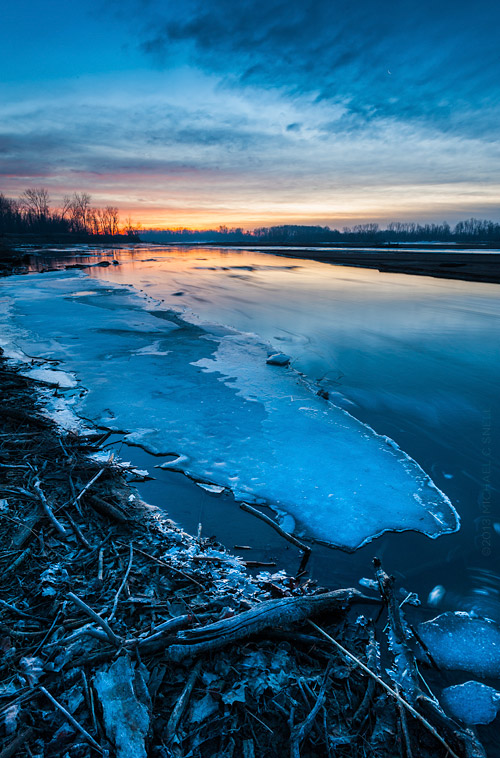
A different destination drew Doug and I out on Wednesday (more on that in the next post) but it wasn’t in a place that would work well at sunrise so we looked for another, nearby spot to take advantage of first light. Since water effectively doubles your sunrise impact by reflecting the colors, we headed for the Kansas River. Hiking down to the water’s edge in near total darkness provided its own challenge, but it was worth it when the light came up to reveal the melting ice flows. We heard them before we could see them, crashing into one another as they drifted downstream.

The shot at the top of this post is, I believe, the second frame I’ve shot in 2013.

130111sunrise_sotc

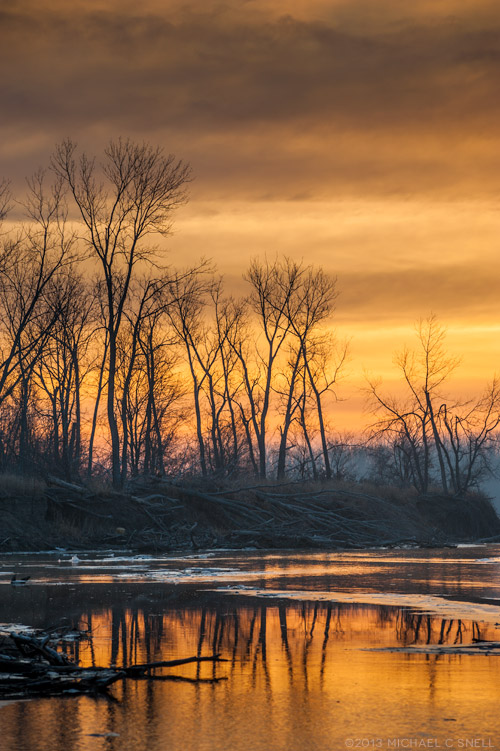
As the sun rose, the colors shifted dramatically and offered a fantastic range of photo options. The following photo was taken about 35 minutes after the first and both are fairly true to the actual colors we were seeing.

130111rivergold_sotc

This is also an HDR shot (High Dynamic Range) assembled from three separate bracketed captures spanning six stops. The process allowed me to get a much wider range of contrast into one image, something that was more and more necessary as the sun rose higher — getting brighter — while the foreground shadows remained very dark. I don’t like to push HDR as far as some do to get that other-wordly effect that so many relate to the process but, instead, I like to use it to get closer to what the scene actually looked like to my eye at the time of capture.

130111ice_sotc

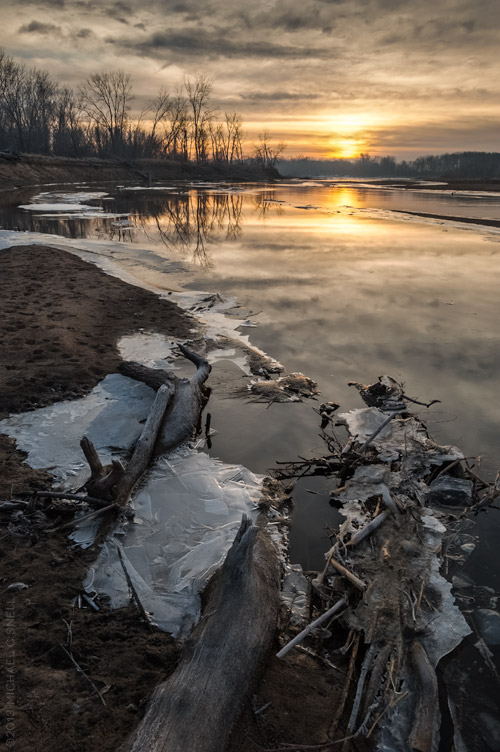
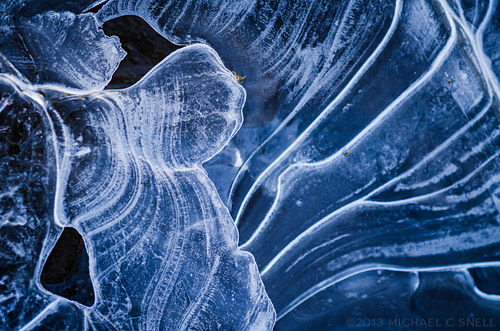
There were also plenty of options for detail shots of the melting ice along the river bank. All-in-all, a good start to the day, and a great start to 2013. I’ll continue with more of Wednesday’s locations in the following post.


Fort Scott Candlelight Tour

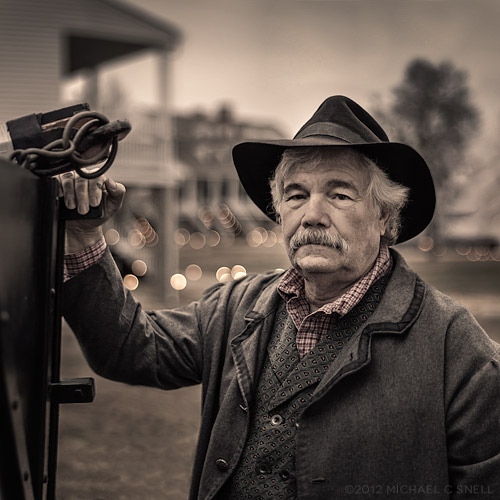
I paid a quick visit to the Fort Scott National Historic Site in Fort Scott, Kansas, last night to photograph their annual candlelight tour. The shot above is something I’ve been playing with lately — creating shallow depth of field images by stitching together multiple frames from a fast normal, to short-telephoto, lens. This one is 13 frames shot on a 50mm lens at f/1.8 and stitched together using Photoshop CS6. It’s an interesting look and reminds me a bit of the old large-format images that might have been made in the late nineteenth century. It seemed appropriate for an evening devoted to recreating the year 1862 on a frontier fort in what had then just become the state of Kansas.

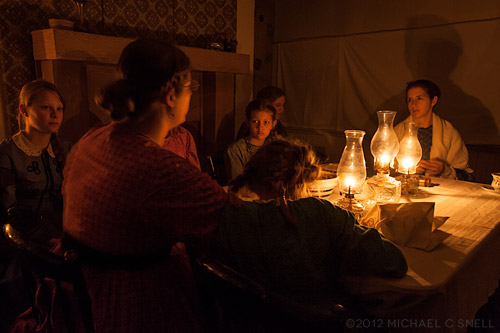
More (single frame) images from last night:

Shooting stars

In yesterday’s post I promised to provide some insights into last Wednesday’s night shoot at Monument Rocks in Western Kansas. It’s a different animal, shooting in near total darkness, and takes some getting used to. I learned a lot last week and I look forward to my next opportunity to improve my process.

None of the images in this post have had huge adjustments made in post-processing. White balance was probably the biggest challenge — especially when getting into mixed light sources — but I’ve decided not to get into localized color changes and instead go with how the camera recorded the images.

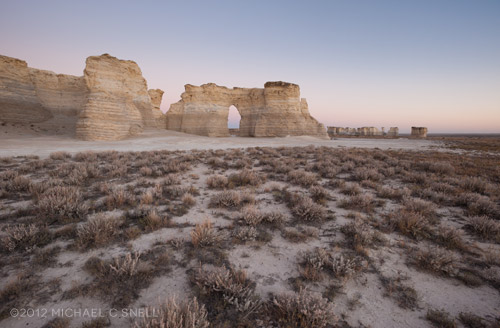
But first things first: if you’re not familiar with Monument Rocks, it’s an area of the high plains of Western Kansas that used to be the bottom of a vast ocean millions of years ago. Eons of erosion have left behind spires of chalk that stand up to 70 feet above the mostly flat surrounding landscape. According to Wikipedia, this was the first region to be designated a National Natural Landmark by the US Department of the Interior.

But why try to describe it when you have photos? Here’s what it looked like just after sunset last Wednesday:

The rocks are also remote enough that there wasn’t a lot of light noise from nearby towns to cause problems with our attempts at night photography. I think the nearest town is at least 20 miles away. We could see a few lights from surrounding farms and ranches, but they didn’t cause huge problems. The stars where clearly visible in the millions, but I do think that the color shifts that I observed in some of the shots may have come from artificial light bouncing around in dust that was being carried in the slight breeze. It was a far calmer night than I had ever experienced at Monument Rocks, but it has been an extremely dry year and the dust was very fine and easily made airborne.

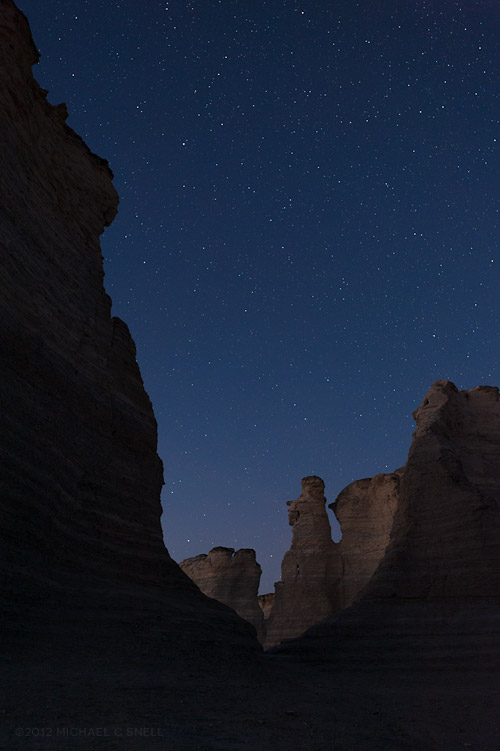
After the sun went down, it didn’t take long for stars to appear and be bright enough to photograph. In this shot, there is still a fair amount of ambient light in the sky and the rocks are still being lit slightly by the dying light of the sunset:

To the eye, it was fairly close to total darkness at this point but the camera could still draw quite a bit of light from the scene. I tried to keep all exposures shorter than 20 seconds, or 30 at the most, in order to keep the stars from streaking due to the earth’s rotation. Focusing was a bit of a trick since many modern auto-focus lenses don’t behave quite like old manual lenses did. On the old lenses, you could often just rack them all the way to infinity and you’d be fine, but with some earlier testing on my 17-35mm Nikkor that I used for these shots, I noticed that I had to pull it back a bit to get things sharp when focussing manually. I’d made a note of where the focus point needed to be on the lens markings and just used that once it was too dark to visually attain focus anymore.

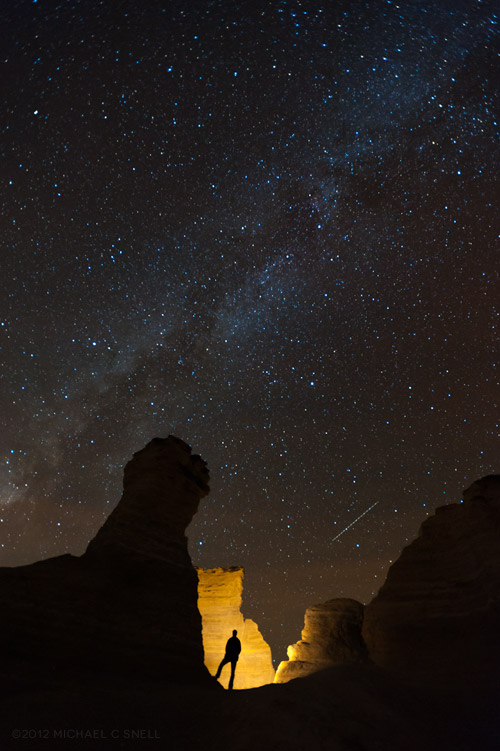
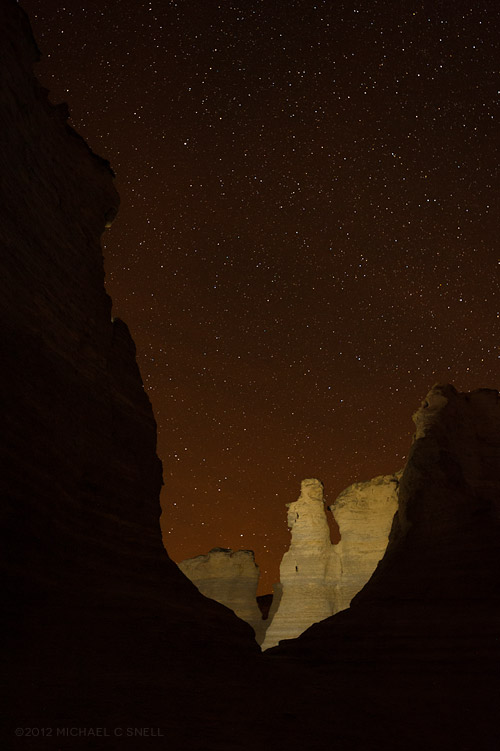
As it got darker still, I started experimenting with adding some light painting. This was done with a variety of sources but the two I found that worked best were 1.) a small, hand-held flood that I picked up at a hardware store for less than $20 and 2.) an even smaller Maglite that I tend to keep in my camera bag to help me locate things in the dark on night shoots such as this. It was this small Maglite that was used in the shot at the top of this post. One of my fellow photographers stood in to give some scale to the scene and also used my Maglite to “paint” the distant rock during the exposure. The hardware store floodlight was used on the following shot:

The light was far too bright when pointed directly at the rocks so I used the silhouetted rock in the foreground as a giant bounce card. I walked around the foreground rock and set the floodlight on the ground, propped but by a small rock, so that it pointed away from the rock I wanted lit. The beam hit the back of the rock that you see in silhouette here, and the light bounced back to illuminate the more distant spires. The redness of the sky is what I believe is coming from some light from surrounding towns and farms refracting in some airborne dust. My best guess anyway.

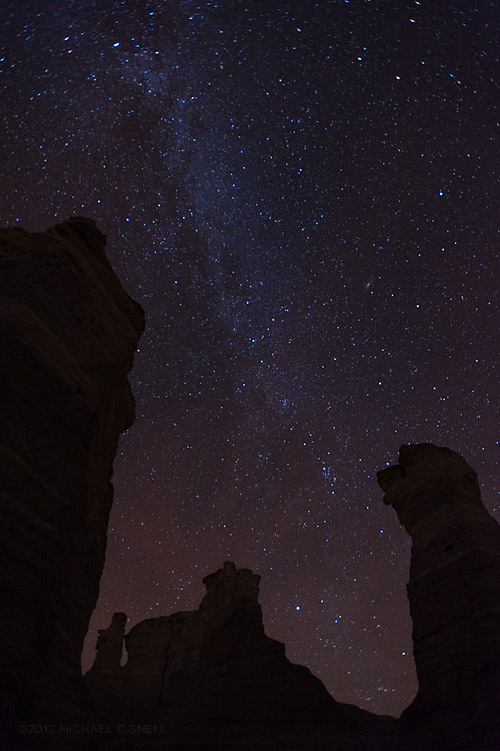
I found that when shooting with a 17mm lens (on a full-frame D700), 20 seconds was indeed about the limit of what an exposure could be before stars began to streak. Twenty seconds or less kept them more or less as pinpoints. To achieve this, I generally shot wide open at 2.8 and used ISOs to control the exposure. By the darkest point in the night I was shooting at ISO 1600. I was surprised to not have to go higher, but relieved that I didn’t need to deal with more noise from even higher ISOs. As it was, these shots required very little noise reduction in Lightroom.

The following night we shot more night skies, including one 15 minute star trail exposure. I’ll share some of those images in later posts.

Billions of stars

I’ve been out shooting in Western Kansas with the Gizmo guys the last few days and we took advantage of a cool, clear night at Monument Rocks to try some night photography of the Milky Way. I’m just getting started on the post-processing and haven’t quite settled on what feels like the right white balance, but I thought I’d go ahead and share this one with you now. It’s amazing how much you can capture digitally in such dim light. I’ll share more later, with details on exposure, some light painting experiments, etc.

Fountain shoot, behind the scenes

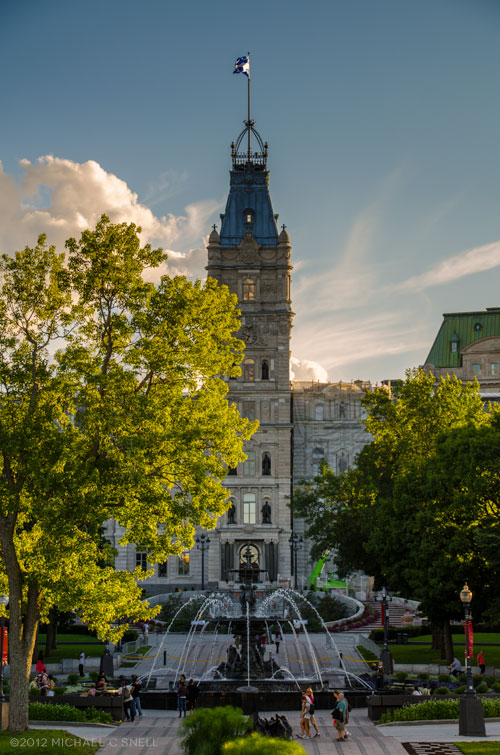
On my last trip to Quebec City in 2007, I never had an opportunity to get a good shot of the Fontaine de Tourny, located in front of the Parliament Building. The fountain was brand new at that time — if you can call something new that was built in France in 1855, put in storage in 1960, and relocated to Quebec in 2007. You can find the whole story here.

Anyway, it’s one of those shots that I felt should be in my files because the fountain has such a great story and it is rapidly becoming yet another landmark of this already beautiful city. So… when I went back to Quebec last month, this fountain was high on my shot list.

I captured the above photo on my next-to-last day in town but it’s not the one I originally had in mind. I really wanted a shot that made the fountain the hero and included the Parliament Building as context. I also wanted to shoot at twilight to get the most impact from the color in the scene.

Early on my first free evening in Quebec I set out with my D700 and a tripod and began scouting out my angle. Things are rarely perfect and this day would be no different. It was cloudy, first of all. Not puffy, dramatic clouds but heavy, overall grey clouds that pretty much made for a dead sky. Grey sky, black fountain, stone building. Not a lot of color so far. Still, you never know what will happen and twilight can be magical in any weather. Secondly, I found that half of the Parliament Building was covered in scaffolding and there was a big, lime-green crane right in front. Scaffolding had been everywhere on this visit — even the most prominent element of the Quebec skyline, the Fairmont Le Chateau Frontenac, was getting a new copper roof. The Parliament Building I could work with, though. It just took a little finesse to hide of the bulk of the scaffolding behind trees and hopefully the green crane would disappear as night fell.

Here’s my initial exposure at 7:29 with the composition pretty much established:
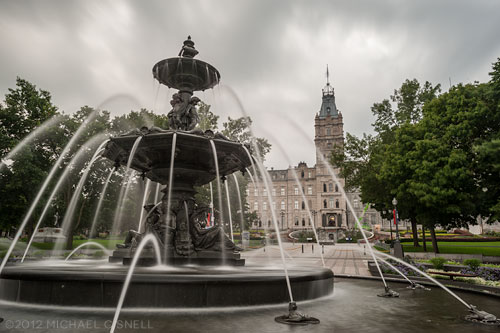
A little grey overall but it was early yet and I knew from experience that even grey skies can go cobalt blue for a few, short minutes at twilight. Patience.

A couple of other details for you photographers: I wanted not only the fountain’s water to blur but also the clouds, which were moving fairly quickly. To achieve this before darkness, I stacked my ND filter and my polarizer to cut down as much light as possible. I stopped down mostly around f/11 or f/16 because I find this lens (my Nikkor 17-35mm)  to be sharper in that range than it is all the way down to f/22. That first shot was 5 seconds at f/16.

Here’s a shot from a bit later in the evening around 7:48 — 30 seconds at f/22 (I accepted the loss of sharpness for more blur on this one):
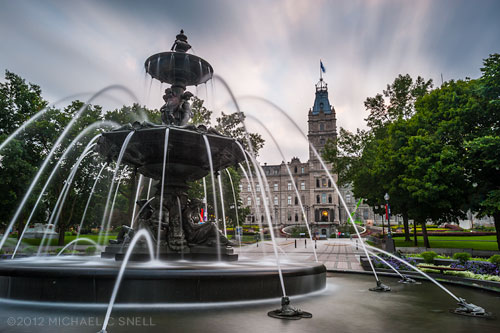
You can start to see the cloud effect in this one. I kept firing a shot off every few minutes, whether it looked like anything had changed or not. I tried some shots with traffic blurring in the background, while on other shots I tried to avoid any cars at all by taking advantage of the nearby traffic signals.

Right around the time of that last shot, this guy shows up:
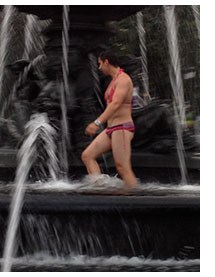
I have no explanation. A group of guys had wandered up with “protest” signs in French, so I had no idea what they said. Then this guy then strips down to his… bikini (mankini?)… and proceeds to strut around in the fountain while all of his buddies video-taped him. Okay, to be honest, I shot some video on my iPhone as well. What are you supposed to do when something like this happens?!? His friends seem thrilled with his performance and were shouting and cheering and egging him on.

Huh. Luckily he didn’t stay around long enough to ruin any of my long exposures during the fleeting prime light.

This is the kind of thing that could easily distract the amateur photographer. But, as a consummate professional (ahem!), I took it all in stride. I shot my little video to share with friends later, and returned my thoughts to the task at hand. There would be time to ponder this moment later. Strange as it may seem, this isn’t the craziest thing I’ve encountered on a shoot.

I’m starting to get a little color in the sky at this point and there are even occasional cloud breaks and patches of blue. Happily most of the breaks occurred right about sunset time, giving some really nice color for just a brief period of time:
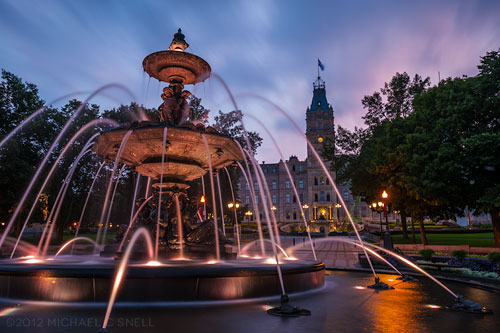
That’s about 8:03, 13 seconds at f/11. The fountain lights were coming on just as the sky was getting nice. I’m liking the balance here. But there’s still more to come. Little by little more lights come on. I notice the floodlights on the front of the parliament building come on extremely green at first but, after they “warm up” a bit, they gradually become a more pleasing tungsten-like color. A good reminder to not pack up too early but to wait and see what happens with time.

During all of this time I played with different apertures and color balances. The latter is mostly just to experiment in-camera. I can easily change the white balance later in Lightroom but it’s interesting to see the changes it makes in such a mixed bag of color temperatures while on location. I tend to like a fluorescent balance on the camera’s screen but I do still tweak it considerably later in Lightroom. Here’s where I was at by 8:24 (30 seconds at f/8):
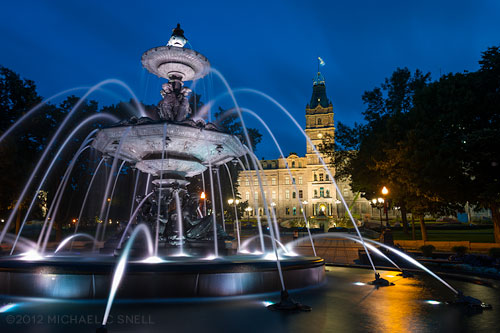
This is closest to the shot that I had pre-imagined, but I now actually like some of the earlier shots better. Even with the cloudy sky, I knew I had a good shot at getting that cobalt blue color after sunset (which contrasts nicely with the warm artificial light on the building), but the earlier pinks and purples in the sky were an unexpected treat.

In the end, that’s about an hour of actual shoot-time but it yielded quite an array of looks. Some of the early, grey shots might make really dramatic black and whites, while I have three or four pretty different twilight looks that might each appeal to different buyers when these get into the stock libraries.

Not bad for an evening’s work.
more from the rodeo

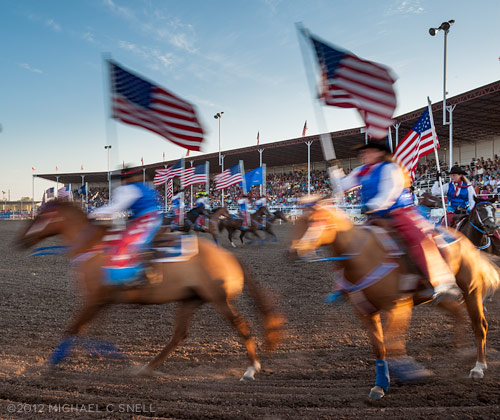
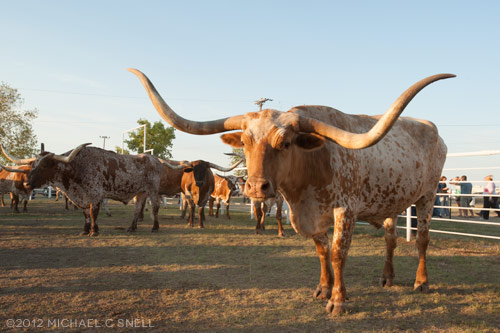
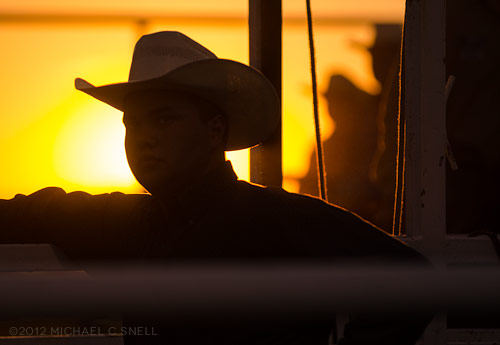
I’m sharing a few more shots from last saturday’s rodeo in Phillipsburg, Kansas. As the biggest rodeo in the state, it’s quiet a show and the grand opening alone is worth the price of admission. I got there early and tried to scope out a good vantage point and settled on this area at one end of the arena where I could shoot through a livestock gate and get views of both the chute and the stands with a nice long throw down to where these riders with their American flags would make their entrance.

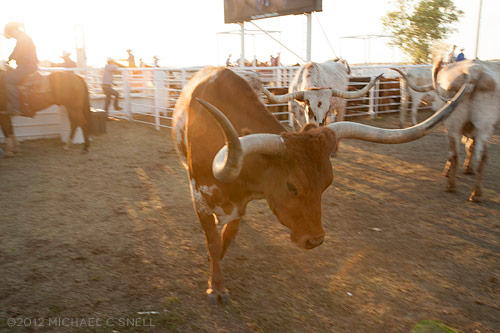
I’d been shooting the beginnings of the grand opening when I turned around and realized I was no longer alone in my little shooting space. In fact, the spot I had chosen was the pen where a few dozen of these longhorn cattle were being prepared for their entrance during a later portion of the grand opening:

Happily, they seemed willing to share the area with me although they did seem to be extremely curious about my cameras. I was carrying two bodies and, as I would shoot with one, the braver of the longhorns would come up to give the other Nikon a good sniff. There was plenty of drooling going on as well (on their part, mostly) but I managed to get through the evening without it finding its way onto my gear.

It did end up being a very versatile location from which to shoot. One that I would be eager to make use of next time I find myself at the rodeo. Even if I do have to share it with these fellows again.

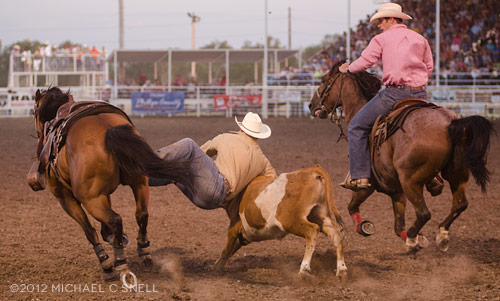
A few more from Saturday:

fast action and slow shutters

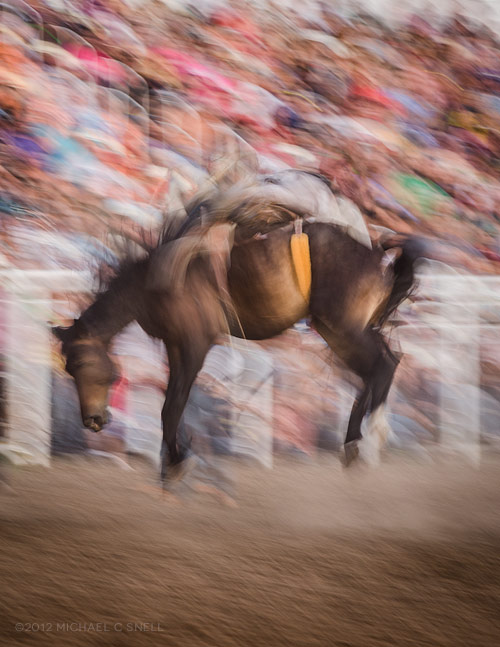
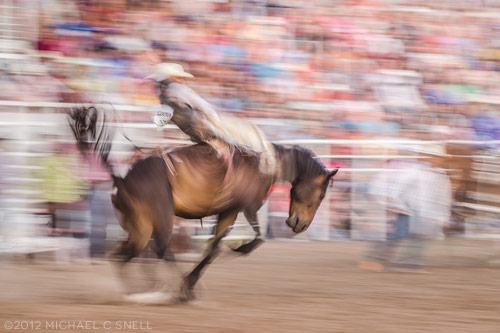
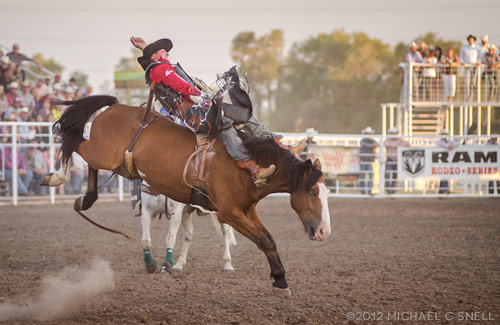
An assignment in Phillipsburg, Kansas over the weekend gave me a chance to catch the rodeo on Saturday night. Always a fun thing to shoot, this time I thought I’d experiment a little with slow shutter speeds to better capture the action. The image at the top of this post was made at 1/10th of a second. For comparison, here’s another shot made at 1/1000th of a second:

Each has it place but I really like the abstract nature of the blurred shot. To me it’s an image that is less about that particular rider and is more about the excitement and action of the overall event.

More to come…

Midsummers Festival, Lindsborg, KS

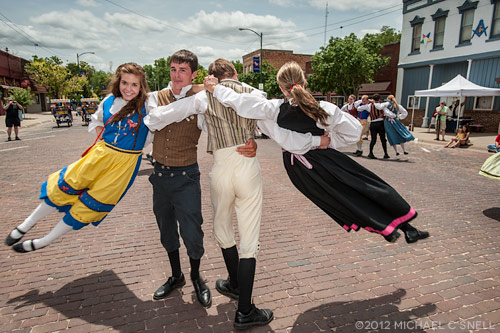
I spent part of last saturday shooting the Midsummer’s Festival in Lindsborg, Kansas — also known as Little Sweden, USA. I love Lindsborg’s festivals but I hadn’t shot this one since back in my film days so I was long overdue for a return.

The dances on Main Street have always been great for photos and I decided to shake it up a bit and use some flash to try and overpower the sun a bit. I didn’t want an unnatural look but was hoping to underexpose the bright skies in the backgrounds to pop the foreground dancers out with the flash. I had totally forgotten about this particular dance (above) where the men swing the women completely off their feet as they spin round and round. It doesn’t last long and I was happy to find myself in a fairly decent position when it happened.

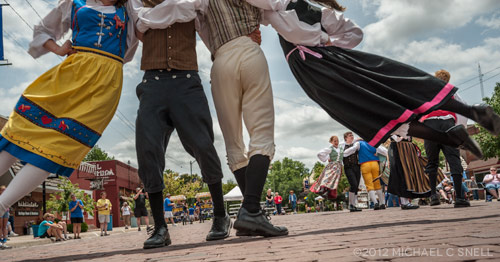
It actually happens twice in this particular dance and for the second time, I decided to try and shoot from a very low angle — basically shooting blind with a wide angle held right down on the brick street. My aim was not perfect, however, and I cropped the heads off of the dancers in nearly every frame. That’s one of the main rules of photography, right? Don’t crop heads off. Well, the more I looked at these shots, the more I thought there was still something there. I cropped a bit more, dodged and burned to redirect the eye, and ended up with this:

Would I have shot it this way purposefully? Probably not. But I now consider it a happy accident. When viewed large, there are some great expressions on the dancers faces in the background on the right side. They actually become the subject and the foreground dancers become more of a frame. I’m liking this shot more each time I look at it.

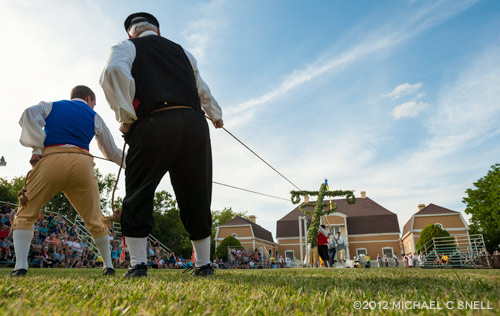
Here are a couple more from the raising of the Maypole. Many thanks to Jim Richardson who was kind enough to wander over before the proceedings and give me a little preview of what would happen. Jim’s a great and generous photographer. If you ever find yourself in Lindsborg, be sure to look up his Small World Gallery on Main.

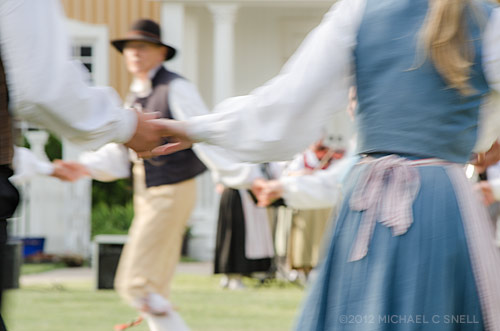
And one last telephoto shot, intentionally blurred for a little movement:

I think my comments are still non-functional here so if you want to leave a note, I’ve also shared this post on Facebook.

Unintended portrait subject

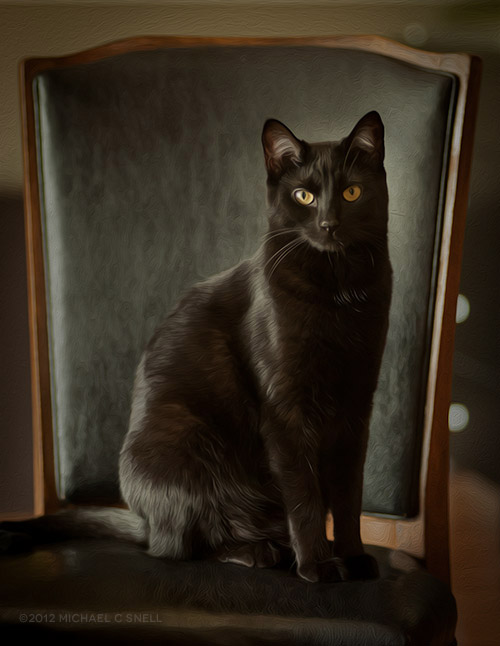
Sorry. I usually try to avoid posting cat photos (the interwebs seem full enough of them already) but this one has a story behind it. My wife/business partner needed a new headshot and, as I was setting up the lighting, our cat Piña decided to make herself available as a stand-in while I got everything situated. She was a real pro. She hopped right into the chair and waited patiently as I made test shots, adjusted lights, etc. until everything was set for the real shoot.

I liked this shot in particular because it feels so formal. I added a bit of an oil-painting filter just to push it a bit further into the realm of those thoroughbred horse portraits. I think it would be perfect in a gilded frame, hanging above a cherry wood humidor full of Cuban cigars.